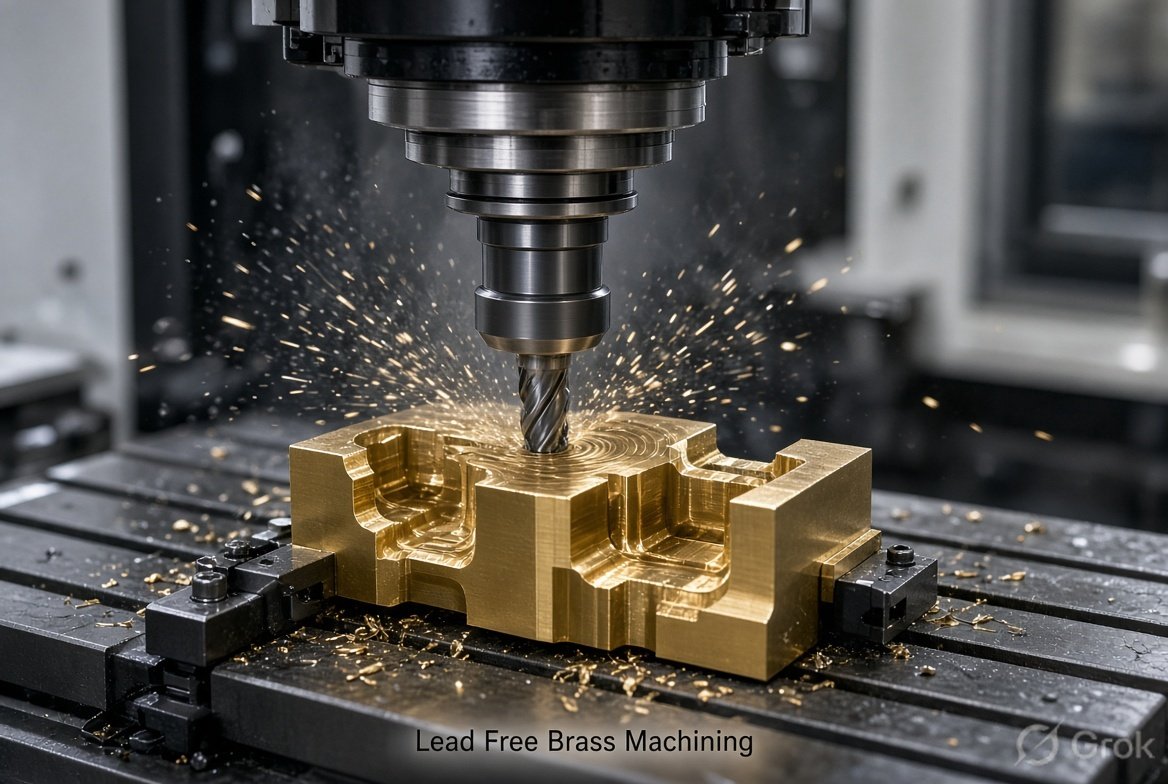
Lead Free Brass Machining and Lead Free Brass Machined Parts -Why use them
Lead free brass machining is increasingly part of the conversation when engineers specify valves, fittings, sensor bodies and precision turned components. The aim is to reduce lead in the selected material while retaining the practical benefits of a copper alloy. Success depends on choosing a defined grade and proving that the finished part meets its service requirements.
“Lead free brass” describes a requirement, not a single alloy. Two materials sold under that description can behave differently in cutting, forming, corrosion and electrical service. Buyers therefore need more than a trade name on a quotation.
Why use lead free brass machined parts?
The first reason is a product or customer requirement that limits lead. This can influence the choice of material early in a new design, or trigger a controlled change to an existing component. A second reason is purchasing consistency: a business may prefer one qualified low-lead material for a family of parts, provided it meets every application.
Reducing the lead content of the starting alloy also reduces the lead introduced through that material into production and recycling streams. It does not eliminate the need for normal controls for chips, dust, cutting fluids and material handling. The practical benefit should be assessed alongside manufacturing performance and the intended use.
What does “lead free” actually mean?
The applicable definition depends on the destination and product. For example, US drinking-water rules define lead free for relevant pipes, fittings and fixtures using a maximum weighted average of 0.25% lead across wetted surfaces. That is not the same as requiring every material in an assembly to contain absolutely zero lead. See the EPA explanation of the definition.
A material certificate alone does not establish that a complete plumbing product is certified for potable use. The EPA describes separate product certification requirements and limited exemptions in its lead-free plumbing compliance advisory. Specify the actual market and approval requirements before ordering.
An example: C69300 silicon brass
C69300 illustrates why a low-lead alternative is a material change rather than a simple label change. The Copper Development Association lists it as a copper-zinc-silicon alloy with a maximum lead content of 0.09%. Its listed uses include machined fittings, valve parts and sensor bodies. The same CDA alloy profile reports excellent hot-forming capacity but poor cold-working capacity.
This makes it a candidate to evaluate for suitable machined or hot-formed parts, not a universal replacement for all leaded brasses. Other low-lead alloy systems are available; the approved grade must match the manufacturing route and required finished properties.
Lead free brass alloys: grades, typical uses and parts made
The table below covers the principal commercial alloy families for machining, forging, forming and casting. It is a practical selection guide, not an exhaustive register of every national, proprietary or custom composition. Conventional low-residual-lead brasses and related casting alternatives are included and identified separately. Pb means lead; percentages are by mass.
Designations shown together are supplier cross-references, not a guarantee of identical specifications. Confirm the product standard, chemical limits, temper and material certificate. Parts described as candidates are illustrative applications to evaluate, rather than blanket approvals for that grade.
| Alloy / designation | Alloy family and lead limit | Typical use / manufacturing route | Example parts made or candidates for qualification |
|---|---|---|---|
| C69300; CW724R; JIS C6932 | Silicon brass (CuZn21Si3P); Pb ≤0.09% for C69300 | Machining and hot forging; plumbing, automotive and industrial service | Valve stems, fluid fittings, sensor bodies, nuts and pump parts |
| C69305; CW724R supplier variants | Silicon brass; specify the supplier’s certified Pb limit | Machining and forming; water-contact components | Fittings and valve components; qualify the selected condition |
| C69310; JIS C6931 (SnECO) | Tin-modified silicon brass; supplier lists Pb <0.09% | Machined rod components; corrosion-sensitive applications | Candidate fittings and valve parts requiring grade-specific approval |
| C69850 | Copper-zinc-silicon brass; Pb ≤0.09% | Machined and hot-formed components | Precision turned parts and fittings, subject to service qualification |
| C68370; CW726R (GloBrass / eco SZ2) | CuZn36Si1P; supplier Pb ≤0.10% | Machining and hot forging; general engineering | Threaded inserts, adapters and other turned or forged components |
| C68330; CW728R (eco SZ3) | CuZn40SiP; supplier Pb ≤0.10% | Machining and hot forging; engineering and electrical hardware | Candidate connector bodies, nuts and threaded parts |
| CW727R (CuZn35Sn1P) | Tin-phosphorus brass; supplier Pb ≤0.10% | Water fittings; machining and forming | Candidate plumbing connectors and valve components |
| CW729R (CuZn29Si1SnP / eco ST3) | Silicon-tin brass; supplier Pb ≤0.10% | Machining and hot forging; DZR water-contact applications | Candidate fittings and valve bodies |
| C27450; CW509L supplier products | Plain Cu-Zn plumbing brass; UNS Pb ≤0.25%; tighter supplier limits available | Machining and hot forging; plumbing and general hardware | PEX fittings, adapters, couplings and forged plumbing parts |
| C27451 | Phosphorus-containing plumbing brass; Pb ≤0.25% | Machining and hot forging; supplier-qualified DZR applications | Fittings and forged water-system components |
| CW511L; C27453 supplier products | Arsenic-containing CuZn38As brass; C27453 Pb ≤0.25% | Water fittings where dezincification resistance is specified | Candidate plumbing fittings and valve components; verify DZR condition |
| CW510L; C28500 supplier products | CuZn42; selected eco SZ4 supply Pb ≤0.10% | Machining and hot forging; general engineering | Candidate cable gland bodies, nuts, bushes and adapters |
| C27250 / C27550 | Carbon-containing Cu-Zn grades; Pb ≤0.009% / ≤0.04%, respectively | Specialist brass rod for qualified building and plumbing components | Candidate machined fittings; confirm supplier process and availability |
| C49100 | Tellurium-bearing high-copper brass; Pb ≤0.09% | Machining and forming; potable-water component applications | Valve bodies, faucet components and pipe fittings |
| C49250 / C49255 / C49260 | Bismuth-bearing brasses; each permits Pb ≤0.09% | Alternative machining alloys; forming route depends on grade | Candidate screw-machine parts, inserts and fittings |
| JIS C6801 / C6802 (BZ-series supply) | Bismuth brass; order the exact supplier Pb limit | Free-cutting rod for precision machining | Candidate turned fittings, inserts and hardware |
| C21000 / C22000 / C22600 / C23000 / C24000 | High-copper Cu-Zn brasses; Pb ≤0.05% | Primarily forming, drawing and decorative fabrication | Formed trim, shells and decorative components; not free-cutting replacements |
| C26000 (cartridge brass) | 70/30 brass; Pb ≤0.07% | Deep drawing and stamping | Drawn cups, shells and formed precision components |
| C26800 / C27000 / C27200 / C27400 | Yellow brasses; Pb limits 0.09 / 0.09 / 0.07 / 0.09% | Stamping and forming; electrical and general hardware | Contacts, stamped washers and formed fittings; machining needs chip-control trials |
| C28000 (Muntz metal) | 60/40 brass; Pb ≤0.09% | Hot-worked general engineering stock | Candidate forged hardware and machined structural fittings |
| C87850; JIS CAC804 supplier casting grade | Cast silicon brass; Pb ≤0.09% | Casting followed by machining; plumbing and water service | Faucets, water valve bodies, meter cases and plumbing fittings |
| C87870 (SnECO casting grade) | Tin-modified cast silicon brass; supplier Pb <0.09% | Casting followed by finish machining | Candidate cast valve and fitting bodies; verify casting specification |
| C89520 / C89833 / C89835 (related casting alternatives) | Bismuth-tin copper alloys, commonly sold as lead-free bronze; verify exact Pb limit | Continuous or shape casting followed by machining | Alternative plumbing or bearing components, depending on the individual grade |
How to use this table: Follow each alloy link for the underlying CDA or producer reference. Supplier limits can be tighter than the designation permits. Grades allowing up to 0.25% Pb are not suitable for an order requiring no more than 0.10% Pb unless a tighter certified supply specification is agreed. Neither a low lead content nor a material trade name establishes finished-product drinking-water approval.
For cable glands, connectors and threaded hardware, assess strength, thread integrity, conductivity where relevant, plating and machining performance. For wetted parts, also establish dezincification resistance, leaching performance and the required product certification. Do not classify conventional C36000, CW614N or CW617N as lead free merely because a particular regulatory exemption may apply.
How does the machining process change?
Traditional free-cutting brasses use lead to help chip formation. When the alloy system changes, review the cutting process feature by feature. Do not assume that the old tool, feed and coolant settings will deliver the same result.
- Drilling: check chip evacuation, hole finish and tool wear, especially in deep or small bores.
- Turning and grooving: establish a stable combination of tool geometry, cutting speed and feed.
- Threading: inspect thread form, burrs and gauge acceptance throughout tool life.
- Finishing: prove the cleaning, deburring and plating route on the selected alloy.
A useful trial includes the most demanding features and enough components to reveal process drift. Record inspection results and tool changes so that the approved sample can be reproduced in a production batch.
Does lead free brass always cost more?
Compare the cost per accepted component. Bar price is only one input; cycle time, tool consumption, scrap, inspection and finishing also matter. A material that needs a revised process can still be commercially appropriate if it meets the customer’s design and market requirements.
Ask for quotations against the same drawing, batch quantity and inspection scope. If the proposed replacement changes strength, conductivity or forming behaviour, include the cost of design verification rather than treating qualification as an afterthought.
Lead content, leaching and corrosion are separate checks
For drinking-water products, distinguish the amount of lead in the materials from what migrates into water. NSF/ANSI/CAN 372 addresses lead content; NSF/ANSI/CAN 61 addresses health effects associated with substances that can leach from drinking-water components. The relevant certification scope belongs to the product being supplied. See NSF’s technical explanation.
Corrosion performance is another question. A low lead limit does not by itself establish dezincification resistance, pressure capability or compatibility with a cleaning chemical. State the fluid chemistry and service conditions, then select the appropriate tests for the design.
A qualification plan for lead free machined components
| Stage | Evidence to agree |
|---|---|
| Incoming material | Grade, heat or batch identity, chemical analysis and supplied condition |
| Machining trial | Tooling, cycle settings, chip control, burrs and tool-life observations |
| Dimensional approval | Critical sizes, thread gauges, geometry and sealing-face finish |
| Functional approval | Applicable leak, pressure, torque, retention or electrical tests |
| Finished condition | Coating, cleanliness, traceability and specified certification documents |
A threaded valve body, for example, may need a leak test as well as dimensional inspection. A connector carrying current may need resistance and temperature-rise measurements. Agree the test conditions and acceptance limits before a supplier produces the first batch.
Frequently asked questions
Does lead free mean absolutely no lead?
Not necessarily. Some specifications allow a small residual amount, while particular regulations use an assembly-based calculation. State the exact limit and applicable definition rather than relying on the phrase alone.
Can C69300 replace C36000 without changing the drawing?
It should be treated as a proposed material substitution. Check mechanical and electrical requirements, machining, finishing and any product approvals before accepting the change.
Does nickel plating make leaded brass lead free?
Do not use a coating as a substitute for the required base-material and product assessment. Order the specified material and verify the complete finished product against its applicable requirements.
What is the best grade for lead free brass machining?
There is no universal best grade. Select against the part’s manufacturing route, operating conditions and approval requirements, then qualify a repeatable production process.
What should be on the purchase order?
- Exact alloy designation, product standard, supplied condition and maximum permitted lead content.
- Drawing revision, critical dimensions, threads and surface-finish requirements.
- Operating fluid, temperature, pressure or electrical duty, as applicable.
- Required material certificates, product approvals and traceability.
- First-article checks and the process for approving a material change.
For an existing assembly, begin with a controlled trial and verify fit and function before releasing repeat orders. For a new design, bring the material and manufacturing review together early.
Read more about our lead free brass parts and machining, or send Cable Glands India your drawing and material requirements to discuss the next step.