Brass Conduit Bushes, Male and Female Brass Bushes
Rate: US$ 17.90/Kg
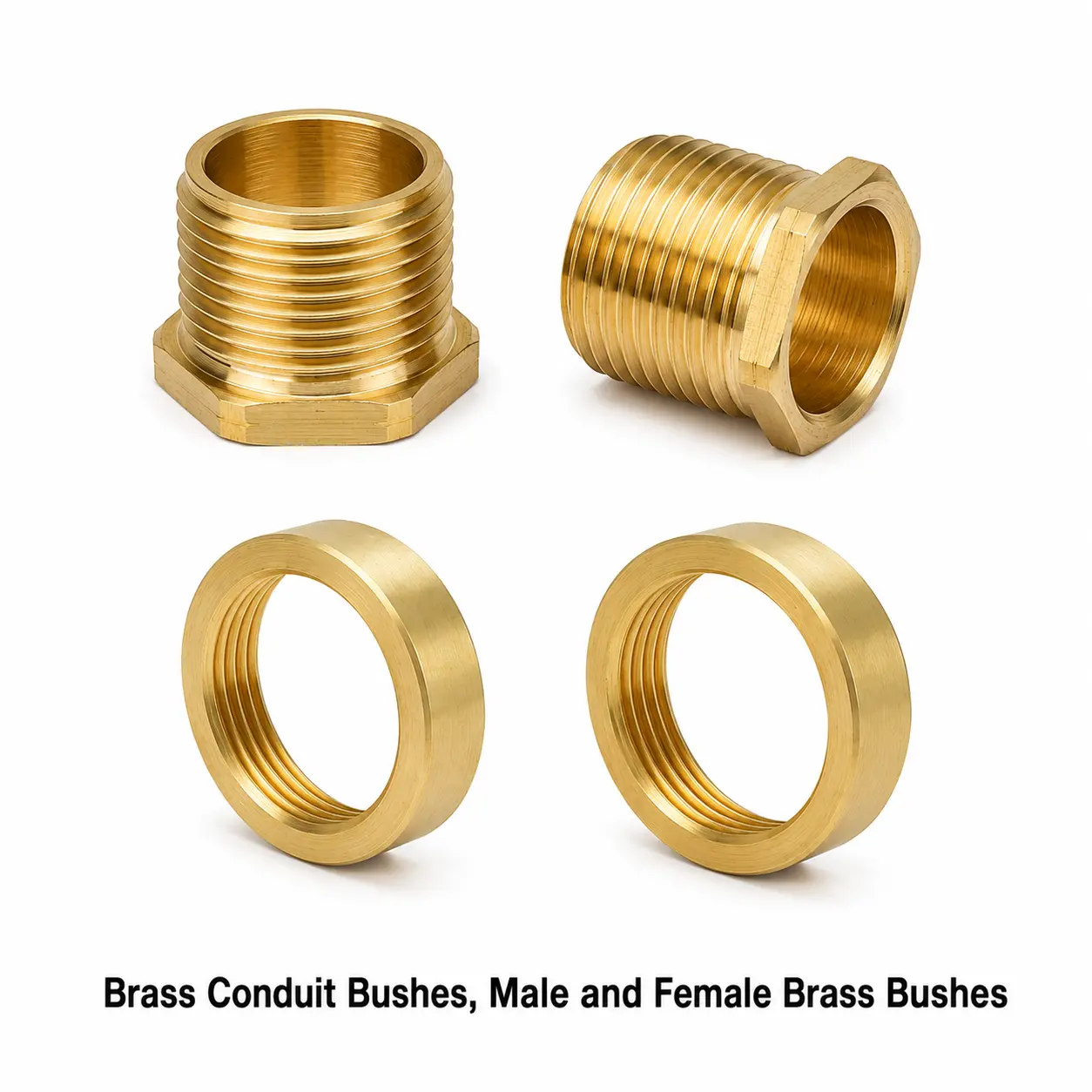
Brass Conduit Bushes, supplied in both Male and Female configurations, are threaded fittings used to terminate metallic and non-metallic conduit ends at enclosures, junction boxes, and equipment housings. Manufactured by Cable Glands India from solid brass bar stock, these bushes present a smooth, rounded internal bore that protects cable insulation from abrasion at the conduit termination point, while providing a mechanically secure and electrically continuous connection between the conduit system and the enclosure. They are supplied across a wide thread range for electrical OEMs, EPC contractors, power utilities, and panel builders worldwide.
Detailed Product Overview
What Are Brass Conduit Bushes
A conduit bush, also referred to as a conduit bushing, is a short threaded fitting installed at the open end of a conduit or at an enclosure entry point to eliminate sharp edges that could damage cable insulation as conductors are pulled through. The bush is machined with a smooth, rounded lip on the cable-facing side and a threaded section on the other, allowing it to be screwed into a coupling, enclosure knockout, or directly onto a threaded conduit end. Brass construction provides corrosion resistance and electrical continuity that plastic bushes cannot offer in earthed metallic conduit systems.
Male Brass Bush Design and Function
The male brass bush has an external thread machined onto its body, allowing it to be screwed directly into an enclosure knockout, coupling, or female-threaded fitting. Once tightened, the rounded internal bore protects the cables passing through, while the external thread and locknut (where fitted) provide a mechanically secure, earthed connection to the enclosure wall. Male bushes are widely used at panel gland plates and junction box entries where the conduit run terminates directly at the enclosure.
Female Brass Bush Design and Function
The female brass bush is internally threaded and is used to receive a male-threaded conduit end, nipple, or adaptor, commonly serving as a reducing or coupling bush between two different thread sizes, or as a protective terminating fitting on a female-threaded enclosure entry. Female bushes are specified where the conduit or fitting being terminated already carries an external thread and a smooth, insulated bore is required at the cable exit point.
Brass Alloy Composition and Machinability
Conduit bushes are machined from CuZn39Pb3 leaded brass (IS 319 Type I, equivalent to UNS C38500 / EN CW614N), an alloy selected for its combination of corrosion resistance, adequate electrical conductivity for earth continuity, and excellent machinability on high-speed CNC lathes. This allows the smooth internal radius and precision threads to be produced consistently across large production volumes while holding tight dimensional tolerances.
Cable Protection and Insulation Safety
The primary function of a conduit bush is mechanical protection of cable insulation at the point where conductors leave the conduit and enter free air inside an enclosure. A correctly sized and installed bush eliminates sharp conduit edges and burrs, preventing insulation abrasion during cable pulling and under vibration in service, which reduces the risk of insulation failure, short circuits, and earth faults over the life of the installation.
Earth Continuity and Bonding
Because brass is electrically conductive, conduit bushes contribute to the earth continuity of a metallic conduit system when installed correctly with appropriate locknuts and bonding accessories. This is a key requirement in industrial and hazardous area installations where the conduit itself may be relied upon as part of the equipment earthing conductor path.
Finish Options – Natural, Nickel-Plated and Tinned Brass
Conduit bushes are supplied in natural brass for general indoor use, nickel-plated for enhanced corrosion resistance and abrasion resistance in outdoor or washdown environments, and tin-plated where specified for compatibility with existing plant standards or additional corrosion protection in humid and coastal installations.
Standards Compliance and Certification Framework
Our brass conduit bushes are manufactured to conform with IS 319 Type I material requirements, IEC 61386 conduit system requirements, and BS 31 / BS EN 61386 thread and dimensional standards where applicable. Export variants are verified against ANSI/UL 514B for the North American market. RoHS and REACH compliance is maintained across all finishes.
Key Features
- Available in Male (externally threaded) and Female (internally threaded) configurations
- Smooth, rounded internal bore to prevent cable insulation damage
- Machined from solid brass for corrosion resistance and earth continuity
- Wide thread range compatible with standard metric and BSP/NPT conduit systems
- Natural, nickel-plated, and tin-plated finish options
- Consistent thread tolerances for reliable enclosure and coupling engagement
- Suitable for indoor, outdoor, and hazardous area conduit installations
- Compatible with standard locknuts, couplings, and conduit fittings
Male Brass Bush – External Thread Termination
The male bush’s external thread allows direct engagement with enclosure knockouts and female-threaded couplings without additional adaptors, simplifying installation at panel gland plates. The rounded lip on the cable side protects conductor insulation as cables are drawn through, while the thread engagement, secured with a locknut, maintains a stable earthed connection under vibration.
Female Brass Bush – Internal Thread Termination
The female bush’s internal thread accepts a male-threaded conduit end, nipple, or reducing adaptor, making it the preferred choice where the conduit fitting already presents an external thread. This configuration is common at reducing joints, where a smaller conduit is terminated into a larger enclosure entry, or as the terminating fitting on pre-threaded equipment housings.
Smooth Bore Cable Protection
The internal radius machined into every bush eliminates the sharp edge that would otherwise be present at a plain-cut conduit end or enclosure knockout, which is a documented cause of cable insulation damage and subsequent earth faults in industrial wiring installations.
Corrosion-Resistant Finish Options
Selecting nickel plating over natural brass extends bush service life significantly in washdown, marine, and outdoor switchgear applications, where repeated exposure to moisture and cleaning chemicals would otherwise degrade an unprotected brass surface over time.
Wide Thread Range Compatibility
A comprehensive thread range allows a single bush family to be specified across small instrumentation conduit through to heavy power conduit entries, reducing the number of distinct part numbers an EPC contractor or panel builder needs to stock and specify across a project.
Earth Continuity in Metallic Conduit Systems
Where the conduit system forms part of the equipment earthing conductor, brass bushes maintain electrical continuity across each joint, which is essential for fault protection and compliance with electrical installation standards governing earthed metallic wiring systems.
Technical Specifications
| Parameter | Specification |
|---|---|
| Body Material | Brass CuZn39Pb3 (IS 319 Type I) |
| Configuration | Male (External Thread) / Female (Internal Thread) |
| Thread Range | M16 to M75 (Metric); BSP / NPT on request |
| Standard Finish | Natural / Nickel-Plated / Tin-Plated |
| Internal Bore | Smooth, Radiused Edge (Burr-Free) |
| Operating Temperature | -20°C to +100°C |
| Dimensional Tolerance | ± 0.05 mm |
| Plating Thickness | 8 – 15 microns (Nickel / Tin, where applicable) |
Raw Material Grades
| Grade | Standard | Typical Composition |
|---|---|---|
| CuZn39Pb3 | IS 319 Type I / EN 12164 | Cu 57-60%, Pb 2.5-3.5%, Zn Balance |
| C38500 | ASTM B453 (USA) | Cu 55-60%, Pb 2.0-3.0%, Zn Balance |
| CW614N | EN 12164 (Europe) | Cu 57-59%, Pb 1.6-2.5%, Zn Balance |
| H59 | GB/T 5231 (China) | Cu 57-60%, Zn Balance |
International Equivalent Standards
| Country / Region | Standard / Designation |
|---|---|
| India | IS 319 Type I |
| Europe | CW614N / CuZn39Pb3 (EN 12164), IEC 61386, BS EN 61386 |
| USA | UNS C38500 (ASTM B453), ANSI/UL 514B |
| Japan | JIS H3250 C3771 |
| China | GB/T H59 |
| United Kingdom | BS 31 (Conduit Thread Reference) |
Product Types / Variants
| Thread Size | Nominal Conduit Size (mm) | Type | Typical Application |
|---|---|---|---|
| M16 / M20 | 16 / 20 | Male / Female | Instrumentation & control panel entries |
| M25 | 25 | Male / Female | Junction box terminations |
| M32 | 32 | Male / Female | Motor terminal boxes |
| M40 | 40 | Male / Female | Distribution board entries |
| M50 | 50 | Male / Female | Power and feeder circuits |
| M63 / M75 | 63 / 75 | Male / Female | Heavy industrial and switchgear entries |
Variant types available: Standard Male Bush, Standard Female Bush, Reducing Bush (dissimilar thread sizes), Long-Pattern Bush, and Insulated-Throat Bush. BSP, NPT, and custom thread forms are available on request.
Applications in Industry
- Control panels and motor control centres (MCCs)
- Junction boxes and distribution board conduit entries
- Motor terminal box conduit terminations
- Industrial machinery and process plant wiring
- Outdoor switchgear and kiosk installations
- Oil, gas, and petrochemical hazardous area installations
- Railway signalling and traction equipment enclosures
- Renewable energy (solar and wind) electrical enclosures
Manufacturing Process
Production begins with certified brass bar stock, which is CNC turned to form the thread (external for male bushes, internal for female bushes) and the smooth, radiused bore on the cable-facing side. Parts are deburred to remove any residual sharp edges before proceeding to surface finishing, where natural, nickel, or tin finishes are applied as specified. Each batch undergoes thread gauge inspection, dimensional verification, and, where a corrosion-resistant finish is applied, salt-spray testing prior to packing, with full batch traceability maintained from raw material to dispatch.
Quality Standards and Certifications
| Standard / Certification | Scope |
|---|---|
| ISO 9001:2015 | Quality Management System |
| IS 319 | Material Specification (India) |
| IEC 61386 / BS EN 61386 | Conduit System Requirements |
| ANSI / UL 514B | US Market Compliance |
| RoHS / REACH | Environmental Compliance |
| Salt Spray Test (ASTM B117) | Corrosion Resistance Verification (Plated Finishes) |
Why Choose Cable Glands India
- Male and Female bush variants manufactured across a comprehensive thread range
- In-house CNC machining ensures a consistently smooth, burr-free internal bore
- Natural, nickel, and tin finish options produced in-house with controlled plating thickness
- Batch-wise thread gauge, dimensional, and corrosion-resistance testing
- Custom thread forms including BSP and NPT engineered to project specification
- Established export documentation and packing for global project shipments
Indicative Pricing
| Product | Indicative Price | Terms |
|---|---|---|
| Brass Conduit Bushes (Male / Female) | US$ 17.90 / kg | Ex-Works India; varies by thread size, type and order quantity |
Final pricing depends on thread size, configuration (Male/Female), finish, and order volume. Contact our sales team for a formal quotation.
Frequently Asked Questions
What is the difference between a male and female conduit bush?
A male bush has an external thread that screws into an enclosure or coupling, while a female bush has an internal thread that receives a male-threaded conduit end or fitting.
Why is a conduit bush needed at conduit terminations?
It provides a smooth, rounded bore that protects cable insulation from abrasion at the point where conductors exit the conduit into an enclosure.
What thread sizes are available?
Our standard range covers M16 to M75 metric threads, with BSP and NPT variants available on request.
Do conduit bushes provide earth continuity?
Yes, brass bushes are electrically conductive and contribute to earth continuity across metallic conduit joints when installed with appropriate locknuts and bonding accessories.
What finish options are available?
Natural brass, nickel-plated, and tin-plated finishes are available depending on the installation environment.
Can these bushes be used in hazardous area installations?
Yes, when used with certified conduit systems and fittings appropriate to the area classification.
Are reducing bushes available for dissimilar thread sizes?
Yes, reducing bushes are available to terminate a smaller conduit into a larger enclosure entry or coupling.
Do you provide test and material certificates?
Yes, mill test certificates and batch inspection reports are provided with every shipment.
What is the production lead time?
Standard lead time is 4-6 weeks depending on size, type, and order quantity.
Do you export internationally?
Yes, we export to the USA, UK, Europe, Middle East, Africa, and Southeast Asia.
Equivalent Terms in Other Languages
| Language | Brass Conduit Bush | Male / Female Bush |
|---|---|---|
| Spanish | Bocina de latón para conducto | Bocina macho / hembra de latón |
| Russian | Латунная втулка для кабельного канала | Латунная втулка папа / мама |
| French | Douille en laiton pour conduit | Douille mâle / femelle en laiton |
| Portuguese | Bucha de latão para conduíte | Bucha macho / fêmea de latão |
| Italian | Boccola in ottone per conduit | Boccola maschio / femmina in ottone |
Related Parts and Linked Terms
- Brass Electrical Accessories
- Brass Battery Terminals
- Brass Terminals Blocks
- Brass Line Taps and Brass Split Bolt Connectors
- Brass Fixed and Swivel Connectors for Flexible Conduits
- Brass Threaded Fittings
Request a Quote
Share your thread sizes, configuration (Male/Female), finish requirements, and quantities, and our engineering team will respond with a detailed quotation within one business day.
Email: sales@cableglandsindia.com | Phone / WhatsApp: +91-22-43449300 | Website: www.cableglandsindia.com