Phosphor Bronze Casting | PB1 PB2 PB4 Bronze Foundry & Cast Parts – Cable Glands India
Rate: US$ 17.90/Kg
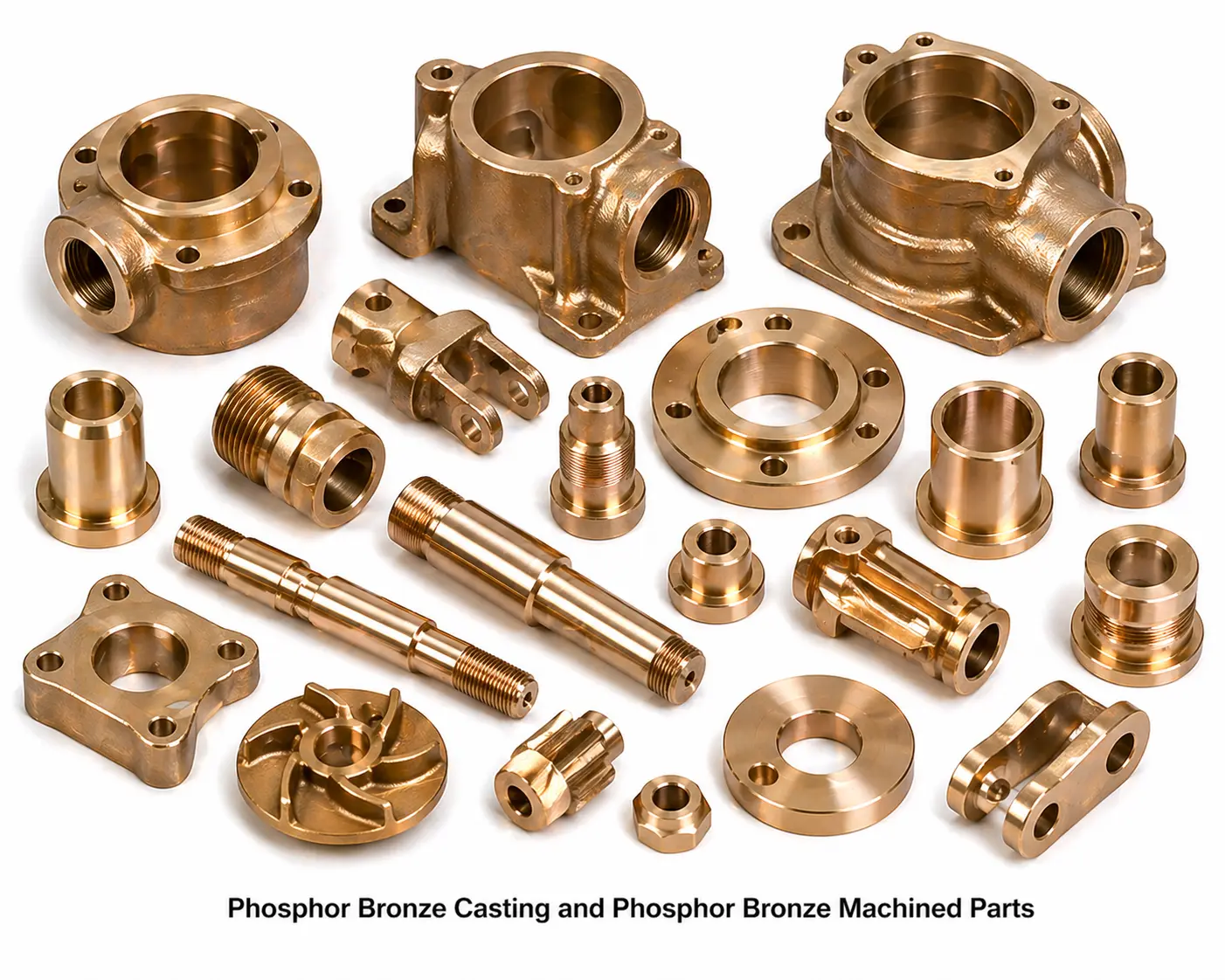
Cable Glands India manufactures phosphor bronze castings in grades PB1, PB2, PB4 (tin bronze with phosphorus deoxidation) for applications requiring high fatigue strength, excellent wear resistance, low coefficient of friction, and superior corrosion resistance in marine, industrial, and electrical environments. We serve electrical OEMs, EPC contractors, pump manufacturers, power utilities, and international distributors with sand castings, centrifugal castings, investment castings, shell mould castings, and gravity die castings in phosphor bronze alloys conforming to BS EN 1982, ASTM B505, DIN 1705, and IS 318 standards.
Product Overview
Phosphor bronze is a copper-tin-phosphorus alloy, typically containing 8–12% tin and 0.02–0.4% phosphorus. The phosphorus acts as a deoxidiser during casting and significantly improves the alloy’s mechanical properties and wear resistance. It is the preferred material for bearings, bushings, gears, pump impellers, valve trim, and structural connectors in corrosive or high-load environments. Cable Glands India produces phosphor bronze castings from 10 grams to 40 kilograms with maximum dimensions up to 1,000 mm.
Casting Processes We Offer
Sand Casting
Green sand and chemically bonded sand moulds for complex geometries, large sections, and prototype runs. Surface finish Ra 6.3–25 µm. Dimensional tolerance CT6–CT7 (ISO 8062). Weight range up to 40 kg.
Shell Mould Casting
Resin-bonded sand shells fired at elevated temperature, producing improved surface finish and dimensional accuracy over green sand. CT5–CT6 tolerance. Preferred for medium-run pump and valve components.
Lost Wax Investment Casting
Wax pattern with ceramic shell investment for intricate components with Ra 1.6–6.3 µm surface finish and CT4–CT5 tolerance. Suited for bearing housings, worm gear blanks, and precision marine fittings.
Centrifugal Casting
True centrifugal casting for hollow cylindrical parts (bushings, sleeves, bearing races, flanges). Produces near-net-shape tubes with dense, segregation-free microstructure and excellent mechanical properties. Semi-centrifugal available for non-symmetric shapes.
Gravity Die Casting (Permanent Mould)
Reusable metal dies filled by gravity for medium-to-high production volumes. Improved surface and dimensional consistency vs. sand casting. Tolerances CT5–CT6.
Continuous Casting
Horizontal or vertical continuous casting for bar, rod, and tube stock subsequently machined to finished dimensions. Available for PB1, PB2, PB4 in round, rectangular, and special profiles.
Key Features
- High load-bearing capacity — tensile strength 240–330 MPa (as-cast)
- Excellent anti-friction properties — low coefficient of friction vs. steel
- Superior corrosion resistance in seawater, steam, and chemical environments
- Good fatigue strength under cyclic loading
- Non-sparking and non-magnetic
- Weight range: 10 g to 40 kg per casting
- Multiple casting processes for any geometry or volume
- Machining, drilling, threading, and surface treatment in-house
- Full material traceability with EN 10204 3.1 certificates
Technical Specifications
| Parameter | PB1 | PB2 | PB4 |
|---|---|---|---|
| Cu Content (%) | Bal. | Bal. | Bal. |
| Sn Content (%) | 9.5–10.5 | 11.0–13.0 | 4.5–6.0 |
| P Content (%) | 0.03–0.35 | 0.03–0.25 | 0.03–0.40 |
| Zn Content (%) | 0.05 max | 0.05 max | 4.0–6.0 |
| Pb Content (%) | 0.05 max | 0.05 max | 0.3 max |
| 0.2% Proof Stress (MPa) | 120 | 130 | 100 |
| Tensile Strength (MPa) | 280 | 310 | 240 |
| Elongation (%) | 15 | 12 | 15 |
| Hardness (HB) | 75–90 | 85–100 | 65–80 |
| Density (g/cm³) | 8.8 | 8.7 | 8.8 |
| Melting Range (°C) | 855–1000 | 820–980 | 860–1020 |
Phosphor Bronze Alloy Grades and International Equivalents
| Grade | BS (UK) | BS EN 1982 | UNS (ASTM B505) | DIN 1705 | JIS H5111 | IS 318 |
|---|---|---|---|---|---|---|
| PB1 (10% Sn) | BS 1400 PB1 | CC481K | C90700 | GBz10 | CAC401 | Grade 2 |
| PB2 (12% Sn) | BS 1400 PB2 | CC483K | C91100 | GBz12 | CAC402 | Grade 3 |
| PB4 (5% Sn) | BS 1400 PB4 | CC480K | C90500 | GBz10Zn5 | CAC502A | Grade 1 |
Product Types and Variants
- Plain Bearings and Bushings — centrifugal and continuous cast, precision bored to H7
- Gear Blanks and Worm Wheels — investment and sand cast, hobbed or profile-machined
- Pump Impellers and Casings — sand and shell mould cast for chemical and marine pumps
- Valve Seats and Disc Blanks — gravity die and investment cast for seawater and steam valves
- Bearing Cages and Retainers — centrifugal cast tubes bored to final OD/ID
- Electrical Connector Components — spring contacts, socket shells, and clip contacts
- Marine Hardware — keel bolts, sheave pins, deadlights, and seacock components
- Custom Engineered Castings — per customer drawing or STEP/IGES 3D model
Industry Applications
- Marine and Offshore — propeller shaft bearings, seacock valves, hull fittings, deck hardware
- Oil and Gas — gate valve seats, non-sparking tool components, pump bearings
- Power Generation — turbine bearings, governor bushings, generator end-shield bearings
- Electrical and Electronics — spring contacts, connector pins, terminal blocks
- Water Treatment — pump wear rings, impellers, bearing housings
- Mining and Earthmoving — bucket pin bushings, hinge bearings, wear plates
- Railways — axlebox liners, brake gear bushings, suspension wear parts
- Chemical Processing — agitator bearings, seal housings, valve trim
Manufacturing Process
Certified phosphor bronze ingots (PB1, PB2, PB4) are charged into induction furnaces and melted under controlled temperature profiles. Phosphorus additions are made at the final stage of melting. Molten metal is poured into prepared moulds (sand, ceramic shell, permanent die, or rotating centrifugal mould) at the correct superheat temperature. After solidification and cooling, castings are shaken out or ejected, fettled (runners and risers removed by sawing or grinding), and dressed. Heat treatment (solution anneal or stress relief) is applied where required. CNC machining produces finished dimensions to drawing tolerances. Each batch is inspected for dimensional conformance, chemical composition (OES spectrometer), and, where specified, ultrasonic testing or pressure testing.
Quality Standards and Certifications
- ISO 9001:2015 certified quality management system
- Chemical analysis per BS EN 1982 / ASTM B505 with EN 10204 3.1 MTC
- Mechanical property testing per BS EN 1982 (tensile, hardness)
- Dimensional inspection with CMM data on request
- Non-destructive testing: ultrasonic, dye penetrant, radiographic (on request)
- PPAP Level 1–3 for OEM customers
Why Choose Cable Glands India for Phosphor Bronze Castings?
- Grade Expertise: PB1, PB2, PB4 and custom compositions — in-house metallurgical support for alloy selection.
- Centrifugal Casting Capability: Produce dense, high-quality bearing-grade bushings without external sub-contracting.
- Full Supply Chain: Casting, machining, surface treatment, and inspection under one roof.
- Competitive Lead Times: Standard casting 3–5 weeks, machined castings 4–7 weeks.
- Export Experience: Regular shipments to UK, EU, UAE, Singapore, and other markets.
- Cost Advantage: India-based manufacturing offers significant savings vs. Western European foundries.
Multilingual Equivalent Terms
| Language | Terms (3–4) |
|---|---|
| Spanish (ES) | Fundición de bronce al fósforo, Piezas fundidas de bronce fosforoso, Colada de bronce fosforoso, Fundición PB1 PB2 bronce |
| Russian (RU) | Литьё из фосфористой бронзы, Бронзовые отливки ПФ1 ПФ2, Фосфористая бронза литьё, Отливки из оловянной бронзы |
| French (FR) | Moulage en bronze au phosphore, Pièces coulées en bronze phosphoreux, Fonderie bronze PB1 PB2, Bronze phosphore coulé |
| Portuguese (PT) | Fundição de bronze ao fósforo, Peças fundidas em bronze fosforoso, Fundição bronze PB1 PB2, Bronze fosforoso fundido |
| Italian (IT) | Fusione in bronzo al fosforo, Getti in bronzo fosforoso, Fonderia bronzo PB1 PB2, Bronzo al fosforo fuso |
Frequently Asked Questions (FAQ)
What is phosphor bronze and why is phosphorus added?
Phosphor bronze is a copper-tin alloy with 0.02–0.4% phosphorus. Phosphorus serves as a deoxidiser during casting, preventing tin oxide porosity, and also increases hardness, strength, and wear resistance. The result is a denser, stronger, and better-wearing casting than plain tin bronze.
What grades of phosphor bronze do you cast?
We cast PB1 (BS 1400 PB1 / CC481K / C90700), PB2 (BS 1400 PB2 / CC483K / C91100), and PB4 (BS 1400 PB4 / CC480K / C90500). Custom alloy compositions are also available on request.
What is the best casting process for phosphor bronze bushings?
Centrifugal casting is the industry standard for bearing bushings and sleeves because it produces a dense, segregation-free microstructure with superior mechanical properties. For non-cylindrical shapes or where geometry complexity is high, sand casting or investment casting may be more appropriate.
Can you machine phosphor bronze castings to finished dimensions?
Yes. We machine castings on CNC lathes and machining centres to drawing tolerances, including bores to H7, external diameters to h6, and threaded features. Tolerances to IT7 are achievable.
What is the minimum order quantity?
No strict MOQ for prototypes. Production run MOQ is typically 50–100 pieces for castings, lower for machined stock. Small batches are accommodated for specialist OEM applications.
Do you supply phosphor bronze centrifugal cast tubes as stock?
Yes. We supply centrifugal cast phosphor bronze tubes in PB1 and PB2 grades in standard OD/ID size ranges. Custom sizes are available with 3–5 week lead time.
What is the difference between PB1 and PB2?
PB2 has higher tin content (11–13% vs. 9.5–10.5% for PB1), which increases hardness and compressive strength but reduces ductility slightly. PB2 is preferred for heavy-duty bearings and gears; PB1 is used for moderate-load bearings and pump components.
Are phosphor bronze castings suitable for seawater service?
Yes. Phosphor bronze has good resistance to seawater corrosion, steam, and many chemical solutions. For critical seawater applications, LG2 gunmetal (which contains zinc) may be preferred; consult our technical team for alloy selection guidance.
Do you provide material test certificates?
Yes. We provide EN 10204 3.1 mill test certificates confirming chemical analysis and mechanical properties for every production batch. Third-party inspection is available on request.
Can you work from customer drawings?
Yes. We accept 2D drawings (PDF, DWG, DXF) and 3D CAD files (STEP, IGES). Our engineers perform DFM review and submit a detailed quotation within 48–72 hours.
Request a Quote
Submit your drawing, alloy grade, quantity, and delivery requirement to receive a detailed quotation for phosphor bronze castings. Our technical team will respond within 24–48 hours.
Email: sales@cableglandsindia.com | Phone: +91 22 4344 9300