Lead Free Brass Casting and Cast Parts | RoHS-Compliant Brass Foundry – Cable Glands India
Rate: US$ 17.90/Kg
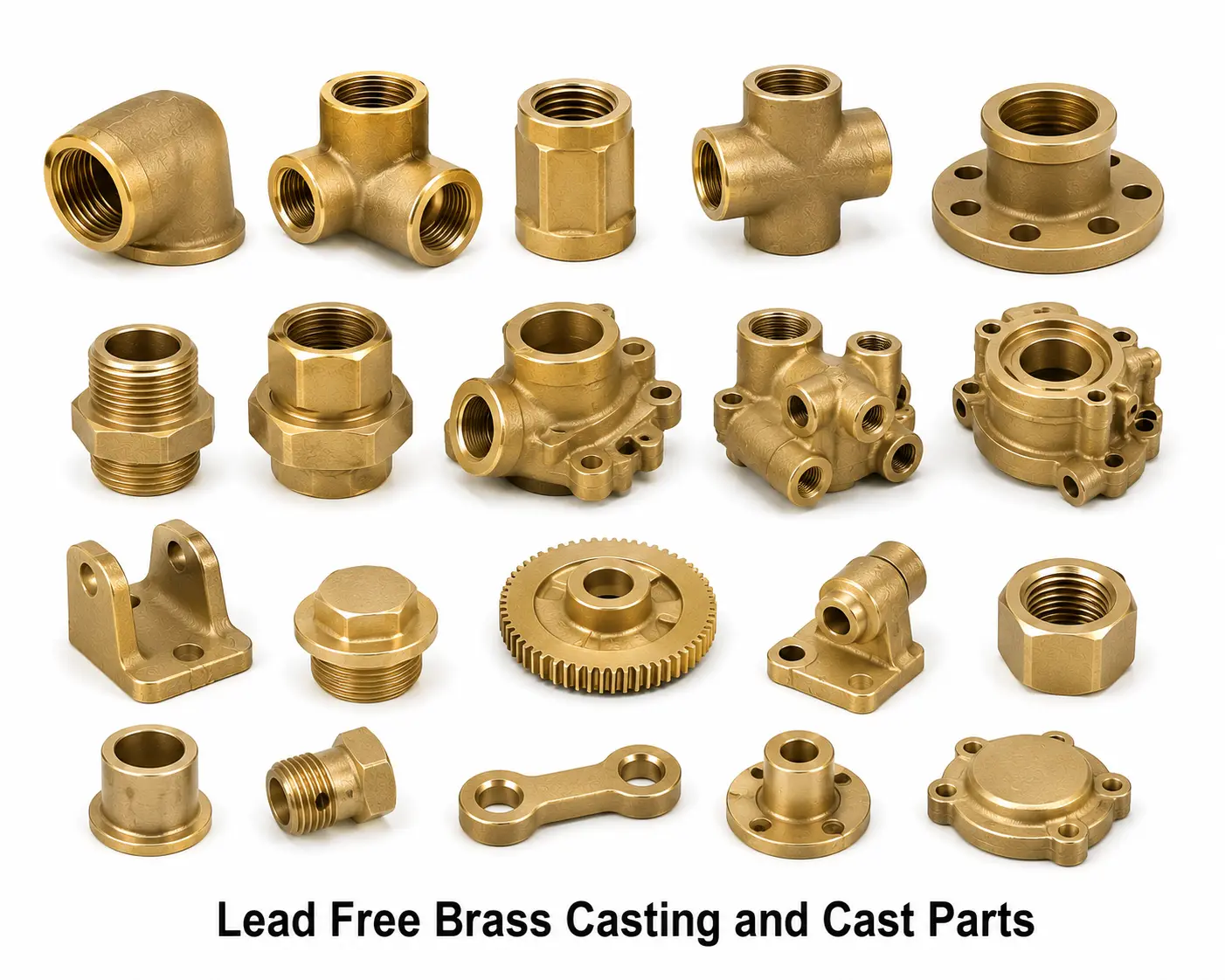
Cable Glands India manufactures lead free brass castings and cast parts that comply with RoHS Directive 2002/95/EC and EU REACH regulations. Our lead-free brass alloys — including CW510L, CW724R, and BS EN 12163-compliant compositions — deliver the machinability and corrosion resistance of standard brass without lead content, making them suitable for potable water fittings, medical instruments, food-grade equipment, and electrical components where lead restrictions apply. We supply electrical OEMs, EPC contractors, power utilities, and industrial distributors across India and internationally.
Product Overview
Lead free brass is a copper-zinc alloy with lead content reduced to below 0.1% (RoHS) or 0.25% (NSF/ANSI 61), achieved by substituting bismuth, silicon, or antimony for traditional lead. Cable Glands India sources certified billets and ingots and produces castings through multiple processes to serve a broad weight range from 10 grams to 40 kilograms. Components are available with natural brass finish, nickel plating, electro-tinning, or chrome plating per customer specification.
Casting Processes We Offer
We operate across six primary casting methods to match mechanical requirements, production volume, and dimensional complexity:
Sand Casting
Silica or green sand moulds for complex geometries and prototype runs. Suitable for parts 100 g to 40 kg. Surface finish Ra 6.3–25 µm. Tolerances to CT7 (ISO 8062).
Shell Mould Casting
Resin-bonded sand shells fired at 250–350 °C, producing better dimensional accuracy than green sand. Suitable for medium production volumes. Tolerances to CT6.
Lost Wax Investment Casting
Wax pattern → ceramic shell → dewax → pour. Achieves Ra 1.6–6.3 µm surface finish and tight tolerances (CT4–CT5). Ideal for intricate valve bodies, instrument housings, and connector shells.
Centrifugal Casting
Rotating die for symmetric tubular and cylindrical parts — bushings, flanges, bearing races. Produces dense, pore-free microstructure. True centrifugal and semi-centrifugal variants available.
Gravity Die Casting (Permanent Mould)
Reusable metal dies filled by gravity. Best for medium-to-high volumes requiring consistent dimensions and smoother surfaces than sand casting. Tolerances to CT5–CT6.
Pressure Die Casting
High-pressure injection into hardened steel dies. High production rates, excellent surface finish (Ra 0.8–3.2 µm), tight tolerances. Suitable for thin-wall, complex-shape components in volumes above 5,000 pieces.
Key Features
- RoHS and REACH compliant — lead content <0.1% by weight
- NSF/ANSI 61 suitable alloys available for potable water applications
- Weight range: 10 g to 40 kg per casting
- Six casting processes under one roof
- Custom alloy composition available on request
- Machined, deburred, and inspection-certified before dispatch
- PPAP documentation and first-article inspection (FAI) reports on request
- Made in India — cost-competitive vs. imports from China or Taiwan
Technical Specifications
| Parameter | Details |
|---|---|
| Base Material | Copper-Zinc (Lead-Free Brass) |
| Lead Content | <0.1 wt% (RoHS) / <0.25 wt% (NSF/ANSI 61) |
| Weight Range | 10 g – 40 kg |
| Length (max) | 1,000 mm |
| Casting Processes | Sand, Shell Mould, Investment, Centrifugal, Gravity Die, Pressure Die |
| Dimensional Tolerance | CT4 – CT7 (ISO 8062-3) |
| Surface Finish | Ra 0.8 – 25 µm (process dependent) |
| Tensile Strength (typical) | 300 – 450 MPa |
| Hardness | 70 – 120 HB |
| Density | 8.3 – 8.5 g/cm³ |
| Melting Range | 880 – 920 °C |
Lead-Free Brass Alloy Grades and International Equivalents
| Alloy Type | BS EN (Europe) | UNS (USA/ASTM) | DIN (Germany) | JIS (Japan) | IS (India) |
|---|---|---|---|---|---|
| Bismuth Brass (LF) | CW510L | C89550 / C89835 | CuZn39Pb0.5 | C3604LF | – |
| Silicon Brass (LF) | CW724R | C87600 / C87610 | CuZn16Si4 | – | – |
| Low-Lead Dezincification Resistant | CW602N | C36000 (modified) | CuZn36Pb1.5 | – | – |
| Eco Brass | – | C87850 | – | – | – |
| Standard LF Grade | BS EN 12163 | ASTM B16 LF | DIN 17660 | JIS H3250 | IS 319 LF |
Product Types and Variants
We manufacture lead free brass cast parts across the following categories:
- Valve Bodies and Valve Components — ball valves, gate valves, check valves
- Plumbing Fittings — elbows, tees, unions, couplings, nipples
- Electrical Connectors and Housings — cable gland bodies, terminal blocks, connector shells
- Pump Components — impellers, pump casings, wear rings
- Meter Bodies — water meter housings, gas meter bodies
- Flanges and Adaptors — BS, ANSI, DIN flanged components
- Custom Engineered Castings — per customer drawing or 3D model
Industry Applications
Lead free brass castings from Cable Glands India are used across the following sectors:
- Electrical and Electronics — cable gland bodies, enclosure fittings, switchgear components
- Potable Water and Plumbing — NSF/ANSI 61 compliant fittings and valves
- Oil and Gas — instrument fittings, manifold blocks
- Power Generation and Distribution — busbar connectors, earth fittings
- HVAC and Refrigeration — valve bodies, service fittings
- Medical Equipment — instrument housings and precision components
- Automotive — fuel system components, brake system fittings
- Marine — seacock valves, throughhull fittings (compliant alloys)
Manufacturing Process
Raw material ingots are verified against mill test certificates (MTC) before entering production. Billets are melted in induction furnaces under controlled temperature. Mould preparation varies by process — green sand rammed on pattern plates, ceramic shell investment, or permanent steel dies. After pouring and controlled solidification, castings are shaken out, fettled, and heat treated if required. Machining is performed on CNC lathes and machining centres to drawing tolerances. Each casting batch undergoes dimensional inspection, chemical analysis (spectrometer), and where specified, pressure testing or X-ray examination.
Quality Standards and Certifications
- ISO 9001:2015 Quality Management System
- RoHS 2002/95/EC — lead content <0.1 wt%
- REACH SVHC compliance documentation available
- Material Test Certificates (MTC) per EN 10204 3.1
- Dimensional inspection reports and CMM data on request
- NSF/ANSI 61 suitable alloy grades available
- PPAP Level 1–3 documentation for automotive and OEM customers
Why Choose Cable Glands India for Lead Free Brass Castings?
- Regulatory Compliance: All alloys certified RoHS and REACH compliant with full traceability documentation.
- Multi-Process Capability: Sand casting through pressure die casting in one facility — no sub-contracting delays.
- Custom Alloy Matching: We match your specific alloy requirement or suggest the closest approved lead-free equivalent.
- Competitive Pricing: India-based manufacturing offers 20–40% cost advantage vs. European or North American sources.
- Global Shipping: Export experience to EU, UK, Middle East, Southeast Asia, and Africa.
- Technical Support: Engineering team assists with alloy selection, DFM review, and tolerance stack-up analysis.
Multilingual Equivalent Terms
| Language | Terms (3–4) |
|---|---|
| Spanish (ES) | Fundición de latón sin plomo, Piezas fundidas de latón libre de plomo, Fundición de latón RoHS, Colada de latón sin plomo |
| Russian (RU) | Литьё из безсвинцовой латуни, Детали из безсвинцовой латуни, Латунное литьё без свинца, RoHS-совместимое латунное литьё |
| French (FR) | Moulage en laiton sans plomb, Pièces coulées en laiton sans plomb, Fonderie laiton RoHS, Coulée de laiton exempte de plomb |
| Portuguese (PT) | Fundição de latão sem chumbo, Peças fundidas de latão isento de chumbo, Fundição de latão RoHS, Latão fundido sem chumbo |
| Italian (IT) | Fusione in ottone senza piombo, Parti fuse in ottone privo di piombo, Fonderia ottone RoHS, Getti in ottone esente da piombo |
Frequently Asked Questions (FAQ)
What is the difference between lead free brass and standard brass?
Standard brass (e.g., CZ121 / C36000) contains 1–3% lead as a machinability aid. Lead-free brass replaces lead with bismuth, silicon, or antimony. Performance is equivalent in most structural applications; lead-free variants are mandatory where RoHS, REACH, NSF/ANSI 61, or local regulations prohibit lead.
Which casting process is best for lead free brass?
Sand casting is best for large, complex, or low-volume parts. Investment casting suits intricate, high-accuracy components. Gravity die casting is preferred for medium production runs. Centrifugal casting is optimal for cylindrical, dense-microstructure parts such as bushings. Our engineers select the process based on geometry, volume, and tolerance requirements.
What is the minimum order quantity (MOQ)?
There is no strict MOQ for prototypes and samples. For production runs, MOQ is typically 50–100 pieces depending on casting process and complexity. We accommodate small batch requirements for specialised OEM parts.
Do you supply material test certificates (MTC)?
Yes. We provide EN 10204 3.1 mill test certificates with each batch, confirming chemical composition and mechanical properties. Third-party inspection is also available on request.
Are your lead free brass castings RoHS compliant?
Yes. All lead-free brass alloys we use contain <0.1 wt% lead, conforming to RoHS Directive 2011/65/EU (recast). We provide RoHS compliance declarations on request.
Can you cast from customer-supplied drawings or CAD files?
Yes. We accept 2D drawings (PDF, DXF, DWG) and 3D CAD models (STEP, IGES, Parasolid). Our engineers perform DFM review before committing to tooling.
What surface finishes are available?
Available finishes include: natural brass (as-cast and machined), nickel plating, electro-tinning, chrome plating, passivation, and powder coating. Specify the finish requirement in your RFQ.
Do you export lead free brass castings?
Yes. We export to the EU, UK, UAE, Saudi Arabia, Singapore, and other markets. We handle export documentation including commercial invoice, packing list, certificate of origin, and test certificates.
How long does tooling and sample approval take?
Tooling lead time is typically 3–6 weeks depending on casting method and complexity. Sample approval (first article) is 1–2 weeks after tooling. Total time from order to approved sample is typically 4–8 weeks.
What is the maximum casting weight you can produce?
We can cast lead free brass components up to 40 kg in weight and up to 1,000 mm in length using sand casting. For die casting and investment casting, maximum weight is typically 5–10 kg.
Request a Quote
To receive a quotation for lead free brass castings, contact Cable Glands India with your drawings, specifications, and required quantity. Our technical team will respond within 24 hours with a DFM review and indicative pricing.
Email: sales@cableglandsindia.com | Phone: +91 22 4344 9300