Bronze Vise Connectors – Vise Clamps for Structural and Earthing Bonding
Rate: US$ 17.90/Kg
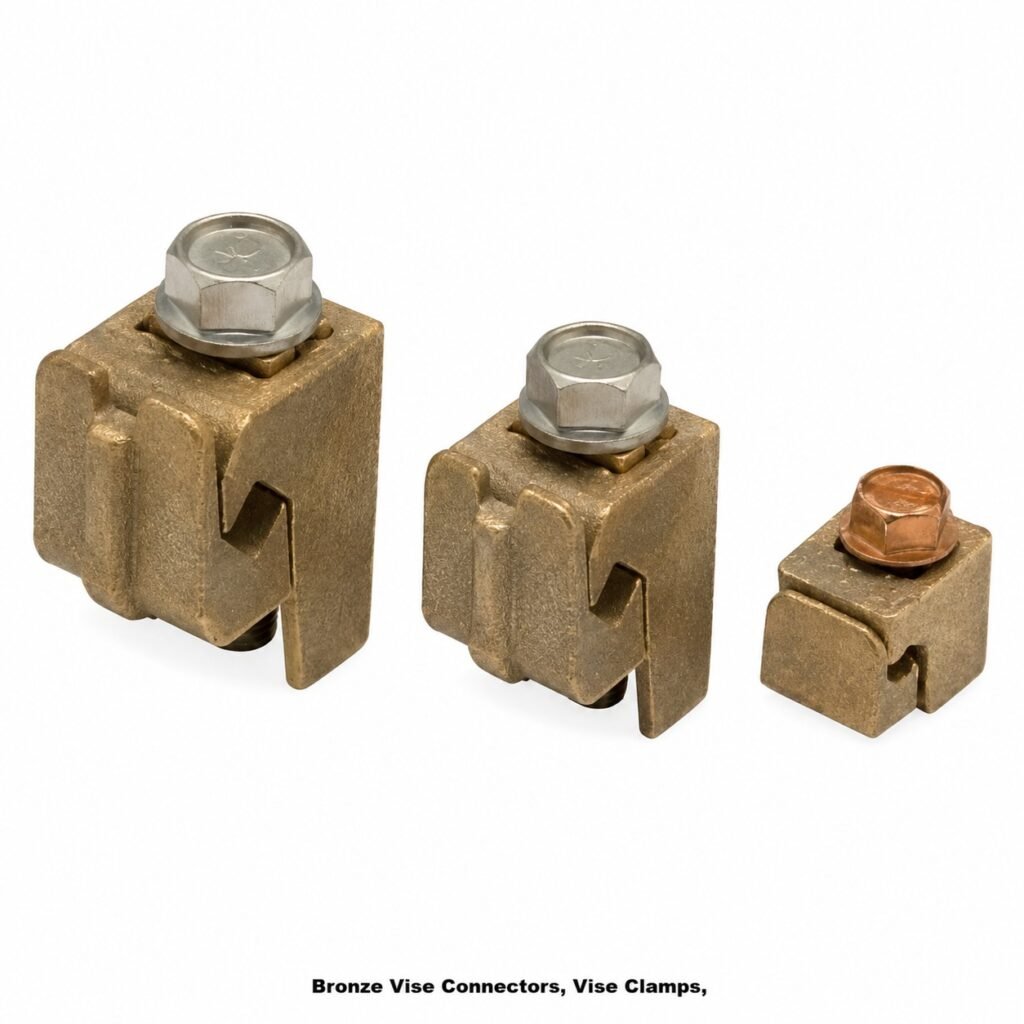
Cable Glands India manufactures bronze vise connectors, widely known in earthing and bonding hardware catalogs as vise clamps or vise-type ground clamps, for bonding earth conductors, bonding jumpers, and down conductors to structural steel members, angle iron, channel, rebar, and tower legs. The connector uses a screw-operated vise jaw to grip an irregular or flat structural section without requiring drilling or welding, while a separate conductor port accepts a copper or bronze earth conductor. Utilities, steel fabricators, and lightning protection installers specify bronze vise connectors because the jaw geometry adapts to variable material thickness on site while bronze construction keeps the joint corrosion free for the life of the structure.
Price: US$ 17.90 per kilogram | Custom pricing available for bulk and OEM orders
Product Overview
Function of a Vise Connector in Bonding Systems
A vise connector bonds an earth or bonding conductor to a structural member using a movable jaw tightened by a screw, similar in principle to a bench vise. This design lets one connector body accommodate a range of member thicknesses, from thin angle iron to heavier structural sections, without needing a drilled hole or welded lug. The connector is used where the structure itself forms part of the grounding or bonding path and a mechanically adjustable, code compliant connection is required.
Bronze Body Construction and Conductivity
Cable Glands India casts vise connector bodies from silicon bronze and leaded tin bronze alloys chosen for high electrical conductivity, casting integrity, and long-term corrosion resistance in outdoor and buried applications. Because the connector is frequently installed at height on towers or structures that are difficult to re-access, the bronze body is designed to remain serviceable for decades without maintenance or re-tightening.
Adjustable Jaw for Structural Steel Sections
The vise jaw opens to accept angle iron, channel, flat bar, small pipe, and tower leg members within its rated range, then closes under screw torque to bite into the structure with a serrated or knurled contact face. This adjustability reduces the number of connector variants a contractor must stock compared to fixed-clamp designs for each member profile.
Conductor Port and Cable Range
The conductor side of the vise connector accepts solid or stranded copper or copper-clad conductors across a defined AWG or kcmil range, secured by a separate set screw or saddle clamp integral to the casting. Dual-port versions allow two conductors, such as an incoming and outgoing bonding jumper, to terminate at a single structural attachment point.
Use in Tower and Structure Grounding
Transmission tower grounding designs use vise connectors to bond tower legs to counterpoise conductors and down leads without drilling galvanized steel members, which would otherwise create a corrosion initiation point in the galvanizing. This makes the vise connector a preferred choice on galvanized lattice tower structures.
Rebar and Reinforcement Bonding
In building and foundation earthing, vise-type connectors bond reinforcement bar cages to the earthing conductor to create a concrete encased electrode or to equipotentially bond structural reinforcement, following the same adjustable-jaw principle applied to round rebar sections instead of angle iron.
Corrosion Behaviour at Dissimilar Metal Joints
Where the vise connector clamps onto galvanized or painted steel, the bronze-to-steel interface is designed and, where specified, plated to manage galvanic corrosion risk, since the joint typically remains in place for the operational life of the structure and cannot be easily inspected once installed at height.
Field Installation Without Hot Work
Because the vise mechanism clamps mechanically, no welding, drilling, or hot work permit is required for installation, which is a significant advantage on live structures, painted steelwork, or sites where hot work is restricted for safety reasons.
Key Features
- Adjustable screw-operated vise jaw fits a range of structural member thicknesses
- Cast bronze body for high conductivity and long-term corrosion resistance
- No drilling or welding required for installation
- Single and dual conductor port configurations available
- Serrated jaw and conductor contact faces for reliable low-resistance bonding
- Suitable for galvanized steel, angle iron, channel, and rebar sections
- Corrosion resistant in buried, outdoor, and coastal environments
- Reusable and field-adjustable without special tooling
Adjustable Clamping Range
A single vise connector body typically spans a wide jaw opening range, allowing the same part number to be used across multiple structural member sizes on a project, simplifying procurement and field stock management for contractors.
High Conductivity Bronze Alloy
The alloy composition is selected to balance electrical conductivity against the mechanical strength needed to sustain screw clamping force over years of thermal cycling and vibration without loosening or cracking.
No Hot Work Installation
Because the connection is purely mechanical, vise connectors can be installed on energized structures, painted steelwork, or explosive atmosphere sites where welding or drilling would require special permits or is prohibited entirely.
Dual Port Bonding Capability
Dual-port variants allow a single structural attachment to serve both an incoming down conductor and an outgoing bonding jumper, reducing the number of separate attachment points needed on a tower leg or structural column.
Corrosion and Weathering Resistance
Bronze construction avoids the rust staining, pitting, and eventual loss of clamping force that affects plated steel vise clamps after years of outdoor exposure, which is particularly important for connectors installed at height where re-tightening is impractical.
Compatibility with Galvanized Structures
Because the vise jaw clamps rather than penetrates the galvanized coating in most applications, the connector helps preserve the corrosion protection of galvanized structural members compared to drilled and bolted lug connections.
Technical Specifications
| Parameter | Typical Range / Value |
|---|---|
| Jaw opening range | 0.10 in to 1.50 in (2.5 mm to 38 mm) |
| Conductor range | #6 AWG solid to 4/0 AWG stranded |
| Structural sections supported | Angle iron, channel, flat bar, rebar, small pipe |
| Body material | Silicon bronze / leaded tin bronze |
| Finish | Natural bronze or tin-plated |
| Port configuration | Single or dual conductor port |
| Fastener | Bronze or stainless steel clamping screw |
| Operating temperature | -40 degrees C to +110 degrees C |
Raw Material Grades
| Grade | Alloy Type | Key Properties |
|---|---|---|
| C83600 | Leaded red brass / bronze | Good casting quality, machinability, conductivity |
| C65100 | Low silicon bronze | Good conductivity, cold formable, strong |
| C93200 | High leaded tin bronze | Excellent bearing and casting properties |
| C95400 | Aluminum bronze | High strength, superior corrosion resistance |
International Equivalent Standards
| Country / Standard Body | Equivalent Reference |
|---|---|
| USA – ASTM / UL | ASTM B584, UL 467 (grounding and bonding equipment) |
| India – IS | IS 3043 (earthing code reference for bonding hardware) |
| UK – BS | BS 7430, BS EN 1982 (copper alloy castings) |
| Europe – EN | EN 12163, EN 12164 (copper alloy bars and rods) |
| IEC | IEC 62561-1 (lightning protection component testing) |
Product Types and Variants
| Type | Description | Typical Use |
|---|---|---|
| Single port vise connector | One conductor port, standard jaw | General structural bonding |
| Dual port vise connector | Two independent conductor ports | Tower legs, through bonding |
| Heavy duty vise clamp | Wider jaw range, larger conductor port | Substation structures, large sections |
| Rebar vise clamp | Jaw profiled for round rebar | Foundation and reinforcement bonding |
| Tin-plated vise connector | Plated body for dissimilar metal joints | Aluminum structures, coastal sites |
Applications in Industry
Transmission Tower Grounding
Vise connectors bond tower leg members to counterpoise conductors and down leads without drilling galvanized steelwork.
Substation Structural Bonding
Structural columns, cable trays, and equipment support steel are bonded to the station earth grid using vise-type connectors during construction and retrofit projects.
Building and Foundation Earthing
Reinforcement bar cages are bonded to the earthing system using rebar vise clamps to form concrete encased electrodes as permitted by national earthing codes.
Lightning Protection Down Conductor Bonding
Down conductors are bonded to structural steel and metallic building features using vise connectors as part of a coordinated lightning protection system.
Temporary Construction Site Earthing
Vise connectors allow temporary bonding of scaffolding, site cabins, and construction equipment to a temporary earth system without permanent fixings.
Manufacturing Process
Cable Glands India casts vise connector bodies using sand casting or gravity die casting depending on order volume, followed by CNC machining of the jaw, screw bore, and conductor port to finished tolerance. The clamping screw is manufactured separately in bronze or stainless steel and assembled with the cast body, then each unit undergoes function testing of jaw travel and clamping force. Components requiring dissimilar metal compatibility are tin-plated after machining, and finished connectors are dimensionally inspected, contact-resistance tested, and packed prior to dispatch.
Quality Standards and Certifications
| Standard / Certification | Scope |
|---|---|
| ISO 9001 | Quality management system certification |
| UL 467 | Reference performance basis for grounding and bonding equipment |
| IEC 62561-1 | Reference testing basis for lightning protection components |
| IS 3043 | Indian earthing code reference for bonding hardware |
| RoHS | Restriction of hazardous substances compliance on request |
Why Choose Cable Glands India
- In-house bronze foundry and CNC machining for full process control
- Wide jaw range options covering angle iron, channel, rebar, and pipe sections
- Batch-wise material composition and contact-resistance test certificates
- Tin-plated options for galvanized and dissimilar metal structures
- Custom conductor port configurations on request
- Competitive per-kilogram pricing with volume and OEM discounts
Frequently Asked Questions
Q1: What is a vise connector used for?
A vise connector bonds an earth or bonding conductor to a structural steel member, such as angle iron, channel, or rebar, using an adjustable screw-operated jaw instead of drilling or welding.
Q2: What structural sections can be clamped?
Standard vise connectors accommodate angle iron, channel, flat bar, small pipe, and rebar within the rated jaw opening range.
Q3: Can vise connectors be used on galvanized steel?
Yes, the mechanical clamping action is designed to preserve the galvanized coating better than drilled bolted connections, and plated options are available for added corrosion protection.
Q4: Is welding or drilling required for installation?
No, the vise mechanism clamps mechanically onto the structure, making it suitable for sites where hot work is restricted.
Q5: What conductor sizes are supported?
Standard conductor range is 6 AWG solid up to 4/0 AWG stranded copper or copper-clad conductor.
Q6: Are dual conductor versions available?
Yes, dual port vise connectors allow two separate conductors to terminate at a single structural attachment point.
Q7: Why choose bronze over plated steel vise clamps?
Bronze resists corrosion without a sacrificial coating, maintaining clamping force and conductivity at hard-to-access structural attachment points for decades.
Q8: Can these be used for rebar bonding?
Yes, rebar profiled vise clamps are available for bonding reinforcement cages in foundation and building earthing systems.
Q9: Do you provide test certificates?
Yes, every batch is supplied with material composition, dimensional, and contact-resistance test certification on request.
Q10: What is the standard lead time?
Standard lead time is 4 to 6 weeks depending on quantity and configuration, with expedited options available.
International Equivalent Terms
| Language | Equivalent Terms |
|---|---|
| Spanish | Conector de tornillo de banco de bronce, Grapa tipo tornillo |
| Russian | Bronzovyi tiskovyi zazhim, Zazhim dlya konstruktsii |
| French | Connecteur a etau en bronze, Collier de serrage structurel |
| Portuguese | Conector tipo torno em bronze, Grampo estrutural |
| Italian | Connettore a morsa in bronzo, Morsetto strutturale |
Linked Parts and Related Terms
Vise Clamp, Structural Bonding Connector, Rebar Vise Clamp, Angle Iron Ground Clamp, Tower Leg Bonding Connector, Dual Port Connector, Bronze Bonding Clamp, Hotline Clamp, KUL Type Clamp.
Related Products in this Category
- Hotline Clamps, Bronze Hotline Clamps
- Bronze KUL Type Clamps, Bronze Bonding Clamps
- Hot Line Stirrup, Hotline Stirrup Bail Clamps
- Bronze Pipe Fittings
- Bronze Ground Rod Clamps – Acorn Clamps
Get a Quote – Bronze Vise Connectors
Ready to source bronze vise connectors for structural bonding, tower grounding, or rebar earthing applications? Our engineering team can recommend the correct jaw range and conductor port configuration for your project.
Price: US$ 17.90 per kilogram | Custom pricing available for bulk and OEM orders
Email: sales@cableglandsindia.com
Phone / WhatsApp: +91-22-43449300
Website: www.cableglandsindia.com
Share your project specifications, required quantities, and preferred delivery timeline, and we will respond with a detailed quotation within one business day.