Hexagon Nuts in Brass, Copper and Silicon Bronze
Cable Glands India offers hexagon nuts for electrical and industrial fastening applications.
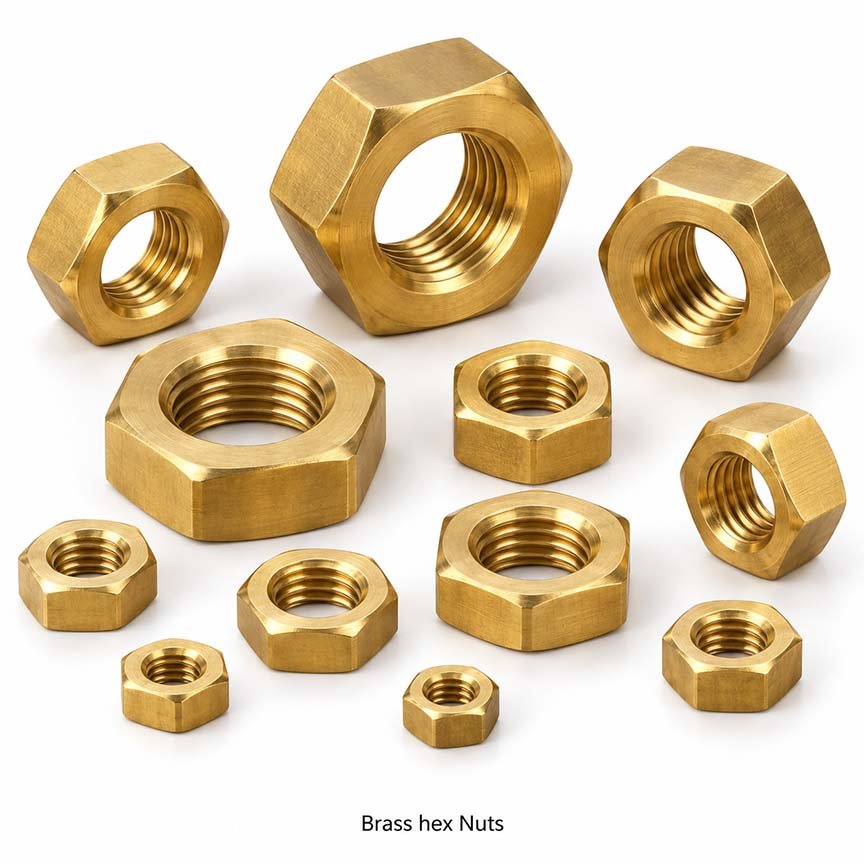
Brass Hex Nuts
Material
Brass hex nuts are copper-zinc alloy fasteners valued for machinability and corrosion resistance in electrical and general engineering applications. Free-machining brass is commonly used for machined nuts; forging brass may be selected for forged blanks. Specify the exact grade and condition to match the required strength and environment. DZR and lead-free brass are separate material requirements and must be specifically requested. Natural brass, nickel-plated or tin-plated finishes can be specified for quotation.
Threads
Metric coarse, metric fine, UNC, UNF, BSW and BSF threads can be specified to match the mating bolt or stud. State the diameter, pitch or threads per inch, tolerance class and direction. Different thread systems are not interchangeable merely because their nominal diameters are similar. Nut height, engagement and tightening torque must suit the alloy and joint design.
Types and Applications
Types include full hex nuts, thin or jam nuts, heavy hex nuts, hex flange nuts and serrated flange nuts. Full nuts provide the specified engagement height; thin nuts suit restricted spaces or approved double-nut arrangements. Flange nuts provide an integral bearing face, while serrated versions have teeth to help resist rotation against a suitable surface. Dedicated lock nuts require a specified locking feature. Typical uses include electrical terminals, cable accessories, instruments, panels and general assemblies.
Copper Hex Nuts
Material
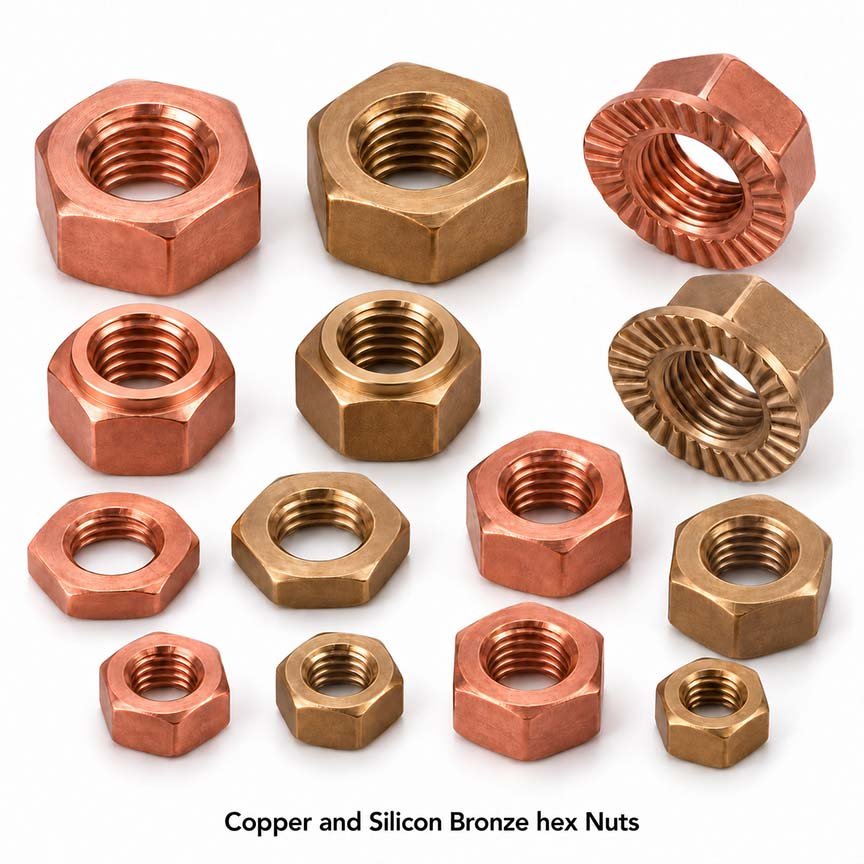
Copper hex nuts are selected where electrical or thermal conductivity and compatibility with copper components are important. Specify the exact copper grade and temper, including whether high-conductivity or oxygen-free copper is required. Copper is generally softer than brass or silicon bronze, so material condition, bearing area and engagement length must be considered when setting the clamping load. Natural copper or a specified tin-plated finish may be chosen according to the contact environment.
Threads
Metric coarse, metric fine, UNC, UNF, BSW and BSF internal threads can be specified against the mating fastener. State diameter, pitch, tolerance and direction. Accurate threading is important because damaged threads, excessive torque or insufficient engagement can deform or strip softer copper. Plating allowance must be considered for the finished thread. Assembly torque should account for material condition, finish, lubrication and bearing surfaces.
Types and Applications
Types include full copper hex nuts, thin hex nuts, extended-height nuts and hex flange nuts. Serrated and locking versions require design review because copper softness affects tooth durability and locking behaviour. Typical applications include copper studs, terminal connections, busbars and transformer-related hardware. Joint design should account for deformation and relaxation under sustained load and temperature changes. The nut alone does not establish an electrical connection’s current rating.
Silicon Bronze Hex Nuts
Material
Silicon bronze hex nuts are copper-based alloy fasteners containing silicon as an important alloying element. They combine useful mechanical strength with corrosion resistance for many marine, outdoor and industrial applications. Specify the exact alloy, product specification and condition. Silicon bronze is distinct from phosphor bronze and aluminium bronze and must not be treated as interchangeable. Its conductivity is lower than high-conductivity copper and should be considered where the connection carries current.
Threads
Metric coarse, metric fine, UNC, UNF, BSW and BSF threads can be specified to match the mating bolt or stud. State diameter, pitch or threads per inch, tolerance class, direction and required engagement. The strength compatibility of the bolt-and-nut combination and tightening torque must be assessed together. Lubricants and coatings affect torque and clamping force and should be included in the assembly specification.
Types and Applications
Types include full hex nuts, heavy hex nuts, thin or jam nuts, hex flange nuts and serrated flange nuts. Heavy hex versions provide larger wrenching and bearing dimensions where required. Jam nuts are used in approved double-nut arrangements; dedicated prevailing-torque lock nuts need a defined locking mechanism. Applications include marine hardware, grounding connectors, outdoor equipment and electrical distribution assemblies. Check compatibility with surrounding metals and actual service exposure, especially in wet or salt-laden environments.
Manufacturing: Machining, Cold Forging and Hot Forging
Brass, copper and silicon bronze hex nuts can be produced by machining or by cold or hot forging, with the route selected according to alloy formability, material condition, nut geometry, size and order quantity.
Machined Hex Nuts
Machined nuts are produced from suitable bar stock or blanks by cutting, facing, drilling and internal threading. This route supports close dimensional control, special nut heights, non-standard profiles and smaller or varied production batches. The hexagon may be retained from hexagonal bar or machined from another stock form.
Cold Forged Hex Nuts
Cold forging forms a suitable blank under pressure without heating it to hot-forging temperature. For compatible alloys and designs, it can provide efficient material use and repeatable production at volume. Forming may increase hardness through work hardening; the starting condition, forming sequence and any intermediate annealing must therefore be chosen for the alloy. The bore and internal thread are finished as required by the drawing.
Hot Forged Hex Nuts
Hot forging shapes a heated blank in dies, reducing the force needed to form suitable materials and geometries. Forged blanks may subsequently require trimming, facing, drilling, tapping and other machining to achieve final dimensions and thread accuracy. Heating conditions and finishing requirements depend on the exact alloy. Forging does not by itself establish the finished nut strength or compliance with a standard.
For all three materials, the final manufacturing route is agreed against the required grade, dimensions, mechanical properties, surface finish and inspection specification.
Available Sizes in All Materials
Brass, copper and silicon bronze hex nuts are all offered in metric sizes M3 to M50 and imperial sizes 1/8″ to 2″. These are separate nominal size ranges, not direct equivalents. Specify the thread series and pitch for each size.
Ordering Information
For quotation, send the material grade and condition, nominal size, thread specification, dimensional standard or drawing, across-flats size, nut height, finish, quantity and inspection requirements. Special locking designs and compliance requirements are subject to technical review.
Features
- High mechanical strength
- Precision cut threads for easy assembly
- Resistant to corrosion and wear
- Available in multiple material grades
Applications
- Electrical assemblies
- Machinery and equipment
- Construction and structural fastening
- General industrial use
Explore Our Hexagon Nut Product Range
Select a product below for alloy options, metric and inch sizes, manufacturing details, pricing and frequently asked questions.
- Brass Flange Nuts to ISO 4161 / DIN 6923 / ASME B18.2.2
- Brass Hex Nuts to DIN 934 and ISO 4032
- Copper Hex Nuts to DIN 934 and ISO 4032
- ASME B18.2.2 Bronze Hex Nuts — ASTM F467 C65100 / C51000
- ASME B18.2.2 Brass Hex Nuts
- Brass Panel Nuts in UNEF, UNF and UNS Threads
- Brass Thin Nuts and Brass Jam Nuts
- Copper Hex Nuts
- Silicon Bronze Hex Nuts and Flange Nuts