C26000 (Cartridge Brass) Stamping and Stamped Brass Components, Brass Stamped Parts from C26000
Rate: US$ 17.90/Kg
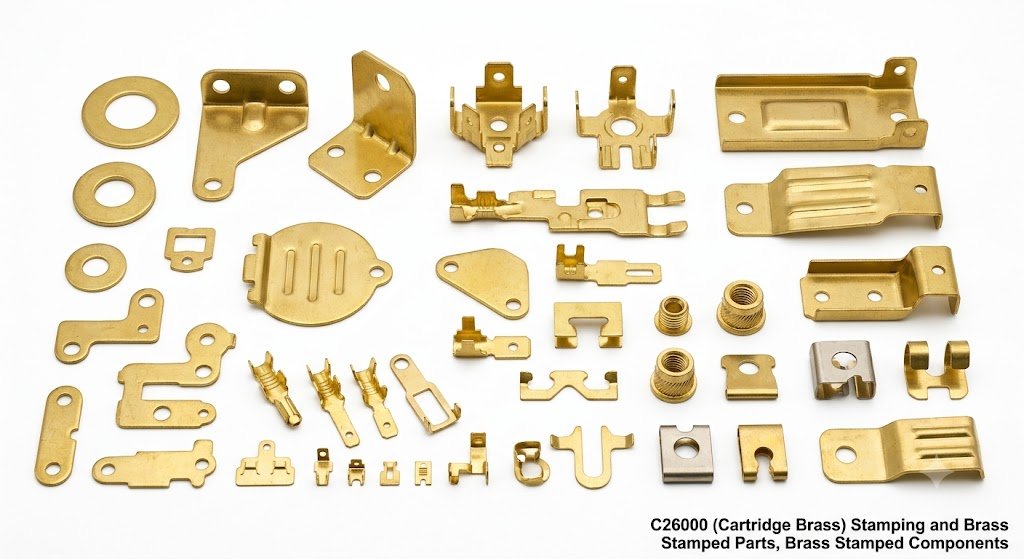
Manufacturer: Cable glands India | Price: US$17.90/kg
Cable glands india supplies C26000 cartridge brass stamping and stamped brass components for electrical, mechanical and industrial assemblies. We work from customer drawings to define the material condition, forming sequence, dimensional requirements and surface finish. The listed price is per kilogram; send your drawing and order quantity for a project quotation and confirmation of tooling, packing, delivery and commercial terms.
Commonly described as 70/30 brass or CuZn30 Brass , C26000 combines cold formability with useful electrical conductivity. It is a practical material for pressed terminals, contact strips, washers, brackets, eyelets and drawn shells where the design requires a formed sheet-metal component.
Request a C26000 stamping quotation | View our brass stamping manufacturing overview
C26000 chemical composition and material specification
C26000 is an alpha brass with nominally 70% copper and 30% zinc. Its ductility makes it particularly useful when a blank must undergo several forming operations. The UNS composition limits below identify the alloy; they do not define the delivered temper or dimensional tolerances.
| Element | UNS limits |
|---|---|
| Copper, Cu | 68.5–71.5% |
| Zinc, Zn | Remainder |
| Lead, Pb | 0.07% maximum |
| Iron, Fe | 0.05% maximum |
Copper plus the sum of named elements is at least 99.7%. Source: Copper Development Association C26000 alloy data.
Standards and comparable designations
ASTM B36/B36M covers brass plate, sheet, strip and rolled bar, including C26000. The purchase specification should state the applicable edition, product form, thickness, temper and acceptance requirements. See the ASTM B36/B36M scope. A sheet-material standard does not, by itself, specify every tolerance on the finished stamping.
CuZn30 / EN CW505L / JIS C2600 are comparable designations listed by Aurubis for connector strip. Cross-references are a starting point for procurement: chemistry limits, temper systems and test requirements must be checked before substitution. C26000 should not be ordered simply as “brass” when alloy identification matters.
Physical properties of 70/30 cartridge brass
| Property | Typical value | Design relevance |
|---|---|---|
| Density | 8.53 g/cm³ | Blank mass and component weight estimates |
| Electrical conductivity | About 28% IACS, approximately 16 MS/m | Conductor cross-section and resistance calculations |
| Thermal conductivity | Approximately 121 W/(m·K) | Heat transfer through the component |
| Elastic modulus | Approximately 110 GPa | Elastic deflection and stiffness calculations |
| Thermal expansion | Approximately 20 × 10⁻⁶/K over 20–300°C | Expansion relative to adjoining materials |
These are reference material properties, not a finished-part guarantee. Conductivity values refer to the soft condition in the Aurubis CuZn30 material datasheet. Operating temperature, cold work and joint design must be considered separately.
Temper selection, strength and forming behaviour
Specify both alloy and temper. A soft blank and a hard-rolled blank can share the same chemistry but behave differently in the die. Cold work raises strength and reduces the deformation available before cracking. Annealed material allows more forming; harder conditions may help achieve contact force or resistance to permanent deformation.
| Condition | Tensile strength, approximate | Elongation |
|---|---|---|
| Annealed, 0.050 mm grain size | 324 MPa | 62% |
| H01, quarter hard | 372 MPa | 43% |
| H02, half hard | 427 MPa | 23% |
| H04, hard | 524 MPa | 8% |
Values are illustrative for 0.04-inch (approximately 1.02 mm) flat products; elongation is measured over 2 inches. Strength values are rounded conversions from ksi. Source: CDA tensile-strength design guide. They are not universal purchase limits. Use the applicable material specification and mill certificate for acceptance.
For a formed spring contact, define the required load at a specified deflection and the allowable permanent set. Hardness alone cannot establish contact performance. Any soldering, brazing or annealing after stamping must be included in the process review because heat can change the cold-worked condition.
C26000 stamping and forming process
Our brass stamping programme includes progressive, compound and single-operation tooling. The choice depends on part complexity, projected volume and the number of forming stages. A simple washer may require blanking and piercing; a terminal with a formed tab may also need bending, coining or secondary machining.
- Drawing review: identify functional datums, critical dimensions, forming direction, mating parts and finish allowances before tooling design.
- Strip and blank planning: select thickness and temper, determine rolling direction and establish a strip layout that supports reliable feeding and part retention.
- Blanking and piercing: establish punch-to-die clearance and control cut edges, hole location and burr orientation.
- Forming: sequence bends, embossing, lancing or drawing so that local strain is distributed across suitable operations.
- Secondary operations: define deburring, tapping, cleaning, coating and any justified heat treatment in the agreed process route.
- First-article approval: verify drawing dimensions and functional checks before releasing repeat production.
Deep drawing and intermediate annealing
Cartridge brass is well suited to cold-formed sheet and strip products. For cups, shells and eyelets, blank-holder force, lubrication, die radii and drawing stages need coordinated development. Excessive restraint may promote tearing; insufficient control can allow wrinkling. A demanding part may need several draws and intermediate annealing instead of a single severe operation. These settings are established for the actual geometry and material condition.
The metallurgy behind this formability is described in the CDA introduction to alpha brasses.
Common Brass Stamping parts and Pressed Brass Components-
Electrical
- Brass Crimp terminals (ring, spade/fork, pin, blade, bullet)
- Socket contacts and receptacle Brass contacts
- Plug blades / switch blades
- Fuse clips and fuse holders
- Brass Spring contacts and contact tongues
- Relay contacts of Brass
- Brass Battery terminals and battery clips
- Brass Earth tags, earthing washers, and bonding clips
- Grounding lugs and straps
- Terminal plates and short bus links
- Neutral links / busbar links (small stamped)
- Connector housings and shells (drawn/formed)
- PCB terminals and press-fit pins
- Shielding clips and EMI/RFI shields
- Brass Cable lugs and clamps
- Brass Switchgear contact arms and trip mechanism stampings
- Circuit-breaker / MCB contact components
- Lighting fixture contacts and ceiling-rose parts
- Power-strip and wall-socket contacts
Industrial / general hardware
- Flat washers, spring washers, and lock washers
- Precision shims and spacers
- Mounting brackets and retaining clips
- Clamps and retaining plates
- Nameplates and identification tags
- Deep-drawn cups, shells, and covers
- Valve discs, seats, and sealing plates (lighter sections)
- Fastener blanks and formed hardware
- Sensor housings and electrode sheets
- Heat-dissipation / contact plates
- Automotive electrical clips, fuse-box strips, and connector pins
- Pneumatic / industrial coupling components (stamped portions)
Design guidance, tolerances and drawing requirements
Cable glands india’s general brass stamping range includes 0.2–6.0 mm material thickness and typical feature tolerances of ±0.05 mm to ±0.10 mm where geometry permits. These are enquiry guidelines from our brass stamping capability overview. C26000 feasibility, tool design and final tolerances are confirmed against your drawing; the full range does not apply to every part.
- Bend radius and rolling direction: state the inside radius and bend axis relative to rolling direction where critical. Avoid treating one radius-to-thickness ratio as suitable for every temper.
- Holes near bends: identify holes that locate mating parts. Forming can distort nearby holes or shift their positions, so the piercing sequence may require adjustment.
- Burr specification: show the permitted burr side, maximum burr height and edge-break requirements, particularly for contacts and parts handled during assembly.
- Flatness and datums: specify the inspection support condition. A thin free-state stamping can measure differently when clamped into its assembly.
- Coating allowance: mark dimensions that apply after plating. Coating on opposing surfaces can affect hole size, fit and contact clearances.
- Springback: validate bend angle and formed height after unloading. Tool compensation must account for material condition and thickness variation.
Mass and press-load estimation
For a flat blank, theoretical mass in kilograms is net area (mm²) × thickness (mm) × 8.53 × 10⁻⁶. For example, a 1,000 mm² blank at 1 mm thickness weighs approximately 0.00853 kg before allowances. Purchase weight, strip utilisation and finished-part weight are different quantities and should be identified in the quotation.
A first estimate of cutting force is cut perimeter × thickness × shear strength, using consistent units. Total press selection must also consider stripping force, forming loads, off-centre loading and the press load curve. Tensile strength should not be substituted for shear strength without an appropriate engineering basis.
Typical C26000 stamped brass components and applications
- Electrical assemblies: terminals, contact strips, connector elements and formed mounting features where current rating and contact-force requirements have been verified.
- Brass Terminals for batteries and plugs– Pressed Brass terminals and stamped parts for electrical use
- Brass Shims and Brass Washers: Brass stamped washers for various fastening applications
- Cable-gland and enclosure hardware: Brass earth tags, washers, clips and retaining pieces to customer dimensions.
- Mechanical hardware: shims, brackets, eyelets, grommets and formed covers with controlled fit and edge condition.
- Drawn parts: small cups, shells and sleeves requiring several forming stages.
- Appliance and instrument assemblies: stamped supports, conductive pieces and precision locating components.
The part’s service requirements determine whether C26000 is suitable. A high-current conductor, a repeatedly flexed spring and a decorative cover impose different electrical, fatigue and surface requirements even when their shapes appear similar.
Deburring, plating, joining and corrosion considerations
Discuss bare, cleaned brass or specified tin, nickel, silver and other finishes during quotation. Define coating thickness, masked regions, significant surfaces and tests relevant to the application. Specify whether dimensions apply before or after finishing and whether parts need individual protection against cosmetic damage.
C26000 can be soldered and brazed, but the heat cycle must be assessed against final hardness and geometry. Cold-worked brass is susceptible to stress-corrosion cracking in ammonia-bearing environments. Avoid ammonia-containing cleaning or storage conditions; discuss a validated stress-relief route when the application requires it. See the CuZn30 supplier guidance.
Request material and finish declarations for any required RoHS or REACH assessment. Alloy identification alone does not certify the complete coated component or its suitability for a regulated end use.
Inspection, traceability and production approval
Inspection should follow the drawing and an agreed control plan. Suitable checks include incoming alloy and temper verification, strip thickness, critical hole positions, bend angles, formed height, burr condition and final finish. Where required, the enquiry should identify first-article reports, material certificates, coating reports or PPAP documentation.
For contact components, add measurable functional requirements: force at working deflection, contact resistance, temperature rise or retention after thermal exposure. State the assembly and test conditions so that acceptance is repeatable. For repeat orders, retain the approved drawing revision and sample reference, and identify material or process changes that require renewed approval.
Quotation, lead time and export packing
Listed price: US$17.90 per kilogram. Please provide the drawing, temper, thickness, batch quantity and annual demand. Identify tooling ownership requirements, finishing, packaging, inspection documents and destination. The project quotation establishes the supply scope and delivery terms.
The general brass stamping programme indicates approximately 4–6 weeks including tooling; the C26000 production schedule is confirmed after drawing review and material planning. Packing can be discussed to protect edges, formed features and finished surfaces during transport and storage.
Contact Cable glands india: sales@cableglandsindia.com · +91 22 4344 9300
C26000 cartridge brass stamping FAQs
What is C26000 cartridge brass?
C26000 is a wrought copper-zinc alloy commonly called 70/30 cartridge brass. Its high cold formability makes sheet and strip suitable for stamped, bent and drawn components.
Is C26000 the same as CuZn30 or CW505L?
CuZn30, EN CW505L and JIS C2600 are commonly used comparable designations. Purchase to the specified standard and temper; compare chemistry, dimensions and mechanical requirements before approving substitution.
Which temper should I specify for a stamped brass component?
Use an annealed condition when substantial drawing or forming is required. Rolled tempers can suit flatter or less severely formed components needing higher strength. Select the final temper after reviewing bend direction, geometry, contact force and any subsequent heat exposure.
What tolerances can Cable glands india quote?
The general brass stamping range is typically ±0.05 mm to ±0.10 mm on suitable features. Final tolerances, burr limits, flatness and inspection methods are agreed after review of the C26000 drawing, thickness, temper and finish.
Can C26000 stamped parts be plated?
Tin, nickel, silver and other specified finishes can be discussed during quotation. Specify coating thickness, contact areas, masking and functional tests. Coating selection and processing must be compatible with the component’s use.
Is C26000 suitable for electrical contacts?
It can be used for formed electrical contact and terminal components where its conductivity and mechanical properties meet the design. Current rating, temperature rise, contact resistance and force retention must be validated on the finished assembly.
What is the price of C26000 stamped brass components?
The listed price is US$17.90 per kilogram. Send the drawing, quantity, temper and finish requirements for a project quotation and confirmation of tooling, packing, delivery and commercial terms.
What information is needed for a quotation?
Provide a dimensioned drawing or CAD file, C26000 material specification, temper, sheet thickness, order quantity, annual demand, finish and delivery destination. Identify critical dimensions, permitted burr direction and required inspection documents.
Back to Brass Stamping, Brass Stamped Parts and Brass Stamped Components