Aluminum Gravity Die Casting Parts
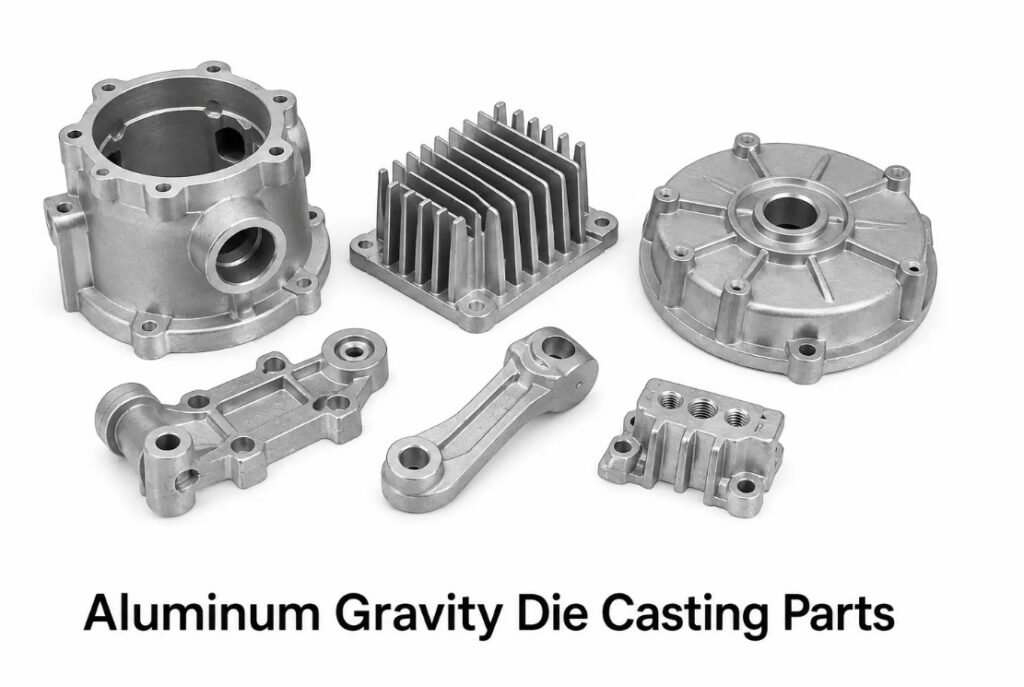
Permanent Mould Gravity Die Cast Aluminum Components for Electrical, Automotive and Industrial Applications
Cable Glands India manufactures Aluminum Gravity Die Casting Parts using permanent steel mould casting processes for medium-volume production of aluminum enclosures, housings, brackets, junction boxes and structural components. Gravity die casting produces denser, more mechanically sound castings than sand casting, with better surface finish and dimensional repeatability, supplied at US$ 17.90/kilogram CIF/FOB Indian port in LM6, LM24 and A356 aluminum casting alloys for electrical OEMs, EPC contractors and industrial equipment manufacturers worldwide.
Product Overview
Gravity die casting, also known as permanent mould casting, is a metal casting process in which molten aluminum is poured by gravity into a reusable steel mould (die) without external pressure, allowing controlled solidification and finer grain structure than sand casting while remaining more economical than high-pressure die casting for small to medium production volumes. Cable Glands India operates gravity die casting lines producing aluminum components from a few hundred grams up to several kilograms per casting.
The permanent steel mould used in gravity die casting yields significantly better dimensional consistency, surface finish and mechanical properties compared to sand casting, since the metal mould extracts heat faster and more uniformly, producing a finer as-cast grain structure with reduced porosity. This makes gravity die cast aluminum parts suitable for pressure-retaining housings, structural brackets and components requiring post-machining to tight tolerances.
Typical gravity die cast aluminum parts supplied by Cable Glands India include electrical enclosure housings, junction box bodies and covers, motor end brackets, pump housings, valve bodies, heat sink bodies, and structural brackets for panel and switchgear assemblies. The process is well suited to parts with moderate complexity, undercuts achievable through simple core pulls, and wall thicknesses from 3mm upward.
Cable Glands India’s gravity die casting alloys are selected according to application: LM6 (Al-Si12) for high fluidity and pressure tightness in housings exposed to weather or fluid contact; LM24 (Al-Si-Cu) for higher strength structural brackets; and A356 (Al-Si7Mg) for aerospace-grade mechanical properties after T6 heat treatment, where fatigue resistance and strength-to-weight ratio are critical.
Post-casting operations available include fettling and de-gating, shot blasting, heat treatment (solution treatment and artificial ageing for T6 temper), CNC machining of mating faces and mounting holes, powder coating or anodizing, and leak testing for pressure-retaining enclosures such as motor terminal boxes and pump housings.
Cable Glands India supports full end-to-end tooling development for gravity die casting projects, including in-house tool design review, mould manufacturing coordination, first-article inspection and production part approval process (PPAP) style documentation for OEM customers transferring an existing casting design or developing a new component from a 3D model.
Key Features
- Permanent steel mould process for superior dimensional repeatability versus sand casting
- LM6, LM24 and A356 aluminum casting alloy options
- T6 heat treatment available for enhanced strength and fatigue resistance
- Post-casting CNC machining, shot blasting and surface finishing available
- Priced at US$ 17.90/kilogram with tooling cost quoted separately per project
- Suitable for enclosures, brackets, housings and structural components
Permanent Mould Process Advantages
Compared to sand casting, gravity die casting in a reusable steel mould produces castings with finer grain structure, reduced porosity, better surface finish and tighter dimensional tolerances, while requiring lower tooling investment than high-pressure die casting, making it the preferred process for production volumes in the hundreds to low thousands of parts per year.
Aluminum Casting Alloy Selection
LM6 alloy offers excellent fluidity and pressure tightness for enclosure and housing applications; LM24 provides higher as-cast strength for structural brackets; A356 with T6 heat treatment delivers the highest strength-to-weight ratio for critical structural or safety components, and Cable Glands India’s metallurgical team assists customers in selecting the correct alloy and temper for their load and environmental requirements.
Heat Treatment and T6 Temper
Where higher strength and fatigue resistance are required, castings are solution heat treated and artificially aged to T6 temper, significantly improving yield strength and elongation compared to as-cast condition, particularly important for load-bearing brackets and safety-critical structural castings.
Post-Casting Machining and Finishing
Cast parts requiring precision mating faces, threaded holes, bearing bores or sealing surfaces are CNC machined after casting, followed by shot blasting for uniform surface texture and optional powder coating, anodizing or chromate conversion coating according to the end-use environment.
Tooling Development Support
Cable Glands India works directly from customer 3D CAD models or physical sample parts to develop gravity die casting tooling, including draft angle and parting line optimization for manufacturability, first-article dimensional inspection, and production part approval documentation for OEM quality systems.
Export Quality Control
Every production batch is checked for porosity (via visual and, where specified, X-ray or dye penetrant inspection), dimensional conformance and surface finish before packing, with mill certificates and inspection reports issued for export shipments.
Technical Specifications
| Parameter | Specification |
|---|---|
| Process | Gravity Die Casting (Permanent Mould) |
| Material | Aluminum Alloy LM6, LM24, A356 |
| Casting Weight Range | 0.1 kg to 15 kg per piece |
| Minimum Wall Thickness | 3mm |
| Heat Treatment | T6 available (Solution Treated + Artificially Aged) |
| Tolerance | CT7-CT9 as-cast, tighter with CNC machining |
| Surface Finish | As-cast, shot blasted, powder coated, anodized |
| Price | US$ 17.90/kilogram, CIF/FOB Indian port |
Aluminum Casting Alloy Grades
| Grade | Composition | Typical Use |
|---|---|---|
| LM6 (Al-Si12) | High silicon, excellent fluidity | Enclosures, housings, pressure-tight parts |
| LM24 (Al-Si-Cu) | Silicon-copper alloy | Structural brackets, medium strength parts |
| A356 (Al-Si7Mg) | Silicon-magnesium, heat treatable | High-strength structural and safety components |
International Equivalent Standards
| Country/Region | Standard Body | Equivalent Reference |
|---|---|---|
| India | BIS | IS 617 (Aluminum Casting Alloys) |
| Europe | EN | EN 1706 (EN AC-44100 / EN AC-42100) |
| USA | ASTM | ASTM B26 (SC84A / SG70A equivalents) |
| UK (legacy) | BS | LM6, LM24, LM25 |
Product Types and Variants
| Type | Description |
|---|---|
| Electrical Enclosure Housings | Junction box bodies and covers |
| Motor and Pump Brackets | End brackets, mounting brackets |
| Valve and Pump Housings | Pressure-retaining cast bodies |
| Heat Sink Bodies | Finned cast aluminum heat sinks |
| Structural Brackets | Panel and switchgear mounting brackets |
Applications in Industry
| Sector | Application |
|---|---|
| Electrical OEMs | Junction box and enclosure housings |
| Industrial Equipment | Pump and valve housings, motor brackets |
| EPC / Construction | Structural brackets and mounting hardware |
| Renewable Energy | Inverter and combiner box enclosures |
Manufacturing Process
Key process stages: (1) tool design and steel mould manufacture or customer-supplied tooling setup; (2) aluminum alloy melting and degassing; (3) gravity pouring into the preheated permanent mould; (4) controlled solidification and mould opening; (5) fettling, de-gating and shot blasting; (6) heat treatment (T6) where specified; (7) CNC machining of critical features; (8) surface finishing; (9) dimensional and porosity inspection; (10) packing and export documentation.
Quality Standards and Certifications
- ISO 9001:2015 certified manufacturing facility
- Alloy composition verified against IS 617 / EN 1706 / ASTM B26 references
- Porosity inspection via visual, and X-ray or dye penetrant on request
- Mill test certificates and dimensional inspection reports for export shipments
- First-article inspection and PPAP-style documentation available for OEM projects
Why Choose Cable Glands India
- In-house gravity die casting, heat treatment and CNC machining under one roof in Jamnagar, India
- Tooling development support from customer CAD models or sample parts
- Competitive export pricing at US$ 17.90/kilogram with transparent tooling cost quotation
- Alloy and heat treatment selection support for strength, weight and corrosion requirements
- Full documentation package for customs clearance and OEM quality approval
Frequently Asked Questions
What is gravity die casting?
It is a permanent mould casting process where molten aluminum is poured by gravity into a reusable steel mould, producing denser and more dimensionally consistent castings than sand casting.
What aluminum alloys are used?
LM6, LM24 and A356 are the standard alloys offered, selected according to fluidity, strength and heat treatment requirements.
Can gravity die cast parts be heat treated?
Yes, A356 and similar alloys can be solution treated and artificially aged to T6 temper for higher strength and fatigue resistance.
What is the minimum order quantity for casting projects?
Gravity die casting is economical from a few hundred pieces per year upward; exact minimums depend on tooling amortization and part size.
What is the price of aluminum gravity die cast parts?
Standard pricing is US$ 17.90/kilogram CIF/FOB Indian port; tooling cost is quoted separately per project.
Can you develop tooling from our 3D CAD model?
Yes, Cable Glands India provides tool design review, manufacturability feedback and mould development based on customer CAD data or physical samples.
What post-casting finishing is available?
Shot blasting, CNC machining, powder coating, anodizing and chromate conversion coating are all available.
Are castings tested for porosity?
Yes, visual inspection is standard, with X-ray or dye penetrant testing available for pressure-retaining or critical components.
What is the difference between gravity die casting and pressure die casting?
Gravity die casting relies on gravity to fill the mould, suited to medium volumes and thicker sections, while pressure die casting injects molten metal under high pressure for thinner walls and higher production rates.
Do you provide mill certificates?
Yes, mill test certificates and dimensional inspection reports are issued with every export shipment.
Equivalent Terms in Other Languages
| Language | Equivalent Terms |
|---|---|
| Spanish | Piezas de fundicion en coquilla de aluminio, Fundicion por gravedad, Piezas fundidas en molde permanente |
| Russian | Гравитационное литье алюминия, Литье в кокиль |
| French | Pieces coulees en aluminium par gravite, Coulee en moule permanent, Fonderie aluminium par gravite |
| Portuguese | Pecas fundidas em coquilha de aluminio, Fundicao por gravidade, Molde permanente de aluminio |
| Italian | Pezzi fusi in conchiglia di alluminio, Fusione per gravita, Stampo permanente in alluminio |
Related Aluminum and Casting Products
- Aluminum Terminal Bars, Aluminum Grounding Bars
- Aluminum Bronze Casting, Aluminum Bronze Casting Foundry
- Aluminum Parts, Aluminum Pressed Parts
- Aluminum Pressure Die Casting Parts (related product)
Request a Quote
Cable Glands India supplies Aluminum Gravity Die Casting Parts to electrical OEMs, EPC contractors and industrial equipment manufacturers worldwide at US$ 17.90/kilogram. Submit your drawing, alloy requirement and annual volume for a formal export quotation and tooling proposal. Email: sales@cableglandsindia.com | Phone: +91-22-43449300