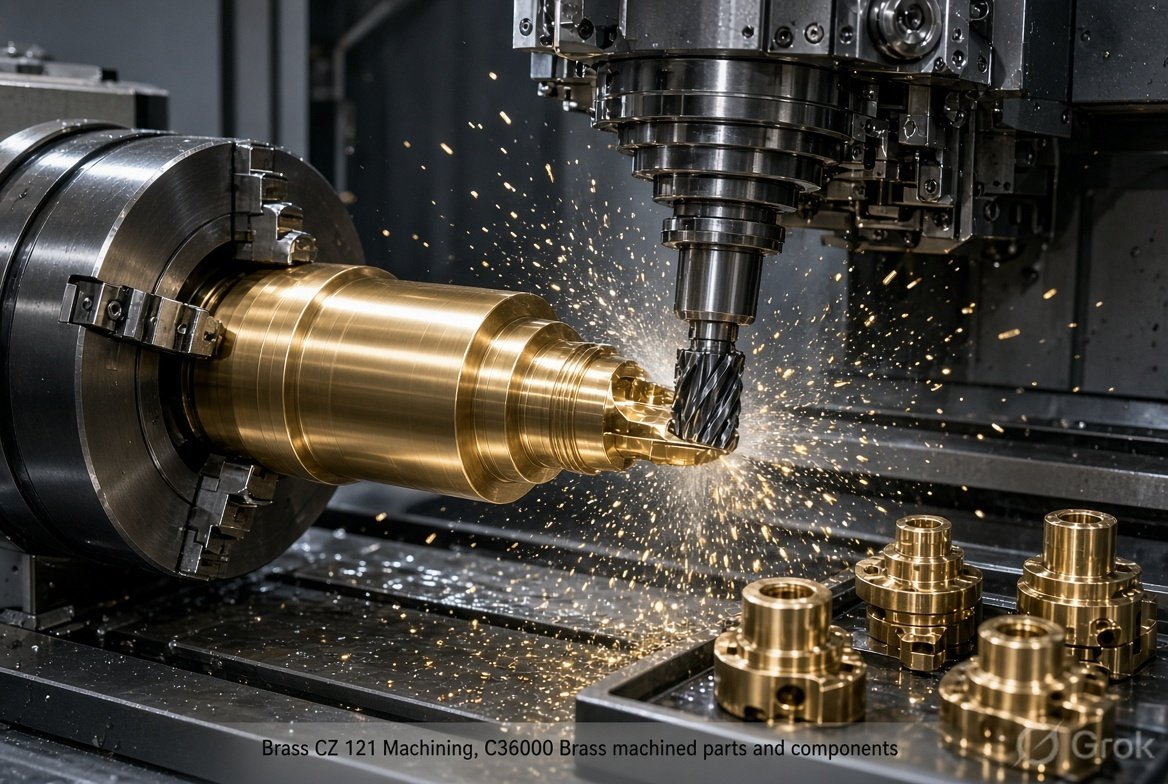
Brass Machining Grades: CZ121 Versus C36000
CZ121 and C36000 are familiar names when buying brass machined parts. Both are associated with free-cutting brass, making them useful starting points for threaded fittings, inserts, bushes and precision turned components. However, a drawing that specifies one grade should not automatically be fulfilled with the other.
The practical question is not simply which brass machines faster. It is which material meets the drawing, applicable product standard and service conditions while delivering a repeatable manufacturing process.
What are CZ121 and C36000?
CZ121 is a legacy British brass designation widely associated commercially with CW614N and CuZn39Pb3. C36000 is a UNS designation commonly called Alloy 360 or free-cutting brass. The naming systems come from different specification frameworks, so a commercial cross-reference is only the beginning of a material review.
Both contain deliberately added lead to improve machining. Lead helps the material produce manageable chips during cutting, which is valuable when turning small diameters, drilling holes and producing threads. The Copper Development Association uses C36000 as the reference alloy for a machinability rating of 100. That rating is a comparison index, not a guarantee of a particular cutting speed or cycle time. See the CDA guide to Alloy 360.
CZ121 versus C36000: the purchasing comparison
| Selection point | CZ121 | C36000 |
|---|---|---|
| Designation | Legacy British designation; commonly supplied with a modern material reference | UNS designation for free-cutting brass |
| Typical purchasing focus | Confirm the stated British or European standard and exact grade on the certificate | Confirm the applicable ASTM or other specified product standard and temper |
| Primary process | Turning, drilling, threading and related machining | Turning, drilling, threading and related machining |
| Substitution | Requires a comparison of chemistry, product form, condition and drawing requirements | |
| Lead restrictions | Neither should be ordered as a lead-free alloy | |
Supplier references can differ in how they relate older designations to current grades. For example, the Smiths Metal Centres CZ121 datasheet lists several related specifications. This is why a purchase order should identify the actual standard and revision rather than relying on the words “equivalent brass.”
How do they behave in machining?
For a bar-turned part, evaluate chip evacuation, tool life, burr formation and surface finish together. A short external turning operation may be straightforward, while a deep drilled hole or narrow internal groove can determine the whole cycle. A supplier should prove the difficult feature during the first-article stage.
Mechanical properties also depend on the supplied condition and section size. Avoid comparing an isolated tensile-strength figure for one grade with a figure for the other unless both refer to comparable stock. For a thin-walled threaded component, dimensional stability and the risk of distortion during clamping may matter more than a small difference in nominal strength.
When should another brass grade be considered?
Start again with material selection if the part needs substantial cold forming, a specified corrosion test, or a restricted lead content. A brass chosen for chip control is not automatically the best brass for deep drawing, spring action or potable-water contact.
Likewise, do not assume that a free-machining designation establishes dezincification resistance. If a component will contact a fluid, define the fluid, temperature and relevant acceptance tests. Where a lead-free material is required, specify an approved alternative and requalify the machining and finished component.
A checklist for buying brass machined parts
- State the grade, product standard, temper and required material certificate.
- Provide a drawing revision with thread forms, fits, datums and surface-finish requirements.
- Identify dimensions that apply after plating and any masked surfaces.
- Describe the operating environment and required product approvals.
- Agree a first-article inspection plan before repeat production.
Turning parameters, tolerances and inspection
Set a machining trial around the part’s critical features. Cutting speed, feed per revolution and depth of cut should be recorded with the tool grade and insert geometry. A successful setting for a rigid external diameter may not transfer to a slender part or a small internal bore.
For a cylindrical turning operation, spindle speed can be estimated from n = 1000Vc/(πD), with cutting speed Vc in metres per minute and diameter D in millimetres. For example, a trial value of 100 m/min at 20 mm diameter gives approximately 1,590 rpm. This is an arithmetic example, not a recommended cutting speed; use tooling guidance and validate the actual process.
Inspection should distinguish size from geometry. A diameter can be within tolerance while its roundness, runout or position prevents assembly. Threads need the specified gauging system, and sealing faces need a defined surface-finish requirement. If a part is plated, confirm which dimensions apply before and after coating.
Material substitution: a practical example
Suppose an existing insert drawing calls for CZ121 and a supplier proposes C36000. First compare the governing specifications and certificate chemistry. Then compare the supplied mechanical condition and the required thread, torque and retention performance. Review finishing and any restricted-substance requirement before accepting samples.
Approve the change against a drawing revision or documented concession. Keeping the decision traceable prevents a commercially convenient substitute from becoming an uncontrolled material change on later orders.
Frequently asked questions
Are CZ121 and C36000 exactly equivalent?
Do not treat them as automatically interchangeable. Similar machining applications do not establish identical composition limits or product requirements. Compare the actual standards and obtain approval where a drawing specifies a grade.
Which brass gives the best surface finish?
Both are associated with free-machining applications. The result depends on stock condition, tooling, cutting parameters, workholding and the feature being produced. Specify the required finish and verify it on the component.
Can I use either alloy for a formed spring contact?
Do not select a spring material from machinability alone. Evaluate the required bend, elastic deflection, retained force and electrical duty. A strip alloy and temper chosen for forming may be more appropriate.
Which grade should you choose?
Use the grade required by the design unless an alternative has been technically approved. If you are designing a new part, compare qualified stock availability and the cost of the finished component, including machining, inspection and finishing. A lower bar price alone does not establish a lower component cost.
Explore our CZ121 brass machined parts and C36000 brass component guide. To discuss a new requirement, send Cable Glands India your drawing, specified material and order quantity.