Copper Forgings – Copper Forged Parts and Forged Components
Rate: US$ 17.90/Kg
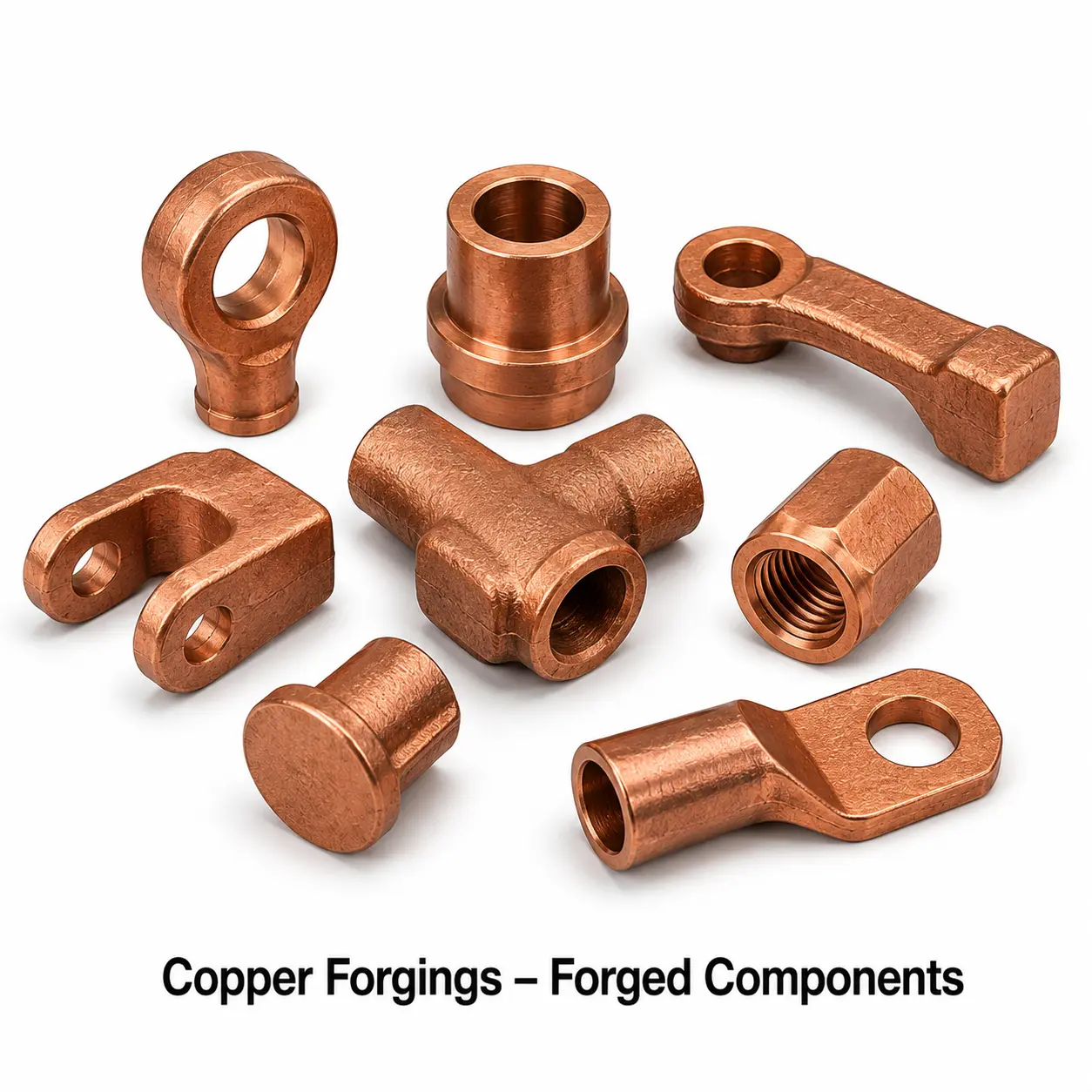
Cable Glands India manufactures copper forgings, supplied as copper forged parts, copper forged components, and closed-die forged copper connectors, produced by hot forging, cold forging, and impact extrusion of electrolytic copper billet into high-strength, precision-dimensioned blanks for electrical, power distribution, and industrial applications. Forging refines and aligns the internal grain structure of the copper along the shape of the finished part, which gives forged copper components higher mechanical strength, better fatigue resistance, and more consistent conductivity than an equivalent cast or machined-from-bar part. Electrical OEMs, EPC contractors, power utilities, and distributors specify forged copper components wherever a part must combine high electrical conductivity with load-bearing strength, such as terminal bodies, connector blanks, valve bodies, and structural electrical fittings.
Price: US$ 17.90 per kilogram | Custom pricing available for bulk and OEM orders
Product Overview
Function and Advantage of Forging in Copper Component Manufacturing
Forging shapes a solid copper billet under compressive force, either hot or cold, so that the metal flows into the die cavity rather than being cut away as in machining or poured as in casting. This flow aligns the copper grain structure along the contours of the finished part, closing internal porosity and producing a component with higher tensile strength, better impact resistance, and more predictable mechanical performance than a cast part of the same alloy and section size, which is why forged blanks are specified for connectors and fittings that must carry both electrical current and mechanical load.
Grain Flow and Mechanical Strength from Hot Forging
Hot forging works the copper billet above its recrystallization temperature, allowing large deformation with low forming force while refining grain size and closing internal voids carried over from the cast billet. The resulting grain flow follows the load path of the finished part, giving forged copper terminals, connector bodies, and structural fittings higher fatigue strength under vibration and thermal cycling than components machined from bar stock, where the grain is cut across rather than aligned with the part geometry.
Closed-Die and Open-Die Copper Forging Processes
Closed-die forging presses the heated copper billet into a shaped die cavity, producing a near-net-shape part with tight dimensional control and minimal machining allowance, suited to medium and high volume connector and fitting production. Open-die forging works the billet between flat or simple-profile dies without full shape constraint, and is used for larger blanks, custom prototype shapes, or where a subsequent machining operation will define the final geometry.
Cold Forging and Impact Extrusion for Precision Parts
Cold forging and impact extrusion form copper at or near room temperature, producing parts with a smooth as-formed surface finish, tight dimensional tolerance, and further grain refinement from the cold working itself. This process is used for small precision components such as ferrules, pins, and connector bodies, where the combination of high conductivity, precise dimensions, and a good surface finish are all required without a secondary machining pass.
High-Conductivity Copper Grades Used in Forging
Cable Glands India forges components from electrolytic tough pitch copper, oxygen-free copper, and phosphorus deoxidized copper grades selected for the balance of formability and conductivity required by the part. High-conductivity grades are specified for current-carrying connectors and terminals, while phosphorus-deoxidized grades are selected where the forged blank will later be welded or brazed as part of assembly.
CNC Machining and Finishing of Forged Blanks
Forged copper blanks are typically finish-machined on CNC lathes and machining centers to produce threads, bores, contact faces, and other precision features not formed directly in the die, combining the mechanical benefit of the forged grain structure with the dimensional precision of machining on the features that require it.
Forged vs Cast vs Machined Copper Components
Compared with sand or gravity die cast copper parts, forged components have higher density, better mechanical strength, and no shrinkage porosity, making them preferred for load-bearing or high-current terminal applications, while cast copper remains more economical for complex hollow shapes such as valve bodies produced in lower volumes. Compared with parts machined entirely from solid bar, forgings reduce material waste on parts with significant cross-section changes and produce a grain structure better aligned to the service loads of the finished component.
Compliance with Forging Dimensional Standards
Copper forgings are manufactured to dimensional and material references drawn from ASTM B283, DIN 1754, and BS EN 12420, which govern forged copper and copper alloy component dimensions, tolerances, and material properties, allowing forged blanks and finished components to be specified into installations governed by these standards.
Key Features
- Closed-die and open-die hot forging for connector bodies and structural fittings
- Cold forging and impact extrusion for precision ferrules and small connector parts
- High-conductivity electrolytic and oxygen-free copper grades
- CNC machining of threads, bores, and contact faces on forged blanks
- Refined grain flow for higher fatigue and impact strength than cast equivalents
- Custom die development for OEM connector and fitting geometries
- Manufactured to ASTM B283, DIN 1754, and BS EN 12420 dimensional references
- Heat treatment and stress relieving available on request
Closed-Die Forged Copper Connectors
Closed-die forged connector bodies are used where a terminal or connector must combine a specific external profile, such as a hex or flange, with internal bores for conductor entry, produced as a near-net shape blank that reduces machining time compared with starting from solid bar stock, while providing the grain-flow strength benefit of forging across the connector body.
Cold Forged Terminals and Ferrules
Small terminal and ferrule bodies are cold forged or impact extruded to final or near-final dimensions in a single operation, producing consistent wall thickness and a smooth bore surface suited to crimping or soldering, with high production repeatability for OEM volumes.
Forged Copper Valve and Fitting Bodies
Forged copper and copper alloy valve and pipe fitting bodies are specified where pressure-containing parts require the mechanical integrity of a forged grain structure, avoiding the porosity risk associated with casting on pressure-critical components.
Impact Extruded Copper Components
Impact extrusion forces a copper slug into or through a die under high-speed press action, producing thin-walled cup or tube shaped components such as ferrules and connector shells in a single stroke, with excellent dimensional repeatability for high-volume OEM supply.
Custom CNC Machined Forged Parts
Where a component requires features not achievable in the forging die, such as fine threads, cross-drilled holes, or precision bores, Cable Glands India finish-machines the forged blank on CNC equipment to the final drawing tolerance while retaining the forged grain structure through the load-bearing sections of the part.
Heat Treated and Stress Relieved Forgings
Forged copper components can be supplied stress relieved or heat treated where the application requires a controlled hardness or where residual forming stresses must be reduced prior to machining or service, particularly on parts that will be subsequently welded or brazed into an assembly.
Technical Specifications
| Parameter | Typical Range / Value |
|---|---|
| Forging process | Closed-die hot forging, open-die forging, cold forging, impact extrusion |
| Billet weight range | 0.01 kg to 15 kg per forged blank |
| Base material | Electrolytic tough pitch copper, oxygen-free copper, DHP copper |
| Post-forging operations | CNC machining, heat treatment, stress relieving, plating |
| Surface finish | As-forged, machined, or tin/silver plated on request |
| Conductivity | Up to 100% IACS depending on grade |
| Operating temperature | -40 degrees C to +150 degrees C (bare copper) |
| Standard packaging | Bulk carton or pallet, size-wise labelled |
Raw Material Grades
| Grade | Alloy Type | Key Properties |
|---|---|---|
| C11000 (ETP Copper) | Electrolytic tough pitch copper | 100% IACS conductivity, good forgeability |
| C10100 / C10200 (OFE / OF Copper) | Oxygen-free copper | High conductivity, low embrittlement risk when heated |
| C12200 (DHP Copper) | Phosphorus deoxidized copper | Good weldability and hot-forging behaviour |
International Equivalent Standards
| Country / Standard Body | Equivalent Reference |
|---|---|
| USA – ASTM | ASTM B283 (copper and copper alloy forgings) |
| Germany – DIN | DIN 1754 (copper forgings reference) |
| Europe – EN | BS EN 12420 (copper and copper alloy forgings) |
| India – IS | IS 191 (copper and copper alloy ingots and forging stock reference) |
| IEC | IEC 61238-1 (crimped and mechanical connection test methods, where applicable) |
Product Types and Variants
| Type | Description | Typical Use |
|---|---|---|
| Closed-die forged connector body | Near-net-shape hex or flanged body | Power connectors, terminal blocks |
| Open-die forged blank | Simple profile, larger section | Custom and low-volume parts, subsequent machining |
| Cold forged terminal / ferrule | Small precision cold-formed part | Crimp ferrules, small connector bodies |
| Impact extruded component | Thin-walled cup or tube shape | Ferrules, connector shells |
| Forged valve / fitting body | Pressure-rated forged shape | Pipe fittings, valve bodies |
| CNC finished forged part | Forged blank with machined features | Custom OEM connectors and fittings |
Applications in Industry
Power Distribution and Switchgear Connectors
Forged copper connector bodies and terminal blanks are used in switchgear, distribution boards, and bus bar systems, where the combination of high conductivity and forged mechanical strength supports both current-carrying and bolted mechanical loads.
Transformer and Substation Fittings
Forged copper and copper alloy fittings are specified for transformer and substation hardware where forged grain structure provides reliable performance under thermal cycling and mechanical stress from cable pull and fault-current forces.
Valve and Pipe Fitting Manufacturing
Forged copper and bronze valve bodies and pipe fittings are used in plumbing, marine, and industrial piping systems where pressure-containing parts benefit from the absence of casting porosity.
OEM Electrical Connector Manufacturing
Electrical OEMs source forged copper blanks as the starting stock for finish-machined connectors, terminals, and custom hardware, combining Cable Glands India’s forging capability with in-house or third-party finish machining.
Renewable Energy and Battery Systems
Forged copper terminal and busbar connector blanks are used in solar inverter, battery storage, and EV charging hardware where high conductivity must be combined with mechanical robustness under vibration.
Manufacturing Process
Cable Glands India manufactures copper forgings starting from certified electrolytic copper billet, which is induction heated for hot forging or processed at room temperature for cold forging and impact extrusion. Heated or room-temperature billets are formed under press or hammer force into closed-die or open-die tooling to produce the near-net-shape blank, which is then trimmed of flash, heat treated or stress relieved where specified, and finish machined on CNC lathes and machining centers to produce threads, bores, and precision features called for on the component drawing. Finished forgings are dimensionally inspected, sample tested for hardness and, where required, conductivity, and batch coded for traceability before plating, packing, and dispatch.
Quality Standards and Certifications
| Standard / Certification | Scope |
|---|---|
| ISO 9001 | Quality management system certification |
| ASTM B283 | Reference standard for copper and copper alloy forgings |
| DIN 1754 | Dimensional reference for copper forgings |
| BS EN 12420 | European reference for copper and copper alloy forgings |
| RoHS | Restriction of hazardous substances compliance on request |
Why Choose Cable Glands India
- In-house hot forging, cold forging, and impact extrusion capability
- CNC finish machining of forged blanks under one roof
- Custom die development for OEM connector and fitting geometries
- Batch-wise dimensional, hardness, and conductivity test certificates available
- Heat treatment and stress relieving available to specification
- Competitive per-kilogram pricing with volume and OEM discounts
Frequently Asked Questions
Q1: What is a copper forging?
A copper forging is a component shaped by compressing a solid copper billet, hot or cold, into or through a die, producing a grain structure aligned to the part geometry and higher mechanical strength than an equivalent cast part.
Q2: What is the difference between hot forging and cold forging?
Hot forging works copper above its recrystallization temperature for large deformation with lower force, while cold forging shapes copper near room temperature for tighter tolerances, a smoother finish, and additional strength from cold working.
Q3: Why choose a forged copper part instead of a casting?
Forged parts have higher density, no shrinkage porosity, and a grain structure aligned to the load path, giving better mechanical strength and fatigue resistance than a cast part of the same alloy and section size.
Q4: Can forged blanks be CNC machined to final dimensions?
Yes, Cable Glands India finish machines forged blanks on CNC lathes and machining centers to produce threads, bores, and other precision features not formed directly in the forging die.
Q5: What copper grades are used for forging?
Common grades include C11000 electrolytic tough pitch copper, C10100/C10200 oxygen-free copper, and C12200 phosphorus deoxidized copper, selected based on conductivity and forming requirements.
Q6: Is impact extrusion the same as forging?
Impact extrusion is a form of cold forging where a copper slug is forced into or through a die under high-speed press action, typically used for thin-walled cup or tube shaped parts such as ferrules.
Q7: Do you supply custom forging dies for OEM parts?
Yes, custom die development is available for OEM connector, terminal, and fitting geometries, including prototype open-die forging before committing to production tooling.
Q8: What standards do your copper forgings comply with?
Copper forgings are manufactured to dimensional and material references drawn from ASTM B283, DIN 1754, and BS EN 12420.
Q9: Do you supply test certificates?
Yes, every batch is supplied with dimensional, hardness, and where applicable conductivity test certification on request.
Q10: What is the standard lead time?
Standard lead time is 4 to 8 weeks depending on die development requirements, quantity, and finish machining scope, with expedited options available for existing tooling.
International Equivalent Terms
| Language | Equivalent Terms |
|---|---|
| Spanish | Forja de cobre, Piezas de cobre forjado |
| Russian | Mednaya kovka, Kovanye mednye detali |
| French | Forge de cuivre, Pieces en cuivre forge |
| Portuguese | Forjamento de cobre, Pecas de cobre forjado |
| Italian | Forgiatura del rame, Componenti in rame forgiato |
Linked Parts and Related Terms
Copper Forging, Copper Forged Parts, Closed-Die Forged Copper Connector, Cold Forged Copper Terminal, Impact Extruded Copper Ferrule, Forged Copper Valve Body, Copper Billet Forging.
Related Products in this Category
Get a Quote – Copper Forgings
Ready to source copper forgings or forged copper components for power distribution, OEM connector, or industrial fitting applications? Our engineering team can recommend the correct forging process and grade for your project.
Price: US$ 17.90 per kilogram | Custom pricing available for bulk and OEM orders
Email: sales@cableglandsindia.com
Phone / WhatsApp: +91-22-43449300
Website: www.cableglandsindia.com
Share your project specifications, required quantities, and preferred delivery timeline, and we will respond with a detailed quotation within one business day.