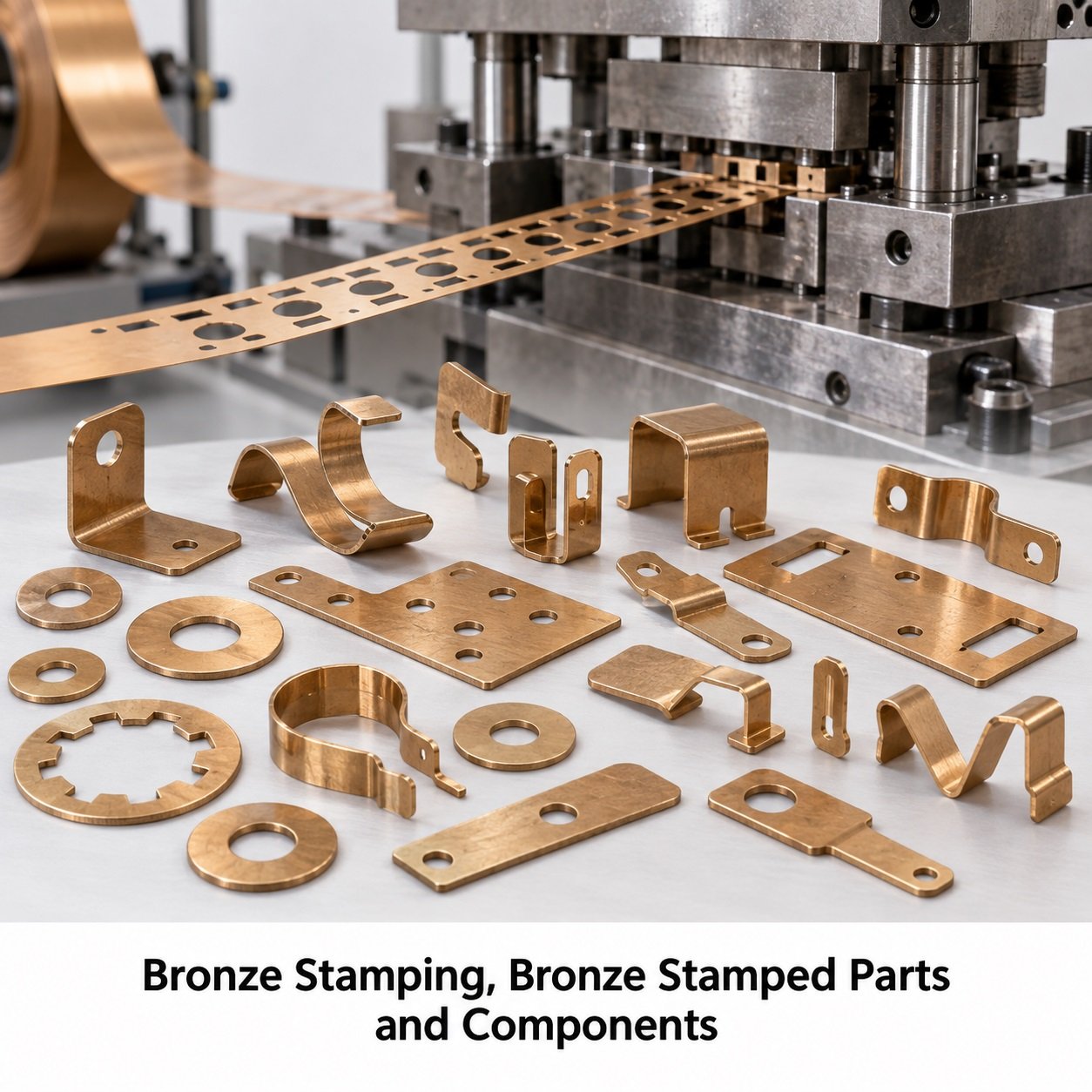
Bronze Stamping, Bronze Stamped Parts and Components:
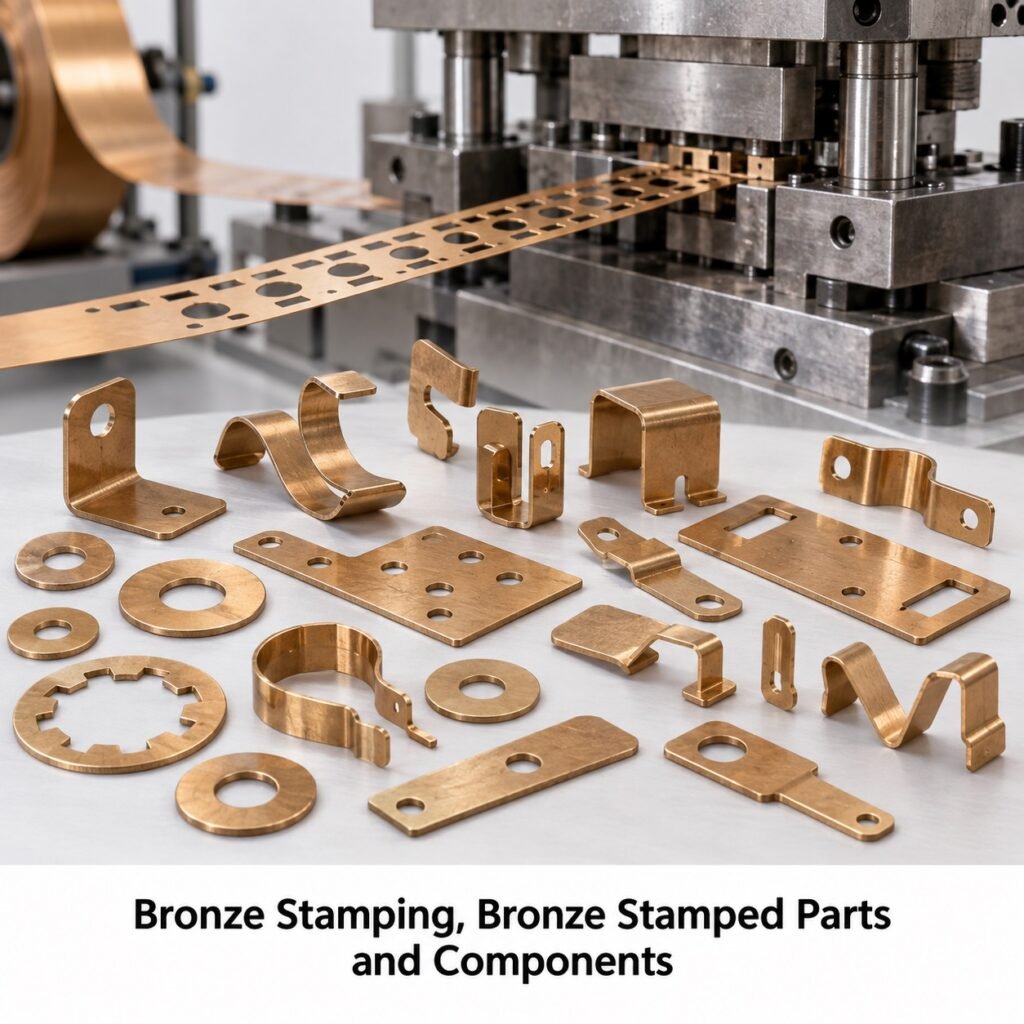
Bronze stamping produces shaped components from sheet or strip using operations such as blanking, piercing and bending. For parts that need spring action as well as electrical contact, phosphor bronze is often a useful material to evaluate. Typical designs include contact fingers, retaining clips, spring washers and formed conductive components.
The value of bronze stamped parts depends on more than the alloy name. Grade, strip thickness, temper, bend geometry and surface finish work together. A component can meet its dimensional drawing and still fail to deliver the required contact force if those details are not specified.
What is bronze stamping?
A stamping die cuts or forms a flat blank under press load. A simple washer may need blanking and piercing, while a spring contact may also require several bends, embossing or coining. A progressive die carries the strip through successive stations; other parts are more suitable for individual operations, particularly during development or at lower volumes.
Stamped bronze components begin with wrought sheet or strip. This is a different manufacturing route from pouring a bronze casting and machining it. A cast bearing alloy should not be substituted for a specified strip alloy simply because both are called bronze.
Which bronze grades are used for stamped parts?
Phosphor bronzes are copper-tin-phosphorus alloys. Two established grades are C51000, commonly described as 5% phosphor bronze, and C52100, commonly described as 8% phosphor bronze. Their composition ranges provide a starting point for selection; the purchase specification also needs to define the product form and condition.
| Grade | Tin content by mass | Selection focus |
|---|---|---|
| C51000 | 4.2–5.8% | A candidate for formed contacts and general spring components; compare available tempers and bend data |
| C52100 | 7.0–9.0% | A candidate when the design needs higher spring strength; check remaining formability in the chosen temper |
Composition references: the CDA profiles for C51000 and C52100, and its UNS wrought bronze register. Nominal tin percentages are convenient names, not complete chemical specifications.
Other bronze families may suit specialised parts, but availability as strip, forming performance and the intended service must be checked. There is no single bronze grade that is best for every stamping.
Why temper matters as much as grade
Cold working increases strength while reducing the deformation available before cracking. A softer strip may permit a demanding bend, whereas a harder temper can support a greater elastic load if the geometry can be formed successfully. “Spring bronze” is therefore not a complete purchasing description.
The CDA formability guide explains the relationship between strength and minimum bend radius. Use bend information for the actual alloy, temper, thickness and rolling direction. Avoid applying one universal radius-to-thickness ratio to every bronze component.
Typical uses of bronze stamped components
- Electrical contacts: formed fingers and contact strips where spring force and electrical performance must be balanced.
- Mechanical retention: clips, tabs and spring elements that hold an assembly in position.
- Spacing and preload: shims and formed washers with a specified load-deflection requirement.
- Instrument mechanisms: small formed elements requiring controlled movement and repeatable geometry.
For an electrical contact, specify more than a maximum current. Contact resistance, temperature rise, mating finish, insertion cycles and retained force can all affect suitability. For a mechanical clip, state the installation deflection, required holding load and allowable permanent set.
Advantages of bronze stamping
Integrated functions: a single formed strip can combine a mounting feature, spring arm and contact region. This can reduce separate components, provided each function is verified.
Repeatable production: tooling can reproduce a developed geometry across a batch. Stable strip properties, controlled feeding and scheduled die maintenance are still necessary to maintain that result.
Efficient manufacture of thin parts: stamping can avoid machining a thin component from solid stock. The economic comparison must include tooling, strip utilisation, production volume and secondary finishing.
Useful material balance: phosphor bronze offers a combination of strength, corrosion resistance and conductivity worth considering for spring contacts. It is not a substitute for a conductivity or environmental assessment of the complete assembly.
Design details that prevent production problems
| Feature | What to specify or review |
|---|---|
| Bends | Inside radius, bend angle, rolling direction and the condition in which the angle is measured |
| Holes near bends | Position after forming and whether distortion affects assembly |
| Cut edges | Permitted burr side, burr height and required edge break |
| Flatness | Free-state or supported measurement and functional datums |
| Spring features | Force at a defined deflection, permanent set and required cycle life |
| Plated surfaces | Coating system, thickness, masking and dimensions after finishing |
Keep drawing tolerances tied to function. Tightening every dimension can increase die complexity without improving assembly performance. Identify the few characteristics that control fit, force or electrical contact and agree how they will be measured.
Spring geometry: a useful engineering check
For an ideal rectangular cantilever with a small end deflection, force is proportional to Ebt³δ/(4L³), where E is elastic modulus, b is width, t is thickness, δ is deflection and L is free length. This simple model shows why thickness and free-length variation can strongly affect spring force.
Real stamped contacts often have bends, changing sections and complex restraint, so this relationship is a design check rather than a finished-part prediction. Validate the actual geometry by calculation, simulation where appropriate, and load-deflection testing. Hardness alone cannot demonstrate contact performance.
Inspection and quotation requirements
Agree incoming strip certification, thickness checks, critical dimensions, burr inspection and functional tests. When plating or heating follows forming, check the part again after that process. Retain the approved drawing revision and first-article results for repeat orders.
To request a quotation, provide the alloy, temper, strip thickness, drawing or CAD file, batch quantity, annual demand and finish. Include operating conditions and any requirements for material certificates, traceability or sample approval.
Frequently asked questions
Is C52100 always better than C51000?
No. Compare strength, formability, conductivity and cost for the actual part and supplied condition. A stronger material is not useful if the required bend cracks or the finished contact fails its electrical test.
Can bronze stampings be plated?
Plating can be specified, but the coating must suit the contact, joining or corrosion requirement. Confirm adhesion, thickness and dimensional allowance with the finishing process.
Are stamped bronze parts the same as bronze castings?
No. Stamping forms wrought sheet or strip. Casting starts with molten metal. Their grades, geometry options and qualification requirements differ.
Explore our bronze pressed parts and phosphor bronze stamping range. For a project discussion, send Cable Glands India your drawing and required material condition.