Indicative rate: US$ 15.60/kg — custom manufacture subject to drawing, quantity, tooling and finish review.
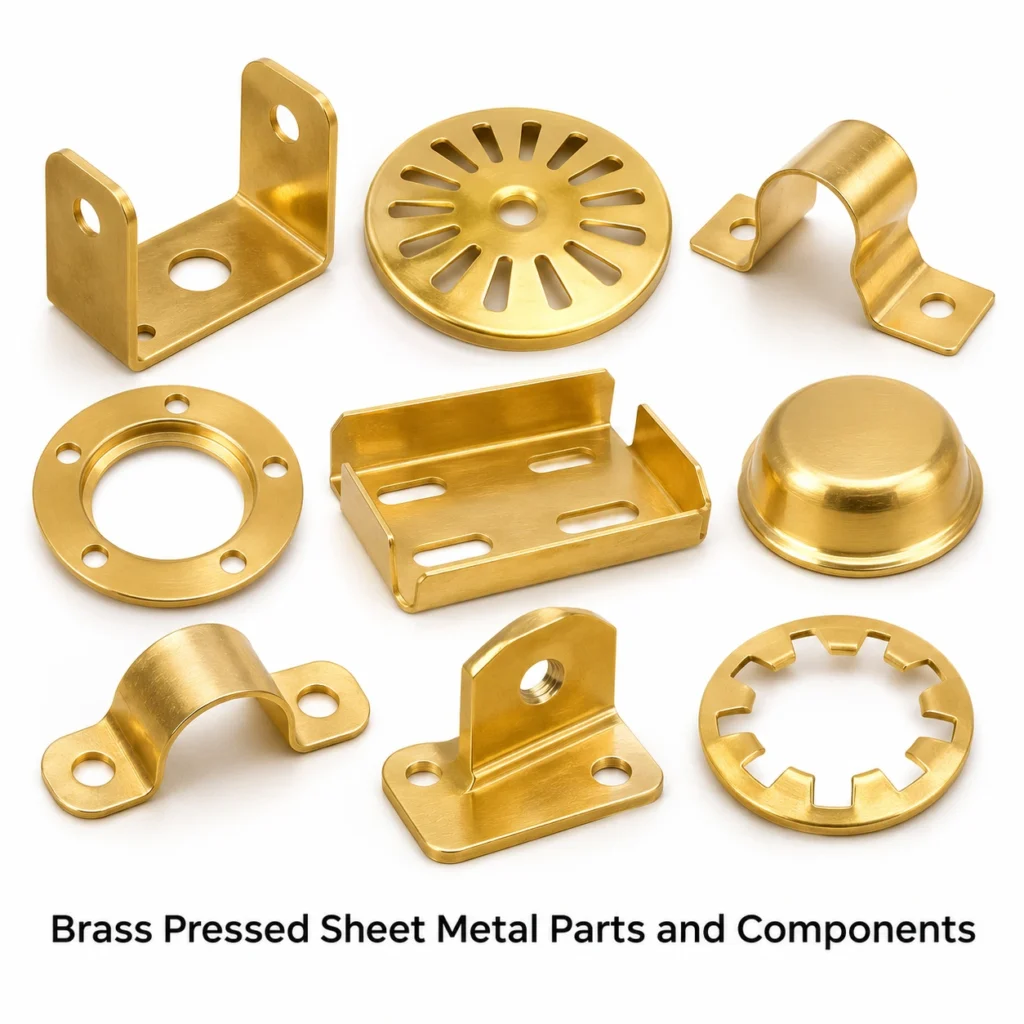
Cable Glands India supplies 63/37 brass pressed parts manufactured from specified brass sheet and strip for electrical OEMs, EPC contractors, power utilities and industrial distributors. The range includes blanked washers, bent mounting plates, cover plates and formed connector hardware. Components are manufactured against approved drawings with defined alloy, temper, inspection and finish requirements, supporting repeat orders and traceable procurement from India for domestic and export projects.
Product Overview
Alloy identity and purchasing specification
CW508L is CuZn37 and legacy CZ108. C27200 and C27400 are related US yellow-brass designations with different permitted chemistry ranges. They must be ordered separately or explicitly dual certified; neither is automatically identical to every CW508L lot. The 63/37 family serves sheet-metal parts with useful cold formability and a yellow appearance. For critical bends, compare the actual sheet temper and elongation rather than selecting solely from the alloy name. C27200 and C27400 options are reviewed individually against the drawing.
Blanking and precision piercing
Blanking establishes the external profile while piercing produces holes, slots, windows and assembly openings. Tool clearances are selected for sheet thickness, alloy and temper to control cut-edge quality and tool wear. A drawing should distinguish functional holes from clearance holes and identify the permitted burr side. Closely spaced features, narrow webs and small radii are reviewed before tooling because they influence strip stability and punch life. Nesting also affects material utilisation and the conversion cost of the finished component.
Bending and formed mounting features
Bent tabs, mounting feet, folded edges and offset sections position a component within an assembly. The bend radius must suit the actual temper, sheet thickness and grain orientation. Springback is managed through tool design and sample validation rather than a universal angle allowance. Dimensions taken across several bends need realistic datum schemes to avoid cumulative variation. Where a mating face controls assembly, that face should be identified on the drawing and checked with a suitable fixture after forming.
Hollow shells and drawn components
Cups, collars and shallow shells require a different assessment from flat stampings. Blank holding, lubrication and draw sequence influence wrinkling, wall thinning and surface marks. A smooth external appearance does not prove acceptable minimum wall thickness. For hollow parts, specify the functional diameter, flange dimensions, allowed thinning and inspection method. Intermediate annealing or additional redraw stages may be necessary. Tooling feasibility determines whether the selected alloy and requested geometry are compatible with reliable production.
Electrical contact and terminal hardware
Terminal plates, connector retainers, bonding accessories and contact carriers may combine mechanical location with an electrical function. Current rating belongs to the complete assembly and cannot be inferred from brass grade alone. Contact area, plating, fastening force, temperature rise and mating material all matter. When a pressed part carries current, the customer should define the electrical test requirement and operating conditions. Brass generally has lower conductivity than pure copper, so direct substitution requires an engineering assessment.
Surface condition and edge requirements
Pressed sheet components can show witness marks, drawing lines and local changes in reflectivity even when dimensionally acceptable. Cosmetic faces should therefore be identified separately from non-visible areas. Burr height, sharp-edge limits and permissible tool marks are agreed against function and handling requirements. Deburring must preserve locating edges and small features. A sample finish standard is useful where appearance affects acceptance, while individual separators can protect visible surfaces during packing and movement between manufacturing stages.
Repeat production and assembly consistency
A released drawing, approved sample and inspection plan establish the production baseline. Repeatability depends on incoming strip consistency, tool condition, press setup and controlled handling after forming. For distributor programmes, packaging quantities and identification should match the downstream stock system. For OEM releases, revision control avoids mixing components made to different drawings. Changes to material, tooling, plating or packing should be assessed against the agreed approval process, especially where the part forms part of a qualified electrical assembly.
Key Features
- Drawing-based 63/37 brass pressed parts from specified sheet or strip.
- Blanked, pierced, bent and formed variants matched to geometry.
- Alloy and temper reviewed together for manufacturability.
- Deburring and surface finish requirements defined at quotation.
- Prototype and production tooling routes evaluated by quantity.
- Inspection and material documentation agreed before release.
- Indicative price: US$ 15.60/kg.
Temper and cold-forming behaviour
Annealed material offers greater forming freedom, while harder tempers can improve resistance to permanent deformation in service. Forming itself changes the local material condition through work hardening. Consequently, the incoming sheet hardness is not necessarily the finished-part hardness at every location. Select temper alongside the bend radius and service load. A component required to flex repeatedly needs a specific fatigue and stress-relaxation assessment rather than an assumption that any brass stamping is a suitable spring.
Datums, flatness and dimensional control
Critical mating features should be dimensioned from functional datums so manufacturing inspection reflects the assembly. Flatness of a plate, position of a pierced hole and height of a bent flange are separate characteristics with different process drivers. Measuring an unsupported flexible part may give misleading results. Where needed, define the restraint condition and inspection fixture. Statistical capability targets are meaningful only after the process, measurement system and sampling plan have been agreed for the actual component.
Coatings, solderability and contact surfaces
Tin plating may be considered for soldered or electrical interfaces; nickel may be selected for wear, appearance or a barrier layer. Coating thickness and underlayers influence dimensions, corrosion behaviour and mating forces. Masking can be necessary on particular faces or holes. Solderability depends on surface cleanliness, storage and the joining process, so the finish specification should include the acceptance test where relevant. Coating approval must also consider the intended service environment and the customer’s substance restrictions.
Material traceability and substitution control
A traceable order identifies the incoming material batch and associates it with the production lot. Certification should describe the purchased grade and relevant results, not merely repeat a commercial name. When supply conditions require an alternative grade, compare chemistry limits, mechanical properties, temper, surface and dimensional requirements. The customer must approve a substitution before manufacture. Retaining the approved material decision with the drawing revision reduces future ambiguity and supports consistent procurement across repeated deliveries.
Corrosion, residual stress and service selection
Brass can tarnish during storage and service. Tarnish differs from structural corrosion, but it may affect appearance and electrical interfaces. Stressed brass can be vulnerable in environments containing ammonia, and some water conditions can promote dezincification. Standard CuZn sheet grades should not be described as DZR without evidence. Residual-stress treatment, protective finish and packaging are considered against the application. Where exposure is severe, material selection should include a documented assessment of the complete assembly and environment.
Tooling strategy and cost drivers
Simple profiles may use single-operation tooling, while repeated high-volume parts may justify compound or progressive dies. The appropriate route depends on annual demand, release quantity, feature complexity and acceptable investment. Tooling cost is distinct from the metal rate. Strip nesting, scrap recovery, secondary operations and inspection effort affect the conversion cost. Design review may identify changes to hole spacing, bend sequence or flange geometry that improve production stability while preserving the component’s functional requirements.
Technical Specifications
| Parameter | Requirement / quotation basis |
|---|---|
| Product family | 63/37 brass pressed parts |
| Primary material | CW508L / CZ108 / CuZn37; C27200 or C27400 by specification |
| Nominal composition | Nominally 63% copper for CuZn37; UNS limits differ |
| Raw form | Rolled sheet or strip; mill standard and temper specified on order |
| Thickness | To approved drawing; feasibility depends on alloy, size and process |
| Manufacturing | Blanking, piercing, forming, bending; drawing where technically suitable |
| Mechanical properties | Tensile strength, elongation and hardness depend on grade, temper and thickness; certificate values govern |
| Dimensions and tolerances | Drawing-specific; no blanket tolerance or draw-ratio guarantee |
| Surface options | Bare, anti-tarnish, nickel or tin as agreed |
| Inspection | Dimensions, edges, visual condition and specified material/finish checks |
| Supply location | India; manufacture and dispatch arrangements confirmed in quotation |
| Price | US$ 15.60/kg indicative; tooling and delivery terms confirmed separately |
Raw Material Grades and International Comparisons
CW508L is CuZn37 and legacy CZ108. C27200 and C27400 are related US yellow-brass designations with different permitted chemistry ranges. They must be ordered separately or explicitly dual certified; neither is automatically identical to every CW508L lot. The following is a purchasing guide, not a statement of automatic interchangeability. ASTM B36/B36M, EN 1652 or another agreed flat-product standard defines requirements where applicable. Legacy BS names assist identification but should be supported by a current specification.
| Nominal family | EN designation | Legacy BS | US comparison / qualification |
|---|---|---|---|
| 70/30 cartridge brass | CuZn30 / CW505L | CZ106 | C26000; verify standard and temper |
| CuZn33 family | CW506L | Specify current standard | C26800 commonly compared; verify lot chemistry |
| Commercial 65/35 / CuZn36 | CW507L | CZ107 | C27000 commonly compared; not blanket dual compliance |
| 63/37 brass | CuZn37 / CW508L | CZ108 | C27200 / C27400 are separately defined grades |
| 60/40 Muntz-type brass | CuZn40 / CW509L | CZ109 | C28000 commonly compared; limited severe cold-forming suitability |
Product Types and Variants
| Variant | Features to define |
|---|---|
| Blanked washers, bent mounting plates, cover plates and formed connector hardware | Drawing, alloy, temper, dimensions and finish |
| Flat punched plates and washers | Hole pattern, edge distance, burr direction and flatness |
| Bent brackets and retainers | Bend radii, angle, grain direction and assembly datums |
| Shallow covers and shells | Depth, corner radii, flange and allowed tool marks |
| Terminal and contact carriers | Contact zone, coating and assembly test requirements |
| OEM kits and distributor packs | Part identification, batch quantity and surface protection |
Industrial Applications
Electrical OEMs use pressed brass parts within connector assemblies, terminal systems, control equipment and mounting hardware. EPC contractors and panel builders may purchase drawing-specific brackets, gland plates and fixing details for equipment packages. Utilities specify such components through approved equipment designs rather than choosing them solely by alloy. Distributors can support recurring OEM demand when drawings, revisions and certification are clearly controlled. All application examples require verification against the actual assembly loads, environment and electrical acceptance tests.
| Customer / sector | Typical application | Engineering consideration |
|---|---|---|
| Electrical OEM | Terminal plates and connector hardware | Contact resistance, temperature rise and fit |
| Switchgear and panel builders | Mounting brackets and cover plates | Clearance, flatness and fastening |
| EPC contractors | Project-specific enclosure accessories | Approved drawing and documentation |
| Power utilities | Parts within qualified equipment | Equipment approval and service environment |
| Industrial distributors | Repeat drawing-based components | Revision, packaging and traceability |
Manufacturing Process
- Engineering review: compare drawing, alloy, temper, finish, quantity and acceptance criteria before selecting the production route.
- Material procurement: order the specified rolled sheet or strip and review its mill documentation against the purchase requirement.
- Tool development: plan nesting, clearances, bending or drawing stages and any secondary operations; validate initial samples.
- Press operations: blank and pierce the profile, then form the required features using the approved sequence and process settings.
- Secondary operations: perform trimming, deburring, cleaning or other drawing-defined work without damaging functional faces.
- Surface treatment: apply the approved finish where specified and verify the agreed coating characteristics.
- Final verification: inspect dimensions, visual condition, edge quality and the order-specific documentation.
- Packing and release: identify production batches, protect surfaces and prepare the agreed shipping and inspection records.
Quality Standards and Certifications
Material standards and management-system certificates have different purposes. ASTM B36/B36M and EN 1652 concern relevant brass flat products; they do not certify a finished electrical assembly. ISO 9001:2015 relates to the quality management system, with the current certificate and scope available for review. RoHS and REACH requirements must be assessed against the actual alloy, coating and supplied article. They are not blanket approvals for every application. Request current declarations and any required test evidence at quotation stage.
Inspection plans should identify the characteristics affecting fit, form and function. Material identification, dimensional checks, coating verification and visual criteria are agreed according to the drawing. Special tests, independent inspection, first-article reporting or customer forms must be requested before production. Do not assume that a standard certificate includes conductivity, fatigue, salt-spray or assembly qualification results. Any test method, sample quantity and acceptance limit should be stated explicitly in the purchase agreement.
Why Choose Cable Glands India
Cable Glands India provides a single technical enquiry route for brass sheet components, tooling review and repeat supply. The practical objective is a component that matches the approved drawing and is documented at the level the customer requires. Buyers can compare material options, forming routes and finish requirements before committing to tooling. Clear quotations distinguish alloy, conversion work, tooling, inspection and delivery assumptions, making it easier to evaluate total procurement cost and manage repeat orders.
Frequently Asked Questions
What alloy should I put on the purchase order?
CW508L is CuZn37 and legacy CZ108. C27200 and C27400 are related US yellow-brass designations with different permitted chemistry ranges. They must be ordered separately or explicitly dual certified; neither is automatically identical to every CW508L lot. State the standard edition, thickness, temper and certification requirement as well as the drawing revision.
Can these parts be made from a customer drawing?
Yes. Supply a dimensioned drawing and, where available, a three-dimensional model. Identify assembly datums, critical dimensions, annual demand, finish and acceptance tests. Samples and tooling are reviewed before production release.
What is the price per kilogram?
The indicative rate is US$ 15.60/kg. The final quotation depends on geometry, material yield, quantity, finish, inspection and packaging. Tooling, freight, taxes and special testing must be confirmed in the quotation; a kilogram price alone does not define the finished-part cost.
Are all listed grades exact international equivalents?
No. Cross-reference names identify comparable families. Chemistry limits, temper definitions and mechanical requirements can differ between standards. Only a mill certificate demonstrating compliance supports a dual-standard claim. Substitution requires written technical approval.
Can you supply deep-drawn versions?
Hollow geometry is assessed using alloy, temper, blank diameter, drawing depth, corner radii and wall-thinning limits. Multiple draws and intermediate annealing may be needed. CuZn40 requires particular caution for severe cold forming; no universal draw ratio is promised.
Which tolerances can be achieved?
Tolerances are agreed feature by feature after tooling and process review. A flat punched feature behaves differently from a formed flange or drawn wall. Identify critical dimensions and inspection datums; general tolerance classes apply only when expressly accepted.
Are nickel and tin finishes available?
Bare brass, anti-tarnish treatment, nickel or tin finishes can be evaluated against the application. Specify coating thickness, coverage, contact or soldering requirements and any restricted substances. Validate the complete finish system rather than relying on the coating name.
Are these grades suitable for water contact or corrosive locations?
Standard yellow brass is not automatically dezincification resistant or approved for potable water. Ammonia, chlorides, residual stress and moisture can affect service performance. Water-contact, marine or aggressive-environment applications require separate material and regulatory review.
What documentation can be requested?
Request the material certificate, dimensional inspection report, approved sample record and finish verification at quotation stage. Any special traceability, third-party witnessing or regulatory declaration must be agreed before manufacture so the evidence can be retained.
What information is needed for an OEM quotation?
Provide alloy and standard, drawing revision, quantity per release, annual forecast, sheet thickness and temper, surface finish, inspection criteria and delivery destination. State whether the order is for prototypes, tooling approval or recurring production.
Equivalent Search Terms in Other Languages
| Language | Related technical terms |
|---|---|
| Spanish | Piezas de latón estampadas; componentes de chapa de latón; embutición de latón |
| Russian | Латунные штампованные детали; детали из листовой латуни; глубокая вытяжка латуни |
| French | Pièces en laiton embouties; composants en tôle de laiton; emboutissage du laiton |
| Portuguese | Peças de latão estampadas; componentes de chapa de latão; estampagem profunda de latão |
| Italian | Parti in ottone stampate; componenti in lamiera di ottone; imbutitura dell’ottone |
Request a Technical Quotation
Send your drawing revision, required alloy and standard, sheet temper, quantity and finish through our contact page. Include critical dimensions, inspection requirements and delivery destination. Our quotation will confirm feasibility, tooling, sample approval and commercial terms. Indicative product rate: US$ 15.60/kg. Approval of samples and specifications establishes the basis for production supply.
Related Brass Sheet Metal Parts and Terms
Brass sheet metal pressed components — parent range
- Brass Deep Drawn Parts 70/30 Brass CW505L CZ106 C26000 Grade Components
- Brass 65/35 CW507L CZ107 C27000 Pressed Sheet Metal Parts and Components
- Brass 63/37 Grade Pressed Parts CW508L CZ108 C27200 C27400 Sheet Metal Parts
- Brass CuZn30 Pressed Parts and Sheet Metal Components
- Brass CuZn40 Sheet Metal Parts and Pressed Components
- C26800 Yellow Brass Pressed Parts and CW507L CuZn36 Alternatives