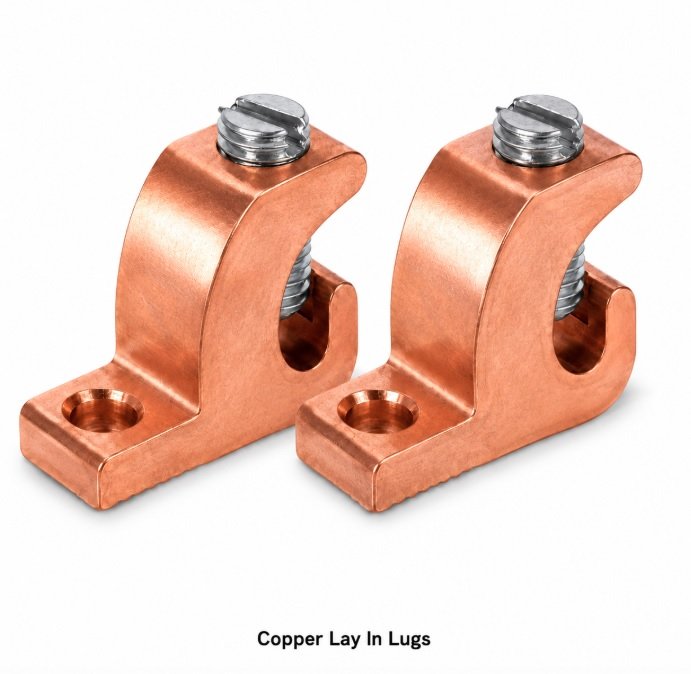
Ask any experienced electrician what slows down a grounding job and the answer is rarely the wire – it is the terminations. Every conduit entry, every enclosure, every ground bus needs a reliable bond, and cutting-and-crimping at each point eats hours. This is exactly the problem the copper lay-in lug was designed to solve. Rather than repeat the datasheet, this guide looks at the practical side: when a lay-in lug is the right tool, how to size and install one correctly, and the field mistakes that quietly raise ground-path resistance. For full specifications, sizes and pricing, see our Copper Lay-In Lugs product page.
When a Lay-In Lug Is the Right Choice
The defining feature of a lay-in lug is that the conductor is never cut. It drops into an open channel and a setscrew clamps it, so a single grounding conductor can run continuously through a whole row of terminations. That one property decides most selection questions. If the ground or bonding conductor has to be continuous – looping past several conduits, motor frames or a ground bus without a break – the lay-in lug wins because it preserves an unspliced path. If, instead, the conductor simply ends at a single stud or pad, a ring-tongue compression lug is often neater. And where a run-through tap is needed on a large feeder, a split-bolt or gutter tap may be the better mechanical answer. Choosing the connector is really a question of whether the conductor passes through or stops.
Lay-In vs Compression vs Split-Bolt vs Exothermic
Grounding hardware is not one-size-fits-all. The table below sets the copper lay-in lug against the other terminations a contractor reaches for, so the trade-offs are visible at a glance.
| Connector | Conductor is… | Re-enterable? | Best for | Watch-outs |
|---|---|---|---|---|
| Copper lay-in lug (setscrew) | Laid in, continuous | Yes – inspect & re-torque | Continuous ground runs, conduit-bushing bonding, equipment grounding | Torque the setscrew correctly; not for run-through taps on big feeders |
| Compression (crimp) lug | Cut & terminated | No | Permanent single-point terminations to a stud or pad | Needs the correct die; one lug per conductor end |
| Split-bolt / gutter tap | Run-through tap | Yes | Tapping a large feeder without cutting it | Bulkier; usually needs taping/insulation |
| Exothermic weld | Fused permanently | No | Buried ground grids where zero maintenance is wanted | Cannot be removed for ground-resistance testing |
The lay-in lug is the only option in this group that is both continuous and re-enterable – you can open it, inspect the joint, re-torque it during an audit, and reuse it. That is why it dominates equipment grounding and conduit bonding even though welds or crimps may win on a permanent buried grid.
Sizing a Copper Lay-In Lug Without Guesswork
Three numbers settle the choice of size, and getting them in the right order avoids a return trip. First, the conductor: read the AWG or kcmil size and whether it is solid or stranded, then pick a lug whose range brackets it rather than sitting at the very edge. A conductor at the extreme top of a lug’s range leaves little room for the setscrew to seat properly. Second, the stud or bolt hole: match the lug’s mounting hole to the bolt on the pad, bus or bushing – a 0.22 in, 0.27 in or 0.33 in hole (roughly M5 to M8) covers most work. Third, the mounting surface: a flat pad accepts a single-hole tongue, while a vibrating busbar or transformer pad is better served by a two-hole tongue that resists rotation. When a run genuinely sits between two sizes, size up: a slightly larger barrel still clamps a smaller conductor, but an undersized barrel will never accept a larger one.
Installation Best Practices: Torque, Oxide and Re-Entry
A grounding connection only works if it is gas-tight, and that comes down to torque. Under-tighten and the joint carries a thin, high-resistance contact that heats and loosens over time; over-tighten and the setscrew shears strands and weakens the conductor. Always torque to the value stamped on the lug or given on the datasheet, using a calibrated wrench rather than feel. Before clamping, wire-brush the conductor lightly to break the surface oxide – copper oxidises the moment it is exposed, and the setscrew’s job is easier when it is biting into clean metal. On outdoor or buried work, and always on aluminium, add an anti-oxidant compound to keep the interface sealed. Because the lay-in design is re-enterable, build a quick re-torque check into the first maintenance cycle; a joint that has relaxed slightly is easy to correct while it is still accessible and visible.
Five Common Grounding-Lug Mistakes to Avoid
Most grounding faults trace back to a handful of avoidable habits. Watch for these:
- Guessing the torque. “Snug” is not a specification – a loose setscrew is the single most common cause of a rising-resistance ground.
- Ignoring oxide. Clamping straight onto an oxidised or dirty conductor traps a resistive film inside the joint.
- Mixing metals carelessly. Bare copper against aluminium hardware invites galvanic corrosion; use a tin-plated, dual-rated lug instead.
- Sizing at the edge. A conductor at the very limit of the barrel range rarely seats cleanly under the screw.
- Never re-checking. The lay-in lug’s big advantage is that it can be re-torqued – skipping that check throws the advantage away.
Bare vs Tin-Plated: Making the Corrosion Call in the Field
The finish is a corrosion decision, not a cosmetic one. Bare electrolytic copper is the default and performs well on copper conductors and in most soils, which is why it is used throughout buried ground grids. Reach for a tin-plated, dual-rated lug when the connection will touch aluminium hardware, when it sits in a coastal, chemical or high-humidity environment, or when a single lug has to serve both copper and aluminium conductors. The tin layer gives a compatible, corrosion-stable surface at the interface and prevents the galvanic cell that would otherwise form between bare copper and aluminium. When in doubt outdoors, tin-plated is the safer specification.
Where Cable Glands India Fits In
Cable Glands India machines and forges copper lay-in lugs from certified electrolytic copper for electrical OEMs, EPC contractors, power utilities and distributors worldwide, in bare and tin-plated finishes with single- or two-hole tongues and private-label marking to drawing. Full size charts, material grades, standards and current pricing live on the Copper Lay-In Lugs product page. If you are specifying a wider grounding kit, our Copper Cable Lugs and Copper Battery Terminals pair naturally with lay-in connectors on the same job.
Frequently Asked Questions
Can a lay-in lug be reused after the conductor is removed?
Yes – that is one of its main advantages. As long as the threads are sound and the body is not deformed, back out the setscrew, remove the conductor, and re-clamp to the marked torque. This makes lay-in lugs well suited to test wells and panels that see moves, adds and changes.
How often should a lay-in grounding connection be re-torqued?
Check the setscrew at the first scheduled maintenance after installation, then on your facility’s normal inspection interval. Connections exposed to vibration or heavy thermal cycling deserve more frequent checks. A calibrated wrench and the value marked on the lug are all you need.
Can two conductors share one lay-in lug?
Only if the lug is specifically rated for two conductors, such as a twin or multi-conductor body. Forcing two conductors into a single-conductor barrel prevents proper clamping. For parallel ground-grid taps, choose a lug designed with parallel channels.
Do I need an anti-oxidant compound on copper conductors?
On bare copper indoors it is optional but good practice; on outdoor, buried or aluminium connections it should be considered standard. The compound seals the interface against moisture and oxygen so contact resistance stays low over the life of the joint.
Lay-in lug or exothermic weld for a buried ground grid?
Use an exothermic weld where you want a permanent, maintenance-free bond and never need to open it. Use a copper lay-in lug where the connection must be removable – for example at a test well where periodic ground-resistance measurement is required.
Will a copper lay-in lug satisfy equipment-grounding requirements?
Listed copper lay-in lugs are evaluated for grounding and bonding use and support installation to the relevant code, provided they are correctly sized for the conductor and torqued as marked. Always confirm the listing and conductor range against the specification for your jurisdiction.
Get Expert Help Selecting Copper Lay-In Lugs
Not sure which size, finish or tongue configuration fits your grounding scheme? Share your conductor range, stud size and environment and our engineering team will recommend the right copper lay-in lug and send a quotation. Email sales@cableglandsindia.com or call / WhatsApp +91-22-43449300, or view specifications and pricing on the Copper Lay-In Lugs product page.