C83300 Bronze Casting – Leaded Red Bronze CDA 833 Castings
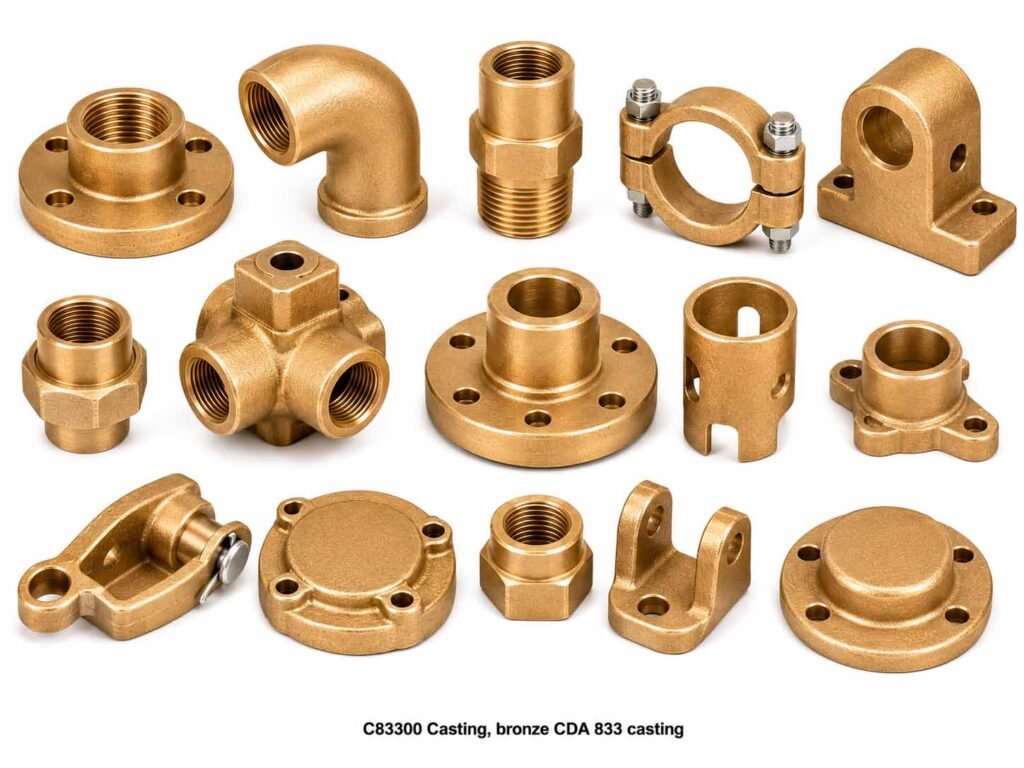
C83300 bronze casting, also designated CDA 833, UNS C83300 and commonly called leaded red bronze or contact metal, is a high-copper cast alloy with a nominal composition of 93% copper, 1.5% tin, 1.5% lead and 4% zinc (93-1.5-1.5-4). Cable Glands India manufactures C83300 castings to ASTM B584 for electrical power distribution hardware — transformer spade terminals, transformer spade connectors, hotline clamps, liveline clamps, transformer grounding clamps, transformer ground connectors, ground rod clamps, stirrup bail clamps and clamshells — where the alloy’s electrical conductivity of approximately 32% IACS, good castability and free-machining behaviour are required in a single material. Castings are supplied sand cast, shell moulded, gravity die cast or centrifugally cast, from 20 g to 60 kg, machined and finished to drawing.
Price: US$ 16.50 per Kg (FOB India). Volume, alloy-market and machining-content based pricing available for OEM and EPC contract quantities. Minimum order quantity and tooling amortisation quoted per part number.
Product Overview
C83300 sits at the top of the leaded red brass family in copper content. Where C83600 (85-5-5-5) is optimised for pressure tightness and general valve service, C83300 trades tin and lead for copper in order to raise electrical and thermal conductivity, which is why it became the default cast alloy for current-carrying connector bodies in overhead and substation power distribution.
Alloy Metallurgy of CDA 833 Leaded Red Bronze
The alloy is a single-phase alpha copper solid solution with tin and zinc in solution and lead dispersed as discrete globules at grain boundaries. Because tin content is held to 1.0–2.0%, the hard, brittle delta phase that dominates higher-tin gunmetals such as LG2 and LG4 does not form in quantity, so ductility remains high — typically 35% elongation in 50 mm. Zinc at 2.0–6.0% deoxidises the melt and improves fluidity, while lead at 1.0–2.0% provides chip-breaking during machining and seals microporosity. The resulting matrix retains most of the conductivity of the copper base, unlike leaded semi-red brasses such as C84400 or high-tin bronzes such as C90300 and C93200. Related alloys in the same casting family include C83600, C83450, C84400, C92200 and C87850 lead-free silicon brass.
Electrical Conductivity and Current-Carrying Hardware
C83300 delivers roughly 32% IACS electrical conductivity and around 145–150 W/m·K thermal conductivity — approximately double the conductivity of C83600 and roughly four times that of a 10% tin bronze. For a transformer spade terminal or a bolted line clamp, this directly reduces I²R heating at the joint, limits temperature rise under short-circuit and emergency loading, and slows the oxidation-driven resistance creep that causes hot connections to fail in service. Utilities specifying connectors to ANSI C119.4, NEMA CC 1 and IEEE 837 test regimes rely on this conductivity margin to pass heat-cycle and current-cycle qualification. Terms that map to this section include high conductivity bronze casting, electrical bronze castings, conductive copper alloy connector body, IACS rated bronze, cast copper connector and bronze current-carrying casting.
Transformer Spade Terminals and Transformer Spade Connectors
Transformer spades — also sold as transformer spade terminals, transformer spade connectors, spade bushing terminals and pad terminals — are the flat, drilled tongues that bolt onto distribution transformer bushing studs and accept the incoming or outgoing conductor. Cast in C83300, the spade body carries full load current while the integral clamp pad, cable groove or threaded stud boss is produced net or near-net shape, eliminating the fabrication cost of machining the part from bar or plate. Typical configurations are 1-hole, 2-hole and 4-hole NEMA drilled pads, angled and offset spades, dual-rated aluminium/copper spades, and spades with tin-plated contact faces for bimetallic service. Cable Glands India casts spade bodies from 60 g to 3.5 kg with as-cast wall sections down to 3.5 mm.
Hotline Clamps, Liveline Clamps and Stirrup Bail Clamps
Hotline clamps and liveline clamps are the hot-stick-operated tap connectors used to make and break energised taps on distribution feeders. The cast body must combine conductivity, thread strength for the eye-screw and clamping jaw, and a surface that stays serviceable outdoors for decades. C83300 supports all three. The mating stirrup bail clamp — the bail, stirrup bail, or “candy cane” bail assembly permanently installed on the main conductor — is likewise cast or cast-and-formed in the same alloy so that the entire joint is electrochemically homogeneous, avoiding the galvanic pairing that accelerates corrosion in mixed-alloy assemblies. Associated hardware includes eye screws, jaw bodies, tap-clamp housings, wedge clamps, parallel groove clamps and bail clamp brackets.
Grounding Clamps, Ground Rod Clamps and Ground Connectors
Transformer grounding clamps, transformer ground connectors, ground rod clamps, ground wire clamps, rebar grounding clamps and pipe ground clamps are direct-buried or exposed components that must pass UL 467 and IEEE 837 grounding and bonding requirements. Cast C83300 resists soil corrosion better than plated steel, remains dimensionally stable through freeze–thaw cycles, and accepts the ANSI-threaded set screws or hex-head bolts used to develop clamping force on 5/8″ and 3/4″ copper-bonded ground rods. Cable Glands India produces acorn-type rod clamps, C-type and U-bolt ground clamps, split-bolt connectors, lay-in lugs, mechanical connectors and grounding pad castings in this alloy.
Clamshells, Compression Housings and Connector Bodies
Clamshells — two-piece cast housings that close over a conductor and are bolted or compressed to form the joint — are used for tap connections, dead-end terminations, bus stabs and cable repair sleeves. The casting route allows the internal conductor grooves, serrations and bolt bosses to be produced without machining, and C83300’s ductility tolerates the cold deformation applied when clamshells are crimped or compressed. Related items include cast connector bodies, bus bar clamps, substation terminal pads, T-connectors, H-taps, bolted deadends and messenger clamps.
Casting Processes Used for C83300
Because the alloy has a narrow freezing range and high fluidity, C83300 is castable by every conventional foundry route. Cable Glands India runs green sand moulding for medium and large volumes, resin-bonded shell moulding for tight-tolerance connector bodies and thin spade sections, no-bake / furan sand for large or low-volume parts, gravity die (permanent mould) casting for high-repeatability clamp bodies, centrifugal casting for bushings, sleeves and ring blanks, and investment casting where cosmetic surfaces or complex undercuts are required. Process selection is driven by annual volume, wall thickness, tolerance class and the fraction of surfaces requiring machining.
Machining, Threading and Assembly
With a machinability rating of approximately 90 on the free-cutting brass scale, C83300 is turned, drilled, tapped and milled at high feeds with long tool life. The alloy is routinely threaded to ANSI, UNC, UNF, BSP, BSPT, NPT and metric ISO profiles for set screws, eye bolts and stud bosses. Cable Glands India performs CNC turning, VMC machining, multi-spindle drilling, tapping, broaching, knurling and assembly of stainless steel or silicon bronze fasteners in-house, delivering the connector as a finished, packaged item rather than a raw casting.
Surface Treatment and Corrosion Behaviour
C83300 develops a stable protective patina in atmospheric exposure and resists rural, industrial and coastal environments without coating. Where specification demands it, castings are supplied electro-tinned, hot-dip tinned, silver-plated for contact surfaces, nickel-plated, passivated or shot-blasted. Tin plating to ASTM B545 is common on bimetallic aluminium-to-copper joints to prevent galvanic attack on the aluminium conductor.
Key Features
- Nominal composition 93% Cu, 1.5% Sn, 1.5% Pb, 4% Zn — highest copper content in the ASTM B584 red brass group
- Electrical conductivity approximately 32% IACS; thermal conductivity approximately 145–150 W/m·K
- Minimum tensile strength 207 MPa (30 ksi), minimum elongation 35% per ASTM B584
- Excellent castability, high fluidity and low hot-tearing tendency in thin connector sections
- Free-machining behaviour (machinability rating ≈ 90) with reliable chip breaking
- Good atmospheric, soil and marine corrosion resistance without protective coating
- Weldable and brazeable; readily tin-plated, silver-plated and nickel-plated
- Non-magnetic and non-sparking — safe for substation and hazardous-area hardware
- Fully recyclable; foundry returns and machining swarf recharged into the melt
Conductivity Versus Mechanical Strength Balance
Every casting alloy trades conductivity against strength. Pure copper castings (C81100, high conductive copper) reach 90%+ IACS but are difficult to cast soundly and machine poorly. Tin bronzes reach 250–310 MPa tensile but drop below 12% IACS. C83300 occupies the working middle: enough conductivity for continuous current ratings, enough tensile and yield strength for bolted clamping loads, and enough elongation to absorb wind-induced vibration and thermal cycling without cracking. For designers, this means a spade terminal or clamp body can be sized on the electrical rating rather than being over-thickened to compensate for a low-conductivity alloy. See also high conductive copper casting when conductivity above 60% IACS is mandatory.
Corrosion Resistance in Outdoor and Buried Service
Distribution hardware lives on poles, in pad-mount enclosures and in soil for 25–40 years. C83300’s copper-rich alpha structure resists dezincification far better than high-zinc brasses, resists sulphide and chloride attack in coastal and industrial air, and does not suffer the stress corrosion cracking seen in cold-worked yellow brass. In direct-buried grounding applications the alloy is compatible with copper-bonded ground rods and bare copper conductor, keeping the entire earthing system at one galvanic potential. Related terms: dezincification resistant casting, marine grade bronze, buried ground connector, soil corrosion resistance, atmospheric patina, galvanic compatibility.
Pressure Tightness and Casting Soundness
Although C83300 is chosen for electrical duty rather than fluid duty, casting soundness matters equally: internal porosity raises joint resistance and creates crack initiation sites under bolt torque. Controlled pouring temperature, chill placement, correct riser modulus and degassing keep shrinkage porosity below acceptance limits. Cable Glands India applies radiographic and dye-penetrant inspection on request, and can qualify castings to ASTM E446 severity levels for critical connector programmes.
Machinability and Secondary Operations
The lead phase in CDA 833 acts as an internal lubricant and chip breaker, permitting high-speed drilling of deep set-screw holes and clean tapping of fine threads without tearing. Practical benefits are lower cycle time, reduced tool consumption, and better thread gauge repeatability on ANSI and metric threads. Machining allowances are typically 1.0–2.5 mm on sand cast surfaces and 0.5–1.5 mm on shell moulded and gravity die cast surfaces.
Dimensional Control and Repeatability
Shell moulding and gravity die casting hold general tolerances of CT7–CT9 per ISO 8062, with surface roughness of Ra 6.3–12.5 µm; sand casting holds CT10–CT12 at Ra 12.5–25 µm. Critical bolt-hole spacing, pad flatness and thread positions are finish-machined on CNC to ±0.05 mm. First-article inspection reports, CMM data and gauge R&R studies are supplied for PPAP-style approvals required by OEM customers.
Plating, Tinning and Contact Surfaces
Contact resistance at a bolted joint is governed by surface condition as much as by bulk alloy. Electro-tinning to 8–15 µm gives an oxidation-resistant, solderable face; hot-dip tinning gives a heavier, more forgiving coating for field-installed connectors; silver plating is specified for substation switchgear contacts where contact resistance must remain in the low micro-ohm range. All plated surfaces are supplied with thickness certification on request.
Technical Specifications – C83300 / CDA 833
| Property | Value (Metric) | Value (Imperial) |
|---|---|---|
| UNS designation | C83300 (CDA 833) | |
| Common names | Leaded red bronze, contact metal, 93-1.5-1.5-4 bronze, electrical bronze | |
| Governing casting standard | ASTM B584 (sand), ASTM B505/B505M (continuous), ASTM B271 (centrifugal), ASTM B30 (ingot) | |
| Nominal composition | Cu 93.0, Sn 1.5, Pb 1.5, Zn 4.0 (%) | |
| Tensile strength (min.) | 207 MPa | 30,000 psi |
| Tensile strength (typical) | 234 MPa | 34,000 psi |
| Yield strength, 0.5% ext. (min.) | 69 MPa | 10,000 psi |
| Elongation in 50 mm (min.) | 35% | 35% in 2 in |
| Brinell hardness (500 kgf) | 35–50 HB | 35–50 HB |
| Electrical conductivity | ≈ 18.6 MS/m | ≈ 32% IACS |
| Thermal conductivity | ≈ 145–150 W/m·K | ≈ 84–87 BTU/ft·h·°F |
| Density | 8.83 g/cm³ | 0.319 lb/in³ |
| Melting range (liquidus–solidus) | 1010–1055 °C | 1850–1930 °F |
| Coefficient of thermal expansion | ≈ 18.0 µm/m·°C | ≈ 10.0 µin/in·°F |
| Modulus of elasticity (approx.) | ≈ 83 GPa | ≈ 12,000 ksi |
| Machinability rating | ≈ 90 (free-cutting brass C36000 = 100) | |
| Magnetic response | Non-magnetic, non-sparking | |
| Casting weight range | 20 g – 60 kg | 0.7 oz – 132 lb |
| General tolerance | ISO 8062 CT7–CT12 as-cast; ±0.05 mm machined | |
| Indicative price | US$ 16.50 per Kg, FOB India | |
Raw Material Grades and Chemistry Limits
| Element | C83300 limits (%) | Function in the alloy |
|---|---|---|
| Copper (Cu) | 92.0 – 94.0 | Base metal; governs electrical and thermal conductivity |
| Tin (Sn) | 1.0 – 2.0 | Solid-solution strengthening, wear and corrosion resistance |
| Lead (Pb) | 1.0 – 2.0 | Machinability, pressure tightness, chip control |
| Zinc (Zn) | 2.0 – 6.0 | Deoxidiser, fluidity, cost balance |
| Iron (Fe) | 0.25 max | Residual; excess reduces conductivity |
| Nickel (Ni) | 1.0 max | Residual; grain refinement |
| Antimony (Sb) | 0.25 max | Residual impurity limit |
| Sulphur (S) / Phosphorus (P) | 0.08 / 0.03 max | Residual impurity limits |
| Aluminium (Al) / Silicon (Si) | 0.005 max each | Strictly limited — cause dross and leakers |
Charge material: virgin electrolytic copper cathode, high-grade tin, SHG zinc and certified C83300 ingot to ASTM B30. Every heat is verified by optical emission spectrometry (OES) before pouring; spectro reports are issued against the heat number printed on the test certificate.
Comparison with Adjacent Cast Copper Alloy Grades
| Alloy | Nominal Cu-Sn-Pb-Zn | Conductivity (% IACS) | Tensile (min.) | Best suited to |
|---|---|---|---|---|
| C83300 | 93-1.5-1.5-4 | ≈ 32 | 207 MPa | Electrical connectors, spades, clamps, grounding |
| C83450 | 88-2.5-2-6.5 | ≈ 22 | 207 MPa | General plumbing and low-pressure valves |
| C83600 | 85-5-5-5 | ≈ 15 | 207 MPa | Valves, pumps, pressure-tight bodies |
| C84400 | 81-3-7-9 | ≈ 16.4 | 205 MPa | Fittings, meter bodies, low-cost valve parts |
| C87850 / silicon brass | Lead-free Cu-Si-Zn | ≈ 7 | 380 MPa | Lead-free potable water hardware |
| C81100 / HC copper | 99.9 Cu | ≈ 92 | 170 MPa | Maximum conductivity, non-machined parts |
International Equivalent Standards
C83300 is a North American alloy designation with no exact one-for-one equivalent in European, Japanese or Indian standards. The table lists the closest analogues by chemistry; they are reference points for procurement, not drop-in substitutes. Where a customer specification calls for C83300, Cable Glands India casts to ASTM B584 chemistry and certifies against it.
| Region / Standard body | Standard | Designation | Relationship |
|---|---|---|---|
| USA – ASTM | ASTM B584 | C83300 | Primary specification |
| USA – UNS | UNS | C83300 | Identical |
| USA – CDA | CDA alloy list | CDA 833 | Identical |
| USA – SAE | SAE J461 / J462 | CA833 | Identical chemistry |
| USA – ingot | ASTM B30 | Alloy 833 ingot | Ingot grade for the same casting |
| Europe – EN | EN 1982 | CuSn2Zn… low-tin red brass group | Nearest family only; no exact match |
| UK – legacy | BS 1400 | — | No direct equivalent (LG2/LG4 are higher tin) |
| Japan – JIS | JIS H5120 | CAC401 family | Nearest family only |
| India – IS | IS 318 | LTB series | Nearest family only; higher Sn/Pb |
| ISO | ISO 1338 | Cu-Sn-Zn-Pb cast group | Family classification |
Procurement note: always qualify a substitution on chemistry and conductivity, not on designation. An alloy with the same tensile rating but 15% IACS will run significantly hotter in the same connector geometry.
Product Types and Variants
| Process / Variant | Description | Typical parts |
|---|---|---|
| Green sand cast C83300 | Automatic and semi-automatic moulding, high volume, CT10–CT12 | Clamp bodies, ground clamps, bail brackets |
| Shell moulded (resin sand) C83300 | Fine finish, thin sections, CT7–CT9 | Transformer spade terminals, hotline clamp jaws |
| No-bake / furan sand casting | Large parts, low to medium volume | Substation terminal pads, bus clamps |
| Gravity die (permanent mould) casting | Repeatable dimensions, denser structure | Liveline clamp bodies, stirrup bail clamps |
| Centrifugal cast C83300 | Dense, porosity-free ring and tube stock | Bushings, sleeves, contact rings |
| Investment cast C83300 | Complex geometry, near-net shape | Clamshells, connector housings |
| Continuous cast C83300 bar | ASTM B505 round, rectangular, tube stock | Machined terminal blocks and studs |
| Machined and assembled connectors | Casting plus CNC, threading, plating, fasteners | Complete transformer spade and clamp assemblies |
Applications in Industry
| Sector | C83300 components supplied |
|---|---|
| Distribution transformers | Transformer spade terminals, transformer spades, transformer spade connectors, bushing pads, LV terminal blocks, transformer ground connectors |
| Overhead line hardware | Hotline clamps, liveline clamps, stirrup bail clamps, bail clamps, tap connectors, parallel groove clamps, clamshells |
| Earthing and lightning protection | Ground rod clamps, transformer grounding clamps, rebar clamps, pipe ground clamps, earth bonding connectors, lay-in lugs |
| Substations and switchgear | Terminal pads, bus bar clamps, isolator contact bodies, jumper connectors, cast lugs |
| Renewables – solar and wind | Array grounding connectors, module bonding clamps, tower earthing hardware |
| Railways and traction | Overhead catenary clamps, bonding connectors, rail earthing terminals |
| Marine and offshore | Bonding straps, cathodic protection connectors, deck earthing points |
| General engineering | Low-load bushings, valve trim, decorative and architectural bronze parts |
Why Utilities and EPC Contractors Standardise on CDA 833
Power utilities, EPC contractors and electrical OEMs standardise on C83300 because it removes a variable from long-life asset design. A connector cast in a known-conductivity alloy, certified against ASTM B584 chemistry and heat-cycle tested per ANSI C119.4, behaves predictably over decades of thermal cycling. Distributors benefit because a single alloy covers spades, clamps, bails and grounding hardware, simplifying stock, certification and warranty handling across a catalogue.
Manufacturing Process
1. Tooling and Pattern Development
Customer 2D drawings or 3D models are converted to a casting model with shrinkage allowance (approximately 1.4–1.6% for this alloy), draft, machining stock and gating. Solidification simulation is run on critical parts to position risers and chills before tooling is cut. Patterns are produced in aluminium, resin or CNC-machined tool steel depending on volume; core boxes are made for internal cable grooves and threaded bosses.
2. Charge Preparation and Melting
Charge is weighed from electrolytic copper cathode, certified ingot, tin, zinc and controlled foundry returns. Melting is done in medium-frequency induction furnaces with a covering flux to limit zinc loss and hydrogen pickup. Bath temperature is held at 1120–1180 °C for pouring, degassing is performed with nitrogen lancing where section thickness requires it, and the melt is grain-refined and deslagged before tapping.
3. Spectrometric Verification
A chill sample is taken from every heat and analysed on an optical emission spectrometer against ASTM B584 limits. Copper, tin, lead, zinc and residual iron, aluminium and silicon are all checked; a heat outside limits is corrected and re-tested before it is allowed to pour. Heat numbers are recorded and carried through to the mill test certificate.
4. Moulding and Pouring
Moulds are produced by green sand, shell, no-bake or permanent-mould routes as appropriate to the part. Pouring is temperature-controlled and monitored, with filters used on thin connector sections to trap dross and prevent inclusions at the pad face. Cooling times are set by section modulus so that directional solidification runs from the thin extremities to the riser.
5. Knockout, Fettling and Shot Blasting
Castings are knocked out, gates and risers removed by cutting or press, and the parts are shot blasted with steel or ceramic media. Parting lines and ingates are ground flush. Runners and risers return to the melt, keeping alloy yield high and cost stable.
6. Machining, Threading and Assembly
CNC turning centres, VMCs, drilling and tapping stations produce bolt holes, pad faces, set-screw threads and stud bores. Threads are gauged with go/no-go plug and ring gauges. Fasteners — stainless steel, silicon bronze or hot-dip galvanised steel — are assembled to the customer’s bill of material, and torque values are applied per specification.
7. Surface Finishing and Plating
Parts are cleaned, deburred and, where specified, electro-tinned, hot-dip tinned, silver-plated or nickel-plated. Coating thickness is verified by X-ray fluorescence. Unplated parts may be passivated or supplied with a light protective oil for transit.
8. Inspection, Marking and Packing
Final inspection covers dimensions (CMM and gauges), hardness, tensile bars poured from the same heat, visual and surface criteria, and plating thickness. Parts are laser-marked or die-stamped with alloy, catalogue number and lot code, then packed in cartons on export pallets with packing list, mill test certificate and country-of-origin documentation.
Quality Standards and Certifications
| Standard / Scheme | Scope as applied to C83300 castings |
|---|---|
| ASTM B584 | Chemistry and mechanical properties for sand-cast copper alloys |
| ASTM B505 / B271 / B30 | Continuous cast, centrifugal cast and ingot requirements |
| ISO 9001:2015 | Quality management system governing the foundry and machine shop |
| ANSI C119.4 | Heat-cycle and current-cycle performance of connectors for conductors |
| NEMA CC 1 | Electric power connection for substations — dimensional and performance |
| UL 467 | Grounding and bonding equipment listing requirements |
| IEEE 837 | Qualification of permanent connections in substation grounding |
| ASTM B545 / ASTM B700 | Electrodeposited tin and silver coatings |
| ASTM E446 / ASTM E165 | Radiographic acceptance levels and liquid penetrant examination |
| RoHS / REACH declaration | Substance declarations issued on request for EU-bound shipments |
| PPAP / FAIR | First-article inspection reports, CMM data and control plans for OEM approval |
Why Choose Cable Glands India for C83300 Bronze Castings
- Foundry and machine shop under one roof — casting, CNC machining, threading, plating and assembly are controlled by one supplier, removing the tolerance stack-up and blame-shifting that occurs across split supply chains.
- Electrical hardware specialisation — the product mix is built around transformer spades, hotline clamps, grounding hardware and connector bodies, so tooling, gating and inspection practice are already tuned to these geometries.
- Certified chemistry on every heat — OES spectro analysis, heat traceability and mill test certificates as standard, not as a paid extra.
- Multiple casting routes — sand, shell, no-bake, gravity die, centrifugal and investment casting, so the process is matched to the part rather than the part forced onto one available process.
- Export experience — regular shipments to the USA, Canada, UK, Germany, Italy, Spain, Netherlands, Australia, New Zealand, UAE, Saudi Arabia, Brazil and South Africa with complete export documentation.
- Drawing-to-sample discipline — DFM feedback before tooling, solidification simulation on critical parts, and first-article approval before series release.
- Transparent pricing — US$ 16.50 per Kg base rate with LME-linked adjustment, published tooling costs and no hidden certification charges.
Pricing
C83300 bronze casting price: US$ 16.50 per Kg (FOB India). The rate covers the certified casting in fettled, shot-blasted condition. The variables below determine the final delivered price per part.
| Cost driver | Effect on price |
|---|---|
| Order quantity / annual volume | Volume discounts applied above 500 kg and again above 5,000 kg per part number |
| Casting process | Shell moulding and gravity die casting carry higher tooling but lower machining cost |
| Machining content | Quoted separately per operation; net-shape design reduces total cost |
| Plating / finishing | Electro-tinning, hot-dip tinning, silver and nickel plating quoted per dm² |
| Testing and certification | Standard MTC included; radiography, PMI and third-party inspection quoted on request |
| Copper and tin market | Base rate reviewed against LME copper and tin movement |
| Incoterms | FOB, CIF, CFR, DAP and DDP available |
Frequently Asked Questions
Q1. What is C83300 bronze casting?
C83300 is a cast copper alloy with a nominal composition of 93% copper, 1.5% tin, 1.5% lead and 4% zinc, standardised in ASTM B584 and designated CDA 833 or UNS C83300. It is classified as a leaded red bronze and is widely known as contact metal because of its use in electrical connector castings.
Q2. Why is C83300 preferred for transformer spade terminals and clamps?
Because it combines approximately 32% IACS electrical conductivity with 207 MPa minimum tensile strength and 35% elongation. That conductivity limits joint heating under load, while the strength and ductility support bolt clamping loads and thermal cycling without cracking. Lower-copper alloys such as C83600 or C84400 conduct roughly half as well.
Q3. How does C83300 differ from C83600?
C83600 is 85-5-5-5 and is optimised for pressure tightness in valves and pumps; C83300 is 93-1.5-1.5-4 and is optimised for electrical conductivity. Both carry the same 207 MPa minimum tensile strength, but C83300 conducts about twice as well and has higher elongation, while C83600 has better bearing and pressure-retaining performance.
Q4. Is C83300 the same as gunmetal, LG2 or LG4?
No. Gunmetal grades such as LG2 (85-5-5-5) and LG4 (87-7-3-3) contain substantially more tin, giving higher hardness and wear resistance but much lower conductivity. C83300 is a low-tin, high-copper alloy intended for current-carrying parts. See our LG2 gunmetal casting and LG4 / CC492K bronze casting pages.
Q5. Which casting processes can be used for CDA 833?
Green sand casting, resin shell moulding, no-bake furan sand casting, gravity die (permanent mould) casting, centrifugal casting, investment casting and continuous casting. Selection depends on volume, wall thickness, tolerance requirement and surface finish.
Q6. Can C83300 castings be tin-plated or silver-plated?
Yes. Electro-tinning (typically 8–15 µm to ASTM B545), hot-dip tinning, silver plating and nickel plating are all routinely applied. Tin plating is standard on connectors used in bimetallic aluminium-to-copper joints to prevent galvanic corrosion of the aluminium conductor.
Q7. Is C83300 suitable for potable water components?
C83300 contains 1.0–2.0% lead and therefore does not meet the “lead-free” weighted-average requirement of the US Safe Drinking Water Act (0.25%), NSF/ANSI 61 and 372, or equivalent EU drinking water regulations. For potable water hardware, specify a lead-free alternative such as lead-free brass casting or silicon bronze casting.
Q8. What casting sizes and weights can you supply?
From approximately 20 g to 60 kg per casting, with as-cast wall sections from 3.0 mm. Both low-volume prototype quantities and series production in tens of thousands of pieces per year are handled.
Q9. What certification is supplied with the castings?
A mill test certificate with heat number, OES chemical analysis against ASTM B584 and mechanical test results from separately cast test bars. Dimensional reports, plating thickness certificates, radiographic reports, RoHS/REACH declarations and third-party inspection can be added on request.
Q10. Do you supply finished connectors or only raw castings?
Both. Cable Glands India supplies raw fettled castings, machined castings, and fully finished, plated and assembled connectors — complete transformer spade assemblies, hotline clamps with eye screws, and ground rod clamps with fasteners — packed and labelled to the customer’s catalogue.
Q11. What is the lead time and minimum order?
New tooling typically takes 2–3 weeks; first samples follow in 3–4 weeks; series production runs 4–6 weeks depending on quantity and machining content. Minimum order quantity is set per part number and is normally expressed in kilograms rather than pieces.
International Equivalent Terms
| Language | C83300 bronze casting | Leaded red bronze casting | Transformer spade terminal | Ground rod clamp |
|---|---|---|---|---|
| Spanish | Fundición de bronce C83300 | Fundición de bronce rojo plomado | Terminal de pala para transformador | Abrazadera para varilla de tierra |
| Russian | Литьё из бронзы C83300 | Литьё из свинцовистой красной бронзы | Лопаточный вывод трансформатора | Зажим для заземляющего стержня |
| French | Pièces moulées en bronze C83300 | Moulage en bronze rouge au plomb | Borne à palette de transformateur | Collier pour piquet de terre |
| Portuguese | Fundição de bronze C83300 | Fundição de bronze vermelho com chumbo | Terminal tipo pá para transformador | Conector para haste de aterramento |
| Italian | Fusione in bronzo C83300 | Fusione in bronzo rosso al piombo | Terminale a paletta per trasformatore | Morsetto per picchetto di terra |
Linked Parts and Related Terms
Transformer spade terminals · transformer spades · transformer spade connectors · hotline clamps · liveline clamps · hot line tap clamps · stirrup bail clamps · bail clamps · transformer grounding clamps · transformer ground connectors · ground rod clamps · acorn ground clamps · rebar grounding clamps · pipe ground clamps · clamshells · clamshell connectors · parallel groove clamps · split bolt connectors · lay-in lugs · mechanical lugs · bus bar clamps · substation terminal pads · bushing pads · jumper connectors · dead-end clamps · wedge connectors · H-tap connectors · earthing bonds · cast copper connectors · CDA 833 · UNS C83300 · ASTM B584 castings · contact metal · high conductivity bronze casting · electrical bronze castings · sand cast bronze connector · shell moulded bronze casting · gravity die cast bronze · centrifugal cast bronze bush · tin-plated bronze casting · silver-plated connector body.
Related Products in Metal Casting
- C83600 Bronze Casting – Leaded Red Brass (85-5-5-5)
- C84400 Bronze Casting – Leaded Semi-Red Brass (CDA 844)
- High Conductive Copper Casting
- Leaded Bronze Alloy Casting
- LG2 Bronze / LG2 Gunmetal Casting
- LG4 Bronze / CC492K Bronze Casting Foundry
- Phosphor Bronze Casting
- Aluminium Bronze Casting
- UNS C95500 Bronze Casting
- DZR Brass Casting
- Lead Free Brass Casting
- Brass Casting
- Stainless Steel Casting
- Aluminium Gravity Die Casting Parts
Request a Quotation – C83300 / CDA 833 Bronze Castings
Send your drawing, 3D model or catalogue reference together with annual quantity, machining requirement and plating specification. Our foundry engineers will confirm the casting process, tooling cost and delivered price per piece, and will flag any DFM changes that reduce cost before tooling is cut.
Price reference: US$ 16.50 per Kg (FOB India). Quotations issued within one business day.
Email: sales@cableglandsindia.com | Tel: +91-22-43449300 / +91-22-43449323
Works: Plot 10 B, GIDC Industrial Estate, Shanker Tekri, Udyog Nagar, Jamnagar – 361004, India
Web: www.cableglandsindia.com