C11000 (ETP) Copper parts, C11000 Copper Machined parts and Components
Rate: US$ 17.90/Kg
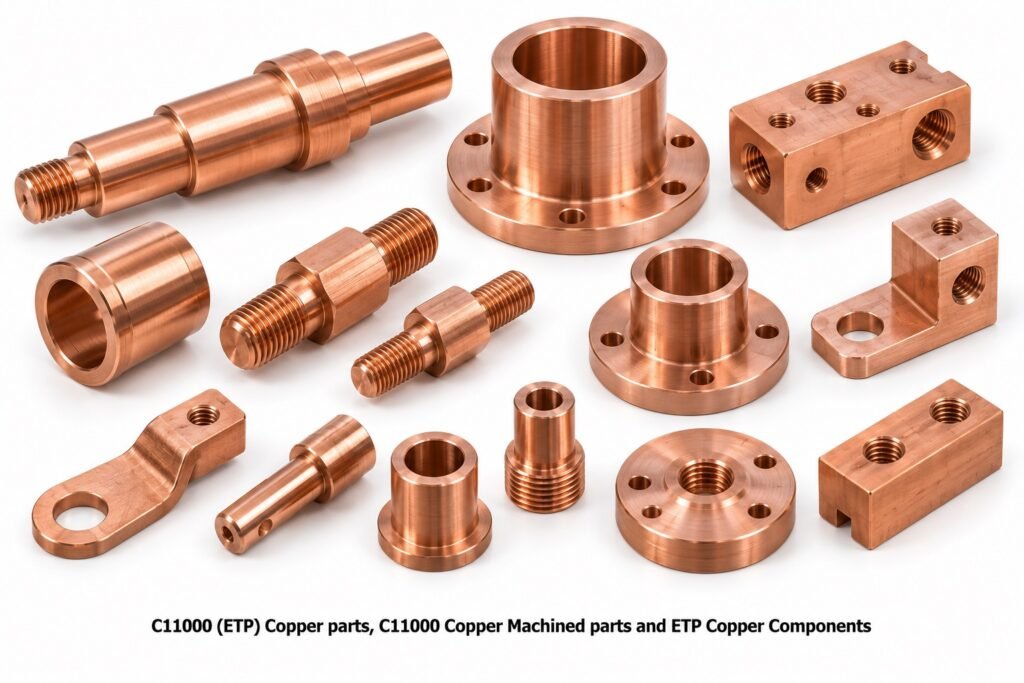
C11000 copper machined parts are precision components made from electrolytic tough pitch copper for electrical connections and heat-transfer interfaces. Cable Glands India manufactures custom ETP copper terminals, connector bodies, contact pins, busbar connectors and machined plates to customer drawings. The range serves electrical OEMs, EPC contractors, power utilities and distributors requiring controlled geometry, defined material grades and application-specific finishes. Parts are supplied from India for domestic and international enquiries.
Brand: Cable Glands India | Listed rate: US$17.90/kg. Final quotation confirms the drawing, quantity, finish and delivery scope.
Detailed Product Overview
C11000 ETP copper material selection
C11000 electrolytic tough pitch copper is an oxygen-bearing, commercially pure copper specified where current conduction and heat transfer govern material selection. Its minimum copper content, including silver, is 99.90%. Annealed material has a minimum conductivity of 100% IACS. The grade designation identifies the metal; the purchase specification must also define stock form, temper and acceptance tests. For procurement, use C11000 together with the applicable material standard and drawing revision. This avoids confusing a chemical grade with a complete specification for a machined terminal, connector block or busbar assembly.
CNC turned copper parts and terminal bodies
Rotational components can combine shoulders, bores, grooves, flats and threaded sections in one drawing. Copper terminal bodies, conductive sleeves, stepped pins and contact studs require coordinated dimensions so their mating parts seat correctly. Turning establishes diameters and axial relationships; drilling and secondary milling add cable entry holes or fastening features. Stock allowance, tool access and workholding are reviewed before machining. Specify functional datums and identify the actual contact surfaces. A well-defined drawing lets inspection focus on fit, current paths and assembly requirements instead of applying unnecessarily restrictive tolerances to every surface.
CNC milled copper components and connector plates
Milling produces flat contact pads, bolt patterns, pockets and profiled outlines in copper plate or rectangular bar. C11000 connector plates and distribution blocks often bridge conductors at different heights or orientations. Their performance depends on adequate conducting section around holes as well as correct mechanical alignment. Deep pockets, narrow webs and unsupported edges need attention during machining because soft copper can deflect under cutting and clamping loads. State flatness, hole position and edge-break requirements separately. Where a plated interface is specified, dimensional acceptance should refer to the finished condition.
Copper Transformer Studs from C11000
As a leading manufacturer of Copper threaded studs, Copper Transformer studs , we produce high-precision copper transformer studs designed for maximum electrical conductivity and mechanical strength in power and distribution transformers. We craft these vital components from premium electrolytic-grade copper to minimize power loss and resist high temperatures under heavy electrical loads. Each stud undergoes strict machining and threading to ensure a tight fit, leak-proof sealing, and reliable long-term performance in demanding setups. We also offer custom lengths, diameters, and surface platings like tin or silver to match your exact project standards. Copper Transformer stud Sizes: 3/8″ UNC, 3/8 UNF, 1/2″ UNC, 1/2″ UNF, 3/4″ UNC, 3/4 UNF, 1″ UNC, UNEF, UNF
Electrical contact interfaces and joint design
A conductive material alone does not establish a reliable electrical connection. Joint geometry, surface preparation, contact pressure and the mating conductor all affect the completed interface. Copper contact blocks should provide sufficient seating area and access for controlled fastening. Bolt holes must align without forcing the conductors into position. Identify washers, fastening hardware and assembly torque in the equipment documentation, with values validated for the actual joint. For aluminium interfaces, specify an approved transition arrangement and surface treatment. Cable Glands India supplies drawing-based parts; equipment current ratings remain an assembly engineering responsibility.
Copper heat spreaders and thermal interfaces
C11000 thermal plates and heat spreaders transfer heat from a concentrated source toward a larger cooling interface. Relevant features include the base thickness, mounting pattern, contact flatness and available space for cooling hardware. A finely machined surface can support interface consistency, but the complete thermal path also includes interface material, clamping and cooling conditions. Identify heat-source footprints and mounting datums when requesting a quotation. Machined copper bases can be evaluated for inverter modules and other power electronics. Finished-component thermal performance should be checked in the intended equipment under representative operating loads.
Temper, machinability and manufacturing economics
ETP copper is ductile and is not a free-cutting alloy. Its machining behaviour requires attention to tool sharpness, chip evacuation and burr control. Temper affects rigidity, forming response and the way thin features behave during manufacture. Specify the required condition rather than assuming all C11000 stock has identical mechanical properties. For complex repeat parts, a comparison with tellurium copper may reveal a useful machining trade-off, provided the design permits another alloy. Order economics also depend on blank yield, cycle time, finishing and inspection. A kilogram rate therefore needs to be read together with the quoted manufacturing scope.
Key Features
- C11000 ETP copper for electrical and thermal components.
- CNC turned, milled, drilled and threaded geometries.
- Custom contact faces, bores, slots and bolt patterns.
- Bar, rod and plate selection to suit the part.
- Bare, tin, nickel or silver finish enquiries.
- Drawing-based inspection and documentation requirements.
- Prototype and repeat OEM supply enquiries.
C11000 copper terminals and contact pins
Terminals and contact pins connect the machined copper body to a cable, busbar or mating contact. Define insertion depth, bore diameter, pin concentricity and any retention feature on the drawing. Threads should include the thread system, pitch and engagement length. Where installation loads act through the copper, check the available section and bearing area. Provide the mating-part drawing when alignment is critical. This information helps distinguish a current-carrying contact from a purely mechanical locating pin and supports an inspection plan appropriate to its function.
ETP copper busbar connectors and distribution blocks
Busbar connectors route current between fixed conductors, while distribution blocks provide multiple termination locations within an assembly. Useful design details include the hole grid, conductor orientation, contact-pad width and required insulation clearances. A milled relief may assist assembly access but also reduces the conducting cross-section. Review such changes against electrical and mechanical requirements before release. Mark the intended contact faces and keep their finish requirements explicit. For repeated panel builds, use a controlled part number and revision so later batches match the approved layout.
Copper threaded studs, sleeves and inserts
Threaded copper studs, conductive sleeves and machined inserts combine fastening features with electrical continuity. Specify metric or inch threads explicitly, including class and inspection method where relevant. Internal thread depth, runout clearance and the remaining wall thickness deserve particular attention. Copper should not be assigned the tightening limits of a steel fastener of similar size. The equipment designer must establish allowable installation loads and retention performance. Protective packing can prevent thread damage before assembly. Plating allowances should be considered when a finished thread must pass the specified gauge.
Precision copper plates and mounting components
Copper mounting plates can include counterbores, alignment holes and seating pads for electrical or thermal hardware. Identify which surfaces locate the component and which simply provide clearance. Thin sections may move after material removal, making a sensible machining sequence and inspection setup important. Define surface finish only where it contributes to function, such as a sealing, electrical-contact or thermal-contact interface. Wide unsupported spans and heavy local clamping should be reviewed during drawing assessment. Samples can then confirm assembly fit before a repeat manufacturing batch is approved.
Tin, nickel and silver plated copper parts
Bare copper and specified plated finishes are available for drawing-based enquiries. Tin, nickel and silver serve different interface requirements and should not be treated as interchangeable coatings. Specify the coating system, thickness, underplate if required, masked areas and acceptance criteria. The finish decision must consider the mating material, assembly process and operating environment. Inspect critical dimensions after plating when coating thickness affects fit. Packaging should protect contact faces from abrasion and contamination. Any finish-specific solderability, adhesion or corrosion testing should be agreed as part of the order.
Prototype copper components and repeat OEM batches
Prototype machining helps confirm fit and drawing interpretation before repeat supply. Provide a three-dimensional model together with a dimensioned drawing; the drawing should control tolerances, material, finish and inspection requirements. Clearly identify the approved revision and distinguish trial features from production requirements. First-article results can then be linked to the released design. Distributors and OEM buyers should also specify batch identification, pack quantities and documentation. Repeat orders benefit from a stable specification, while design changes need review for their effect on manufacturing, inspection and assembly.
Technical Specifications
Material values below are reference data, not guaranteed finished-part performance. The agreed purchase specification controls acceptance.
| Parameter | Reference / requirement |
|---|---|
| Material | UNS C11000, electrolytic tough pitch copper |
| Copper content | 99.90% minimum, including silver |
| Electrical conductivity | 100% IACS minimum in the annealed condition |
| Density | Approximately 8.92 g/cm³ |
| Thermal conductivity | Approximately 394 W/m·K near room temperature |
| Stock forms | Rod, bar, plate or suitable prepared blank |
| Temper / mechanical properties | Specify condition; strength and hardness depend on temper and size |
| Dimensions / tolerances | To approved drawing, subject to manufacturing review |
| Surface condition | As-machined or specified tin, nickel or silver plating |
| Current / temperature rating | Determined by the complete assembly and operating conditions |
| Price basis | US$17.90/kg; detailed scope confirmed by quotation |
Composition and electrical reference: Copper Development Association C11000 profile. Physical-property reference: CDA electrical connector design guide.
Raw Material Grades and Alternatives
| Grade | Material family | Selection context |
|---|---|---|
| C11000 | ETP copper | Primary grade on this page; electrical and thermal parts |
| C10200 | Oxygen-free copper | Consider for oxygen-sensitive processing; high conductivity |
| C10100 | Oxygen-free electronic copper | Higher-purity option for demanding specifications |
| C14500 | Tellurium copper | Consider when machining productivity influences selection |
| C12200 | Phosphorus-deoxidized copper | Consider for joining requirements; conductivity differs from ETP |
Alternative grades require engineering approval and separate quotation. A different copper alloy must not be supplied as C11000 merely because its appearance or part geometry is similar.
International Equivalent Grade References
| System / region | Common corresponding reference | Procurement note |
|---|---|---|
| USA / UNS | C11000 | ETP designation |
| Europe / EN | Cu-ETP / CW004A | Compare applicable product-standard limits |
| United Kingdom / legacy BS | C101 | Historical ETP reference; distinguish from UNS C10100 |
| Japan / JIS | C1100 | Confirm product form and temper suffix |
These are grade cross-references, not identical specifications or automatic substitution approvals. Source: Copper Information Center ETP grade guide.
Product Types and Variants
| Variant | Typical drawing features | Supply choices |
|---|---|---|
| Terminal bodies / pins | Stepped diameters, bores, shoulders | Solid, drilled or threaded |
| Busbar connectors / blocks | Contact pads, bolt patterns, slots | Single or multiple connection points |
| Copper studs / sleeves | Threads, reliefs, through bores | Metric or inch drawing requirements |
| Heat spreaders / plates | Flat bases, mounting holes, pockets | Bare or specified surface finish |
| Custom OEM components | Combined turned and milled features | Prototype or repeat batches |
Applications in Industry
| Industry / customer | Typical application | Main design consideration |
|---|---|---|
| Electrical OEMs | Terminals and internal connector blocks | Mating geometry and interface resistance |
| EPC contractors | Project-specific conductor links | Drawing approval and installation interfaces |
| Power utilities | Distribution equipment connection parts | Assembly qualification and traceability |
| Switchgear and panel builders | Busbar connectors and terminal plates | Contact area and fastening arrangement |
| Renewable energy / power electronics | Inverter links and heat spreaders | Electrical loading and thermal integration |
| Distributors | Specified replacement or OEM components | Part identification and repeatability |
Application suitability depends on the approved assembly design. Material grade alone does not demonstrate a voltage rating, short-circuit withstand capability or equipment approval.
Manufacturing Process
The manufacturing route follows the part geometry and approved specification. Control points should be agreed before production, especially where contact surfaces, plating or batch documentation affect acceptance.
| Stage | Work and control point |
|---|---|
| 1. Drawing review | Confirm revision, datums, grade, temper, finish and inspection scope. |
| 2. Material preparation | Select suitable stock and retain its material identification. |
| 3. CNC programming and setup | Plan tool paths, cutting sequence and support for delicate sections. |
| 4. Machining | Turn, mill, drill, bore or thread the required features. |
| 5. Deburring and cleaning | Remove edge burrs and residues; protect functional contact faces. |
| 6. Surface finishing | Apply the specified coating where ordered, allowing for finished dimensions. |
| 7. Inspection and packing | Check agreed characteristics and protect parts for dispatch. |
Quality Standards and Certifications
Specify the applicable edition and required evidence in the purchase order. Material standards, management-system certificates and finished-equipment approvals address different requirements.
| Reference / document | Relevant scope | Order requirement |
|---|---|---|
| ASTM B187/B187M | Copper conductor bar, rod and shapes | Specify grade, form, temper and agreed tests |
| ASTM B152/B152M | Copper sheet, strip, plate and rolled bar | Confirm applicability to selected stock |
| Drawing / general tolerances | Finished component dimensions | State tolerances and the chosen standard explicitly |
| Material and inspection records | Composition, identification and dimensional results | Agree documents and sampling before production |
| ISO 9001 certification evidence | Quality management system | Request current certificate and scope for supplier approval |
| RoHS / REACH documentation | Material and finish compliance where applicable | Request declarations for the supplied configuration |
See our quality policy. Certification status and document availability should be confirmed during qualification; this page does not claim universal third-party approval of custom parts.
Why Choose Cable Glands India
Cable Glands India brings copper machining and related electrical-component ranges together for drawing-based sourcing. Buyers can discuss connector geometry, material selection, finishing and inspection within one enquiry. The relevant advantage is a clearly agreed supply specification: identified drawings, defined acceptance criteria and commercially documented scope. This approach supports OEM repeat orders, EPC project requirements and distributor part matching. Our published location is Plot 10 B, GIDC Industrial Estate, Shanker Tekri, Udyog Nagar, Jamnagar, Gujarat 361004, India, serving domestic and worldwide enquiries.
Frequently Asked Questions
1. What are C11000 copper machined parts?
They are drawing-based components machined from electrolytic tough pitch copper, including terminal bodies, connector blocks, pins and plates. CNC turning, milling, drilling and threading create their functional geometry for electrical or thermal assemblies.
2. Is C11000 copper the same as ETP copper?
C11000 is the UNS designation for electrolytic tough pitch copper. ETP describes the material family. Procurement should additionally identify the stock standard, temper and testing requirements, because the grade name alone does not define the finished part.
3. What is the electrical conductivity of C11000?
The annealed grade has a minimum electrical conductivity of 100% IACS. Specify the applicable material standard and conductivity verification when ordering. This material value does not establish the current rating of a connector or busbar assembly.
4. Are CW004A and C11000 interchangeable?
CW004A, designated Cu-ETP, is the commonly corresponding European grade. It is a cross-reference rather than blanket substitution approval. Compare composition limits, stock form, temper, mechanical properties and electrical requirements before accepting an alternative.
5. How does C11000 differ from C10200 oxygen-free copper?
C11000 contains oxygen, whereas C10200 is oxygen-free copper. Both are high-conductivity choices. Elevated-temperature processing in reducing atmospheres can make oxygen-free material preferable; the joining process and service requirements should drive the final selection.
6. Can C11000 parts be welded or brazed?
Joining requires process review because oxygen-bearing ETP copper can suffer hydrogen embrittlement when heated in reducing atmospheres. Specify the joining method and thermal cycle before ordering. Oxygen-free or deoxidized copper may be a more suitable alternative.
7. What tolerances and dimensions can you supply?
Dimensions, tolerances and surface finish are confirmed against the submitted drawing. Identify critical fits, flatness, hole position and thread requirements. There is no single tolerance or machining envelope that can be guaranteed for every C11000 component.
8. Can the components be supplied plated?
Enquire for bare, tin-plated, nickel-plated or silver-plated parts. Specify the finish standard, thickness and masked areas. Acceptance should cover the finished dimensions and any agreed coating checks, particularly on contact faces and threaded features.
9. What does the US$17.90/kg rate cover?
US$17.90 per kilogram is the listed product rate. Request a quotation identifying the part, quantity, finish and inspection scope. Confirm weight basis, tooling, packing, freight, taxes and delivery terms in the commercial offer before placing an order.
10. What information is needed for a quotation?
Send the drawing and revision, CAD model if available, C11000 stock specification, temper, quantities, finish, critical dimensions and required documents. Include the delivery destination and requested schedule. Minimum order quantity and lead time are confirmed for the specific requirement.
International Product Terms
These terms assist multilingual procurement searches; retain C11000 on technical drawings and enquiries.
| Language | Related terms |
|---|---|
| Spanish | Piezas de cobre C11000; componentes de cobre ETP; piezas de cobre mecanizadas |
| Russian | Детали из меди C11000; компоненты из меди ETP; медные детали с ЧПУ |
| French | Pièces en cuivre C11000; composants en cuivre ETP; pièces en cuivre usinées |
| Portuguese | Peças de cobre C11000; componentes de cobre ETP; peças de cobre usinadas |
| Italian | Parti in rame C11000; componenti in rame ETP; particolari in rame lavorati |
Linked Parts and Related Products
| Linked range / term | Related requirement |
|---|---|
| Copper CNC machined components | Parent range for turned and milled copper hardware |
| C109 / CW118C tellurium copper machined parts | Alternative machining-grade enquiry |
| Copper screw machine parts | Repeat turned components |
| Copper forgings and forged components | Shaped blanks and forged parts |
| Copper stamped parts | Sheet-based profiles and contacts |
| Copper ring type terminals | Ring termination components |
| Copper cable lugs | Cable termination range |
Browse the complete Copper Parts – Terminals category for related connection hardware.
Request a Quote for C11000 Copper Machined Parts
Listed rate: US$17.90 per kilogram. Send your drawing, grade and temper, batch quantity, finish, inspection requirements and delivery destination to sales@cableglandsindia.com. Call +91-22-43449300 or use our contact page to discuss the requirement. Request a written quotation confirming manufacturing scope, weight basis, commercial terms and schedule for your custom C11000 ETP copper components.