Bronze Flanges – Threaded Lead-Free & Leaded Bronze Flanges
Rate: US$ 17.90/Kg
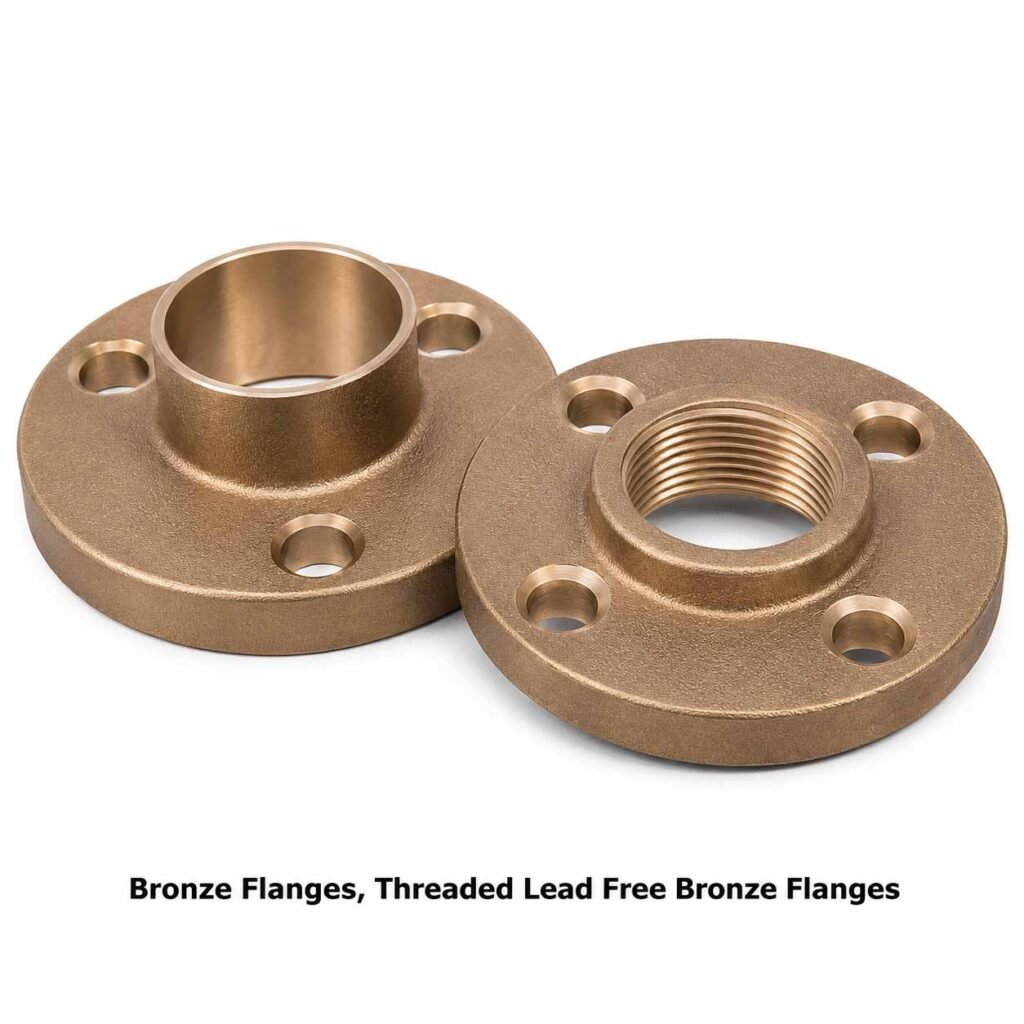
Price: US$ 17.90 / kg (ex-works, alloy- and size-dependent — request a firm quotation)
Bronze flanges are cast copper-alloy pipe flanges used to bolt and seal piping, valves and equipment nozzles, and threaded bronze flanges carry an internal BSP or NPT tapped bore that screws onto pipe without welding. Cable Glands India manufactures threaded, slip-on, blind and floor-type bronze flanges in both lead-free and leaded copper alloys — including aluminium bronze, phosphor bronze, leaded nickel bronze and gunmetal (LG2) — to ASME B16.24 Class 150/300, DIN 2501, EN 1092-3, BS 10 and IS 6392. Each flange is produced with a controlled pitch circle diameter (PCD), bolt-hole drilling, raised or flat face and gasket seating so that electrical OEMs, EPC contractors, power utilities and distributors receive a leak-tight, corrosion-resistant connection ready for direct assembly. Grades, drilling patterns and thread forms are made to drawing, and every batch is offered with material test certification.
Detailed Overview of Bronze Flanges
Threaded Bronze Flanges & Screwed Pipe Connections
A threaded bronze flange terminates a pipe run with an internally tapped hub that engages BSP (parallel or taper) or NPT pipe threads, eliminating welding on non-ferrous lines. The flange face then bolts against a mating flange, valve body or pump nozzle over a gasket, and the tapped hub, sealing face, bolt circle and gasket seat work together to hold pressure. Because bronze is self-lubricating and dezincification-resistant, the thread engagement stays serviceable through repeated make-and-break maintenance. Cable Glands India machines the thread, counterbore, spot-face and back-face concentric to the bore so that flange, union nut, nipple, pipe and gasket assemble true. Threaded bronze flanges are specified where field welding is impractical, where dissimilar-metal isolation is required, or where a compact bolted joint must be broken for cleaning of water, fuel, air and instrument lines.
Lead-Free Bronze Flanges for Potable Water
Lead-free bronze flanges are cast in alloys such as C89833 (EnviroBrass) and C87850 silicon bronze, holding a weighted-average lead content of 0.25% or less to satisfy NSF/ANSI 61 and NSF/ANSI 372 and the US Safe Drinking Water Act. These flanges carry drinking water, food-grade fluids and pharmaceutical media where leaded gunmetal is not permitted. The alloy retains good castability, pressure tightness and machinability while removing lead from the wetted surface, and the flange face, gasket groove, bolt holes and threaded bore are finished to the same tolerances as leaded grades. Lead-free red-brass and silicon-bronze flanges resist dezincification and stress-corrosion cracking, making them a durable choice for municipal water distribution, plumbing manifolds and potable pump skids.
Aluminium Bronze Flanges for Seawater & High Strength
Aluminium bronze flanges in C95400, C95800 and C63000 combine high tensile strength with outstanding resistance to seawater, cavitation and impingement corrosion. The self-healing alumina film on the flange face, hub and bore protects the joint in marine, desalination and offshore piping, and nickel-aluminium bronze (C95800) adds resistance to biofouling and sulphide-polluted water. These flanges pair with aluminium bronze valves, pump casings, impellers and shafting to keep a galvanically compatible system. Aluminium bronze flanges also serve high-load structural and bearing-adjacent connections where a leaded gunmetal would deform, and they are supplied raised-face or flat-face with matching PCD and drilling for ship classification-society and industrial service.
Phosphor Bronze Flanges for Wear & Fatigue Duty
Phosphor bronze flanges (C51000 / PB1, C52100 and C54400) are chosen where the flanged joint sees vibration, fretting or spring load. The tin-phosphorus alloy gives high fatigue endurance, good elasticity and low-friction bearing behaviour, so the flange, gasket face and bolt bosses tolerate cyclic clamping without relaxation. Phosphor bronze resists corrosion in fresh, brackish and mildly acidic media and keeps its properties at low temperature, suiting instrumentation, hydraulic and control-valve flanging. The grade machines to fine surface finish for optical-flat gasket seats, and it mates well with phosphor bronze bushes, thrust washers and wear plates in the same assembly.
Leaded Nickel Bronze & Gunmetal Flanges
Leaded nickel bronze (C97600, C97800) and leaded gunmetal / red brass (C83600 “85-5-5-5”, C84400) are the workhorse flange alloys for general non-potable pressure service. The 4–6% lead content delivers free-cutting machinability, pressure-tight castings and clean threads, while the nickel-bearing grades add strength, whiteness and salt-water resistance for valve trim and marine hardware. These flanges seal water, oil, steam, gas and glycol systems, and gunmetal LG2 flanges are the traditional choice for pump, valve and pipeline flanging. The bore, flange face, bolt circle and tapped hub are machined true, and the alloy takes a smooth gasket-seating finish that holds hydrostatic test pressure.
Flange Faces, Drilling & Gasket Seating
Every bronze flange is defined by its outside diameter, thickness, pitch circle diameter, bolt-hole count and diameter, bore and face type. Cable Glands India supplies flat-face (FF) and raised-face (RF) profiles, with serrated, smooth or phonographic gasket finishes to match the counter-flange. Drilling can follow ASME B16.24, DIN 2501, EN 1092-3, BS 10 or a customer template, and off-standard PCDs are produced from drawing. Companion items — bolts, nuts, washers, gaskets, blind flanges and reducing flanges — are matched to the same bolt circle so the joint torques evenly. This dimensional control keeps flange-to-flange alignment, gasket compression and leak-tightness within specification.
Custom & Application-Engineered Bronze Flanges
Beyond catalogue patterns, bronze flanges are engineered as floor flanges, backing flanges, lap-joint stub ends, orifice flanges, transformer bushing flanges and earthing/bonding flanges. For electrical and utility work, bronze flanges serve as non-magnetic, conductive connection points for busbar, transformer tanks and grounding systems, complementing the company’s bronze clamps, connectors and castings. Threaded, welded-hub and slip-on hubs are combined with tapped, plain or reamed bores, and sizes run from 15 mm (1/2″) to 300 mm (12″) and above. Each application-engineered flange is produced from a validated alloy grade with full traceability from melt to finished part.
Key Features of Bronze Flanges
- Dual metallurgy: supplied in lead-free (C89833, C87850) and leaded (C83600, C97800) copper alloys.
- Multi-standard drilling: ASME B16.24 Class 150/300, DIN 2501, EN 1092-3, BS 10, IS 6392.
- Threaded & slip-on hubs: BSP (parallel/taper) and NPT tapped bores, or plain-bore weld/braze hubs.
- Corrosion resistance: dezincification-, seawater- and stress-corrosion-resistant grades.
- Face options: raised-face or flat-face with smooth or serrated gasket seating.
- Pressure-tight castings: hydrostatically tested, defect-free flange bodies.
- Full traceability: heat number and material test certificate per batch.
- Non-magnetic & conductive: suited to electrical, earthing and instrumentation duty.
Corrosion & Dezincification Resistance
Bronze flanges resist the dezincification and stress-corrosion cracking that attack high-zinc brasses, because tin, aluminium, nickel and silicon stabilise the copper matrix. In potable water the lead-free red-brass and silicon-bronze grades keep the wetted flange face, bore and thread free of meringue dezincification, while aluminium bronze forms a passive alumina film that withstands seawater and chloride pitting. This corrosion resistance extends flange life at the gasket seat, bolt holes and sealing face, reducing joint leakage and maintenance. The result is a flanged connection that holds torque and hydrostatic pressure over long service in water, marine and chemical piping.
Machinability & Thread Integrity
Free-cutting leaded gunmetal and leaded nickel bronze machine cleanly, so the tapped bore, flange face and counterbore hold thread form, pitch and concentricity. Sharp, burr-free BSP and NPT threads give reliable pipe engagement and repeatable make-and-break for maintenance. Even the lead-free grades are formulated for good machinability, letting the flange seat, gasket groove and bolt holes be finished to close tolerance. Accurate machining keeps the sealing face flat and square to the bore, which is what ultimately controls gasket compression and leak-tightness in the assembled joint.
Pressure Rating & Mechanical Strength
Bronze flanges are rated by class and alloy, with ASME B16.24 Class 150 and Class 300 covering the common cast copper-alloy pressure envelope. Aluminium bronze raises tensile and yield strength for high-pressure and structural flanging, while gunmetal and red brass cover general water, oil and steam service. Wall thickness, hub geometry and PCD are proportioned so the flange resists bolt-load bending and internal pressure without face distortion. The mechanical strength of the chosen grade determines the safe working pressure, bolt torque and gasket seating stress the joint can sustain.
Sealing Performance & Gasket Compatibility
The flange face finish, flatness and face type govern how a gasket seals. Raised-face bronze flanges concentrate bolt load onto the gasket ring, flat-face flanges suit full-face gaskets against brittle mating parts, and serrated or phonographic finishes bite into soft gasket material for a tight seal. Bronze is compatible with rubber, PTFE, graphite and non-asbestos fibre gaskets across water, fuel and chemical media. Correct pairing of face type, surface finish and gasket keeps the joint leak-tight through thermal cycling and vibration.
Electrical Conductivity & Non-Magnetic Behaviour
As copper alloys, bronze flanges conduct electricity and are effectively non-magnetic, which makes them useful as bonding, earthing and equipotential connection points in electrical and utility installations. They integrate with the company’s bronze bonding clamps, vise connectors and transformer spades to form conductive, corrosion-resistant joints on tanks, structures and grounding grids. The non-magnetic nature avoids eddy-current heating around transformer bushings and instrument transformers. This dual mechanical-and-electrical role distinguishes bronze flanges from carbon-steel flanges in power and substation work.
Temperature & Marine Endurance
Bronze flanges keep strength and ductility from sub-zero to elevated temperatures, and phosphor bronze in particular retains toughness at low temperature. Aluminium and nickel-aluminium bronze endure seawater, cavitation and biofouling in marine and desalination piping, while gunmetal handles hot water, steam and glycol. The alloys do not become brittle in cold service the way some ferrous flanges can, and their corrosion films re-form after abrasion. This temperature and marine endurance widens the operating window of the flanged joint across HVAC, shipboard and process duty.
Technical Specifications – Bronze Flanges
| Parameter | Specification / Range |
|---|---|
| Product | Threaded, slip-on, blind, floor & backing bronze flanges |
| Nominal size | 15 mm (1/2″) to 300 mm (12″) — larger on request |
| Pressure class | ASME B16.24 Class 150 & Class 300; PN10 / PN16 (DIN/EN); BS 10 Table D/E/F |
| Face type | Raised face (RF) & flat face (FF); smooth / serrated / phonographic finish |
| Bore / hub | Threaded BSP (parallel/taper) or NPT; plain, reamed or weld/braze hub |
| Thread standards | BS 21 / ISO 7 (BSPT), ISO 228 (BSPP), ANSI/ASME B1.20.1 (NPT) |
| Drilling standards | ASME B16.24, DIN 2501/2527, EN 1092-3, BS 10, IS 6392; or to drawing |
| Surface finish | As-cast, machined, shot-blast, tin-plated or nickel-plated (optional) |
| Testing | Hydrostatic / pneumatic leak test, spectro analysis, dimensional inspection |
| Certification | Mill TC (EN 10204 3.1), RoHS, NSF (lead-free grades), on request |
| Price | US$ 17.90 / kg (alloy & size dependent) |
Raw Material Grades – Lead-Free & Leaded Bronzes
| Family | Grade (UNS) | Type | Key attribute for flanges |
|---|---|---|---|
| Lead-free red brass | C89833 (EnviroBrass) | Lead-free | Potable water, NSF 61/372 compliant |
| Silicon bronze | C87850 | Lead-free | High strength, drinking-water safe |
| Leaded red brass / gunmetal | C83600 (85-5-5-5) | Leaded | General pressure service, machinable |
| Leaded semi-red brass | C84400 | Leaded | Plumbing goods, good castability |
| Aluminium bronze | C95400 | Lead-free | High strength, seawater resistance |
| Nickel-aluminium bronze | C95800 | Lead-free | Marine, cavitation & biofouling resistance |
| Aluminium bronze | C63000 | Lead-free | Very high strength structural flanging |
| Phosphor bronze | C51000 (PB1) | Low-lead | Fatigue & wear duty, elasticity |
| Phosphor bronze | C54400 | Leaded | Free-cutting bearing-grade flanging |
| Leaded nickel bronze | C97600 / C97800 | Leaded | Strength, whiteness, salt-water trim |
| High-leaded tin bronze | C94300 | Leaded | Low-friction, conformable service |
International Equivalent Grades
| ASTM / UNS | BS (UK) | EN / DIN (EU) | IS (India) | JIS (Japan) |
|---|---|---|---|---|
| C83600 | LG2 / BS 1400 LG2 | CC491K / G-CuSn5ZnPb | IS 318 LTB2 | JIS BC6 / CAC406 |
| C84400 | LG1 | CC492K | IS 318 LTB1 | CAC403 |
| C89833 | — (lead-free) | CuSn4Zn9 (lead-free) | — | — |
| C95400 | AB1 / BS 1400 AB1 | CC331G / G-CuAl10Fe | IS 305 | CAC703 |
| C95800 | AB2 / BS 1400 AB2 | CC333G / G-CuAl10Ni | — | CAC704 |
| C51000 | PB1 / BS 2870 PB1 | CW452K / CuSn6 | IS 7814 | C5191 |
| C54400 | PB102 | CuSn4Pb4Zn4 | — | C5441 |
| C97800 | — | CuNi (nickel bronze) | — | CAC303 |
Physical & Mechanical Properties (Typical — C83600 Gunmetal)
| Property | Value |
|---|---|
| Tensile strength | 240–255 MPa (min.) |
| Yield strength (0.5% ext.) | 115–120 MPa |
| Elongation | 20–30% |
| Brinell hardness | 60–65 HB |
| Density | 8.83 g/cm³ |
| Melting range | 854–1010 °C |
| Electrical conductivity | ~15% IACS |
Bronze Flange Dimensions – Size Chart (ASME B16.24 Class 150)
| NPS | DN | Flange OD (in / mm) | Min. Thickness (in / mm) | Bolt Circle Ø (in / mm) | No. of Bolts | Bolt Dia (in) | Bolt Hole Ø (in) |
|---|---|---|---|---|---|---|---|
| 1/2″ | 15 | 3.50 / 88.9 | 0.31 / 7.9 | 2.38 / 60.5 | 4 | 1/2 | 5/8 |
| 3/4″ | 20 | 3.88 / 98.6 | 0.34 / 8.6 | 2.75 / 69.9 | 4 | 1/2 | 5/8 |
| 1″ | 25 | 4.25 / 108.0 | 0.38 / 9.7 | 3.12 / 79.2 | 4 | 1/2 | 5/8 |
| 1-1/4″ | 32 | 4.62 / 117.3 | 0.41 / 10.4 | 3.50 / 88.9 | 4 | 1/2 | 5/8 |
| 1-1/2″ | 40 | 5.00 / 127.0 | 0.44 / 11.2 | 3.88 / 98.6 | 4 | 1/2 | 5/8 |
| 2″ | 50 | 6.00 / 152.4 | 0.50 / 12.7 | 4.75 / 120.7 | 4 | 5/8 | 3/4 |
| 2-1/2″ | 65 | 7.00 / 177.8 | 0.56 / 14.2 | 5.50 / 139.7 | 4 | 5/8 | 3/4 |
| 3″ | 80 | 7.50 / 190.5 | 0.62 / 15.7 | 6.00 / 152.4 | 4 | 5/8 | 3/4 |
| 4″ | 100 | 9.00 / 228.6 | 0.69 / 17.5 | 7.50 / 190.5 | 8 | 5/8 | 3/4 |
| 5″ | 125 | 10.00 / 254.0 | 0.75 / 19.1 | 8.50 / 215.9 | 8 | 3/4 | 7/8 |
| 6″ | 150 | 11.00 / 279.4 | 0.81 / 20.6 | 9.50 / 241.3 | 8 | 3/4 | 7/8 |
| 8″ | 200 | 13.50 / 342.9 | 0.94 / 23.9 | 11.75 / 298.5 | 8 | 3/4 | 7/8 |
| 10″ | 250 | 16.00 / 406.4 | 1.00 / 25.4 | 14.25 / 362.0 | 12 | 7/8 | 1 |
| 12″ | 300 | 19.00 / 482.6 | 1.06 / 26.9 | 17.00 / 431.8 | 12 | 7/8 | 1 |
Dimensions to ASME B16.24 Class 150 (raised or flat face). Class 300, DIN 2501 PN10/PN16, EN 1092-3 and BS 10 Table D/E/F drilling supplied on request; all bronze flanges are also produced to customer drawing. Thickness figures are typical minimums — confirm against the governing standard for design.
Bronze Flange Types & Variants
| Variant | Description | Typical use |
|---|---|---|
| Threaded (screwed) flange | Internally BSP/NPT tapped hub screwed onto pipe | No-weld water, fuel & air lines |
| Slip-on flange | Plain bore slides over pipe, brazed/soldered | Low-pressure water & drainage |
| Blind flange | Solid disc, no bore, closes a line | Isolation, pressure testing, spare nozzles |
| Floor / wall flange | Threaded base flange for pipe mounting | Handrails, structural & support fixing |
| Backing / lap-joint flange | Loose flange over a stub end | Frequent dismantling, alignment freedom |
| Reducing flange | Standard OD/PCD with smaller bore | Pipe-size transitions |
| Orifice flange | Flange with pressure tappings | Flow measurement |
| Earthing / bonding flange | Conductive flange with lug provision | Substation, transformer & grounding duty |
Applications of Bronze Flanges in Industry
| Sector | Application |
|---|---|
| Power & utilities | Transformer cooling lines, substation piping, earthing/bonding connections |
| Electrical OEMs | Non-magnetic conductive flanging, busbar & enclosure fittings |
| Marine & shipbuilding | Seawater cooling, ballast, firemain & bilge piping (aluminium bronze) |
| Water & wastewater | Potable distribution, pump skids, valve flanging (lead-free grades) |
| Oil, gas & petrochemical | Fuel, glycol & instrument lines requiring spark-resistant joints |
| HVAC & plumbing | Chilled/hot water, condenser & heat-exchanger connections |
| Desalination | High-chloride seawater piping, RO skids |
| EPC & infrastructure | Bulk-supplied flanging for turnkey mechanical & electrical packages |
Manufacturing Process of Bronze Flanges
Manufacture begins with alloy selection and melting: the chosen grade — gunmetal, aluminium bronze, phosphor bronze, leaded nickel bronze or a lead-free red brass — is charged into an induction furnace and adjusted to composition by spectrometer. The molten metal is then sand-cast, gravity die-cast or centrifugally cast into flange blanks, or continuous-cast bar and plate are used for machined-from-solid flanges where maximum soundness is required. Castings are fettled, shot-blasted and stress-relieved, then inspected for porosity before machining. On CNC lathes and machining centres the bore, sealing face, hub, back-face, bolt holes and pitch circle are cut to the governing standard, and threaded variants have their BSP or NPT threads single-point or tapped to gauge. Each flange is hydrostatically or pneumatically leak-tested, dimensionally inspected for PCD, flatness and bolt-hole position, and given the specified surface finish — as-machined, shot-blasted, tin-plated or nickel-plated. Finally the part is marked with heat number and grade, matched to its material test certificate, and packed for dispatch, giving full traceability from melt to shipped flange.
Quality Standards & Certifications
| Area | Standard / Certification |
|---|---|
| Dimensional / drilling | ASME B16.24, DIN 2501/2527, EN 1092-3, BS 10, IS 6392 |
| Material composition | ASTM B62 / B584 / B505, BS 1400, EN 1982, IS 318 |
| Threads | ISO 7 / ISO 228 (BSP), ASME B1.20.1 (NPT) |
| Potable water (lead-free) | NSF/ANSI 61 & 372, AB1953 low-lead |
| Quality system | ISO 9001 manufacturing controls |
| Test certificate | EN 10204 3.1 mill TC, RoHS & REACH on request |
| Testing | Hydrostatic/pneumatic, spectro, PMI, dimensional & visual |
Why Choose Cable Glands India for Bronze Flanges
Cable Glands India is a Mumbai-based manufacturer of bronze, copper and brass parts serving electrical OEMs, EPC contractors, power utilities and distributors worldwide. Bronze flanges are produced in-house across the full alloy range — lead-free and leaded, aluminium bronze, phosphor bronze, leaded nickel bronze and gunmetal — so a single supplier covers potable, marine, structural and electrical duty. Every flange is made to drawing or to ASME/DIN/EN/BS/IS standards with controlled PCD, drilling and thread form, backed by spectro analysis, hydrostatic testing and EN 10204 3.1 certification. Competitive pricing from US$ 17.90/kg, batch traceability, custom drilling, plating options and export-ready packing make the company a dependable long-run source. Related bronze connectors, clamps and castings can be bundled into a single order, reducing vendor count for mechanical and electrical packages.
Frequently Asked Questions (FAQ)
1. What is a threaded bronze flange?
A threaded bronze flange is a cast copper-alloy flange with an internal BSP or NPT tapped bore that screws directly onto pipe without welding, then bolts to a mating flange over a gasket to make a pressure-tight, dismountable joint.
2. What is the difference between lead-free and leaded bronze flanges?
Lead-free grades (C89833, C87850) contain a weighted-average lead content of 0.25% or less and meet NSF/ANSI 61 and 372 for drinking water, while leaded grades (C83600, C97800) use 4–6% lead for superior machinability in non-potable water, oil, steam and gas service.
3. Which alloys do you offer for bronze flanges?
We supply gunmetal / red brass (C83600, C84400), aluminium bronze (C95400, C95800, C63000), phosphor bronze (C51000, C54400), leaded nickel bronze (C97600, C97800) and lead-free grades (C89833, C87850).
4. Which standards do your bronze flanges meet?
Drilling and dimensions follow ASME B16.24 Class 150/300, DIN 2501/2527, EN 1092-3, BS 10 Tables D/E/F and IS 6392; threads follow ISO 7/228 (BSP) and ASME B1.20.1 (NPT). Off-standard flanges are made to customer drawing.
5. What is the price of bronze flanges?
Bronze flanges start at US$ 17.90 per kilogram. The final rate depends on alloy grade, size, drilling pattern, machining tolerance and order quantity — request a firm quotation for your specification.
6. Are your bronze flanges suitable for seawater and marine use?
Yes. Aluminium bronze (C95400) and nickel-aluminium bronze (C95800) resist seawater, cavitation, impingement and biofouling, making them the preferred choice for marine, offshore and desalination flanging.
7. Can you supply custom drilling and non-standard PCD?
Yes. We machine any pitch circle diameter, bolt-hole count and bore to your drawing, including reducing, orifice, blind and backing flanges, as well as matched bolt/nut/gasket sets.
8. Do bronze flanges resist dezincification?
Yes. Tin, aluminium, nickel and silicon in these bronzes stabilise the copper matrix and prevent the dezincification and stress-corrosion cracking that affect high-zinc brasses, giving long service in aggressive water.
9. What certification is provided with each flange?
Each batch is supplied with an EN 10204 3.1 mill test certificate showing chemical composition and mechanical properties, with RoHS/REACH declarations and NSF compliance for lead-free grades on request.
10. What is the minimum order quantity and lead time?
MOQ and lead time depend on alloy, size and drilling. Standard patterns ship quickly from stock alloys, while custom or large flanges are quoted with a confirmed delivery schedule at enquiry.
Bronze Flanges — Equivalent Terms in Other Languages
| Language | Bronze Flanges | Threaded Bronze Flange | Lead-Free Bronze |
|---|---|---|---|
| Spanish | Bridas de bronce | Brida de bronce roscada | Bronce sin plomo |
| Russian | Бронзовые фланцы | Резьбовой бронзовый фланец | Безсвинцовая бронза |
| French | Brides en bronze | Bride en bronze filetée | Bronze sans plomb |
| Portuguese | Flanges de bronze | Flange de bronze roscada | Bronze sem chumbo |
| Italian | Flange in bronzo | Flangia in bronzo filettata | Bronzo senza piombo |
Related Parts & Terms
Threaded bronze flange, screwed bronze flange, lead-free bronze flange, leaded gunmetal flange, aluminium bronze flange, phosphor bronze flange, leaded nickel bronze flange, gunmetal LG2 flange, bronze slip-on flange, bronze blind flange, bronze floor flange, bronze backing flange, lap-joint flange, reducing flange, orifice flange, cast copper alloy flange, ASME B16.24 flange, DIN 2501 flange, EN 1092-3 flange, BSP flange, NPT flange, raised-face flange, flat-face flange, pitch circle diameter, gasket seating face, bolt circle, dezincification-resistant bronze, seawater-resistant bronze, C83600, C95400, C95800, C51000, C97800, C89833.
Related Bronze Products
- Bronze Pipe Fittings — couplers, unions, nipples & adapters
- Gunmetal Casting – LG2 Bronze Casting — valves, pumps & fittings
- Bronze Vise Connectors – Vise Clamps — structural & earthing bonding
- Bronze KUL Type Clamps – Bonding Clamps — overhead line grounding
- Bronze Transformer Spades — NEMA spade terminals
- Hot Line Stirrup – Bail Clamps — live-line tap connections
- Bronze Hotline Clamps — live-line maintenance & bonding
- « Back to all Bronze Parts and Fittings
Request a Quotation for Bronze Flanges
Send your size, alloy grade, drilling standard and quantity for a firm price. Bronze flanges from US$ 17.90/kg, with material test certificates and export-ready packing for OEMs, EPC contractors, utilities and distributors worldwide.
Cable Glands India | Mumbai, Maharashtra, India
☎ +91-22-43449300 | Contact / Enquiry | www.cableglandsindia.com