Copper Busbars, Pressed Pure Copper ETP Busbars
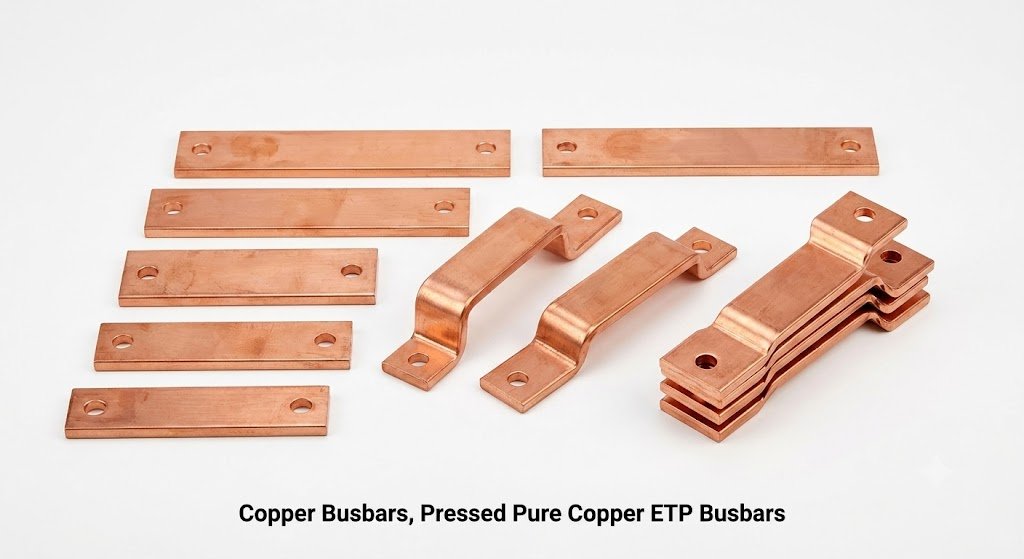
Pressed Pure Copper ETP Busbars for Switchgear, Panel Boards, Transformers and Power Distribution
Cable Glands India manufactures pressed and stamped copper busbars from pure Copper ETP (Electrolytic Tough Pitch, C11000/CW004A) and oxygen-free copper grades for low-voltage and medium-voltage current-carrying applications. Busbars are blanked, punched, bent and pressed from copper strip, sheet and plate in thickness ranges of 0.5mm to 12mm, and are supplied bare, tin-plated, nickel-plated or silver-plated as required by the end application. These pressed copper busbars are supplied to electrical OEMs, panel builders, EPC contractors, transformer manufacturers and power utilities across India, the Middle East, Europe, Africa and Southeast Asia. Indicative price: US$ 17.90/Kg (Ex-Works Jamnagar, India; subject to section size, plating and order quantity).
Detailed Product Overview
Pressed Pure Copper ETP Busbars – Base Material and Conductivity
Pure copper ETP busbars are produced from C11000 electrolytic tough pitch copper, containing a minimum of 99.90% copper with controlled oxygen content for high electrical conductivity. Conductivity of 101% IACS minimum is maintained across all pressed sections, along with density of 8.94 g/cm3 and thermal conductivity of 391 W/m-K. Copper strip and sheet are sourced from certified mills, tested for chemical composition, and cross-verified through spectrometric analysis before pressing. Temper condition is selected between soft annealed and half-hard depending on bending and forming requirements. Busbar blanks are cut to width tolerance of +/-0.1mm to maintain consistent current density across the cross-section. This material forms the base feedstock for flat busbars, laminated busbars, and formed connector links used throughout distribution panels.
Copper Busbar Punching, Blanking and Piercing
Busbar profiles, mounting holes, slots and cut-outs are produced using progressive die punching and CNC punching presses. Hole patterns for bolted connections, spacers, and insulator mounting are punched to +/-0.05mm positional accuracy. Piercing operations remove material for cable entries, ventilation slots, and connection tabs without inducing burrs that could affect creepage and clearance distances. High-tonnage presses up to 200 tons process copper thickness up to 12mm in a single stroke, while thinner gauges are processed on high-speed progressive tooling for volume production of standard busbar links and jumpers.
Copper Busbar Bending, Forming and Fabrication
Flat busbars often require offset bends, edgewise bends, and twists to route current between different mounting planes within a panel. CNC busbar bending and punching machines form these profiles to bend angles of 0 to 180 degrees with springback compensation built into the tooling. Minimum bend radius is maintained at one times material thickness to avoid surface cracking. Multi-bend busbars for compartmentalized switchgear, and offset links for transformer tap connections, are fabricated with repeatable dimensional accuracy suited to interchangeable assembly on production lines.
Tin-Plated, Silver-Plated and Nickel-Plated Copper Busbars
Surface plating is applied to pressed copper busbars to control contact resistance, prevent oxidation, and meet OEM specification requirements. Electrolytic tin plating of 5 to 15 microns is the standard finish for panel busbars, providing corrosion protection and stable contact resistance at bolted joints. Silver plating of 8 to 25 microns is applied for high-current switchgear and transformer connections where minimum contact resistance and high-temperature stability are required. Nickel plating is offered for busbars operating in corrosive or high-humidity environments. All plating is applied after forming to ensure uniform coverage over bend radii and punched edges.
Laminated and Flexible Copper Busbars
Multiple copper laminates are assembled with epoxy-glass insulation between layers to create laminated busbars used in power electronics, drives, and compact switchgear where multiple current paths must be routed in a confined space. Flexible copper busbars, built from stacked thin copper foils or braided copper strip, absorb vibration and thermal expansion between rigid busbar sections, transformer bushings, and battery terminals. Both laminated and flexible constructions are pressed and slit to specified widths before lamination or braiding.
Copper Busbar Connectors, Links and Jumpers
Short pressed copper components including busbar links, jumper straps, and interconnecting tabs are manufactured to connect adjacent busbar sections, circuit breakers, and fuse bases within a panel. These parts are punched with bolt-hole patterns matching standard busbar centers and are supplied bare or plated to match the parent busbar system. Expansion joints and flexible jumpers are also produced for connections that must accommodate thermal movement between transformer terminals and outdoor bus systems.
Insulated and Sleeved Copper Busbars
For applications requiring phase segregation or touch-safe protection, pressed copper busbars are insulated using heat-shrink sleeving, epoxy powder coating, or PVC/polyester tape wrapping. Insulation is rated for voltage classes up to 1100V and is colour-coded per phase (red, yellow, blue, black/green) to meet panel-building standards. Insulated busbars are used in low-voltage switchboards, motor control centers, and busway trunking systems where creepage distance and touch protection are specification requirements.
Busbar Support Insulators and Mounting Hardware
Pressed copper busbars are supplied with matching mounting hardware including brass and copper spacers, support insulators, and bolted clamp fittings. Hole spacing and bolt-circle dimensions are manufactured to align with standard SMC and DMC busbar support insulators used in switchgear assembly. This ensures the busbar system integrates directly into panel builder assembly lines without secondary modification.
Key Features of Pressed Copper ETP Busbars
- Minimum 99.90% pure Copper ETP (C11000) with 101% IACS conductivity
- Thickness range 0.5mm to 12mm, width up to 250mm
- Punching, piercing and bending on CNC busbar processing lines
- Bare, tin-plated, silver-plated and nickel-plated finish options
- Laminated and flexible busbar construction available
- Dimensional tolerance +/-0.1mm on width, +/-0.05mm on hole position
- Insulated and heat-shrink sleeved options up to 1100V
- Custom bending, offsetting and multi-plane forming
- Compliant with IEC 61439, IS 8623 and ASTM B187
- Export packaging suitable for sea and air freight
Electrical Conductivity and IACS Rating
Every batch of copper busbar stock is verified for electrical conductivity using an eddy-current conductivity meter, confirming a minimum of 101% IACS as required for C11000 ETP copper. Conductivity directly determines current-carrying capacity and I2R heating at rated load. Material test certificates report conductivity, chemical composition and mechanical properties traceable to the coil heat number. Consistent conductivity across the full busbar length prevents localized hot spots at bends, punched holes and bolted joints.
Dimensional Accuracy and Tolerances
Busbar width, thickness and hole position are controlled using calibrated progressive dies and CNC punching programs. Width tolerance is held to +/-0.1mm and hole-to-hole spacing to +/-0.05mm so busbars from different production batches remain interchangeable within a panel design. Flatness across the busbar length is maintained within 0.5mm per meter to allow proper seating against support insulators and adjacent busbar sections.
Surface Finish and Plating Options
Surface finish is selected according to contact resistance and environmental requirements. As-pressed bright copper finish is offered for indoor panels with regular maintenance access. Tin plating is specified where bolted joints must resist oxidation over the equipment service life. Silver plating is specified for high-current joints and transformer terminal connections where minimum and stable contact resistance is critical.
Thermal Performance and Current-Carrying Capacity
Cross-sectional area, plating and ambient operating temperature determine the continuous current rating of a pressed busbar. Current ratings are calculated per IEC 61439 and IS 8623 guidelines for enclosed and open busbar installations, accounting for temperature rise limits at rated current. Busbar sizing data is provided to panel designers for standard rectangular sections from 15mm x 3mm up to 200mm x 10mm and custom sizes on request.
Corrosion Resistance and Environmental Sealing
Tin, nickel and silver plating combined with insulation sleeving protect pressed copper busbars from atmospheric corrosion, humidity and industrial pollutants. Busbars destined for coastal, marine or chemical-plant installations are supplied with heavier plating thickness and, where specified, additional epoxy coating over the plated surface.
Mechanical Strength and Fabrication Flexibility
Half-hard and hard temper copper is used where busbars must retain shape under short-circuit electromagnetic forces without loosening at support points. Forming tolerances account for springback in each temper grade, and busbars are validated for repeatable bend geometry across production runs, allowing panel builders to design fixed mounting centers for busbar chambers.
Technical Specifications
| Parameter | Specification |
|---|---|
| Material Grade | C11000 (Cu-ETP), C10100 (OFC), C10200 |
| Copper Purity | 99.90% minimum |
| Conductivity | 101% IACS minimum |
| Thickness Range | 0.5mm to 12mm |
| Width Range | 10mm to 250mm |
| Length | Up to 6000mm (coil-fed for shorter links) |
| Tolerance – Width/Thickness | +/-0.1mm |
| Tolerance – Hole Position | +/-0.05mm |
| Temper | Soft (O), Half-Hard (H02), Hard (H04) |
| Surface Finish | Bare, Tin-plated, Silver-plated, Nickel-plated |
| Plating Thickness | 5 to 25 microns |
| Voltage Rating (Insulated) | Up to 1100V |
| Bend Radius | 1x to 3x material thickness |
| Standards | IEC 61439, IS 8623, ASTM B187, BS EN 13601 |
Material Grades and International Equivalents
| ASTM/CDA (USA) | DIN/EN (Europe) | JIS (Japan) | GB (China) | BS (UK) |
|---|---|---|---|---|
| C11000 (ETP Copper) | Cu-ETP / CW004A | C1100 | T2 | C101 |
| C10100 (OFE Copper) | Cu-OFE / CW009A | C1011 | TU0 | C103 |
| C10200 (OF Copper) | Cu-OF / CW008A | C1020 | TU1/TU2 | C102 |
| C12200 (DHP Copper) | Cu-DHP / CW024A | C1220 | TP2 | C106 |
Product Types and Variants
| Busbar Type | Typical Application |
|---|---|
| Flat Rectangular Busbars | Panel boards, switchgear main bus |
| Laminated Busbars | Power electronics, VFDs, compact drives |
| Flexible Braided Busbars | Vibration isolation, battery/transformer links |
| Formed/Bent Busbars | Multi-plane panel routing, offset connections |
| Insulated/Sleeved Busbars | Touch-safe LV switchboards, MCCs |
| Tin/Silver-Plated Busbars | High-current joints, transformer terminals |
| Busbar Links and Jumpers | Breaker-to-breaker, fuse-base interconnection |
Applications in Industry
| Industry Sector | Application |
|---|---|
| Switchgear and Panel Building | Main and branch busbars, riser bars |
| Transformers | Tap connections, terminal links, tank bushing connections |
| Bus Duct/Busway Systems | Rising mains, plug-in busway conductors |
| Power Distribution Utilities | Substation LV/MV distribution boards |
| Renewable Energy | Solar inverter DC/AC busbars, wind turbine nacelle wiring |
| Railways and Traction | Traction substations, rolling-stock power distribution |
| Battery and UPS Systems | Battery interconnect busbars, UPS terminal links |
| Industrial Machinery | Motor control centers, machine control panels |
Manufacturing Process
- Raw Material Selection: Certified C11000/C10100 copper coil and sheet procured with mill test certificates.
- Incoming Inspection: Chemical composition and conductivity verified by spectrometry and eddy-current testing.
- Slitting and Shearing: Coil slit to specified busbar width with edge condition suited for punching.
- Blanking and Piercing: Progressive die and CNC punching produce outline, holes and slots.
- CNC Bending and Forming: Offset bends, edgewise bends and twists formed to drawing dimensions.
- Deburring: Punched and sheared edges deburred to remove sharp edges affecting creepage distance.
- Surface Finishing: Tin, silver or nickel electroplating applied as specified, or left bare with anti-tarnish treatment.
- Insulation (Optional): Heat-shrink sleeving, epoxy powder coating, or tape wrapping applied per voltage class.
- Quality Inspection: Dimensional check on CMM/fixture, conductivity re-verification, visual and plating-thickness inspection.
- Packing and Dispatch: Busbars packed in export crates with moisture protection for sea/air freight.
Quality Standards and Certifications
- ISO 9001:2015 – Quality Management System
- IEC 61439-1/2 – Low-voltage switchgear and busbar assemblies
- IS 8623 – Low-voltage switchgear and controlgear assemblies (India)
- ASTM B187 – Copper Busbar, Rod and Shapes
- BS EN 13601 – Copper rod, bar and wire for electrical purposes
- RoHS Compliant and REACH Registered materials
- Material Test Certificates (MTC) per shipment with heat traceability
Why Choose Cable Glands India for Copper Busbars
- Manufacturing Base in Jamnagar, India with in-house pressing, punching, bending and plating lines
- Material Traceability from copper coil heat number to finished busbar batch
- Custom Fabrication for panel-specific bend geometry and hole patterns
- Export Experience supplying electrical OEMs and EPC contractors across the Middle East, Africa, Europe and Southeast Asia
- Competitive Pricing at US$ 17.90/Kg with volume-based quotations
- Documentation Support including MTCs, dimensional reports and plating-thickness certificates
Frequently Asked Questions
What copper grade is used for pressed busbars?
Pressed busbars are manufactured from C11000 Copper ETP (electrolytic tough pitch) as the standard grade, with C10100 oxygen-free copper offered where higher conductivity or lower oxygen content is specified.
What is the minimum conductivity guaranteed for copper busbars?
All copper ETP busbars are supplied with a minimum conductivity of 101% IACS, verified by eddy-current testing on every production batch.
What thickness range can be pressed and punched?
Copper busbars are processed from 0.5mm to 12mm thickness, with punching and piercing capability up to 12mm in a single press stroke.
Are tin-plated and silver-plated busbars available?
Yes, tin plating (5-15 microns) and silver plating (8-25 microns) are both offered, along with nickel plating for corrosive environments.
Can busbars be supplied with custom bends and hole patterns?
Yes, CNC bending and punching allow busbars to be fabricated to customer drawings, including offset bends, multi-plane forming and specific bolt-hole patterns.
What insulation options are available for touch-safe busbars?
Heat-shrink sleeving, epoxy powder coating and PVC/polyester taping are available, rated up to 1100V and colour-coded per phase.
Which standards govern copper busbar manufacturing?
Busbars are manufactured to IEC 61439, IS 8623, ASTM B187 and BS EN 13601, with ISO 9001:2015 quality management certification.
What is the price of copper busbars per kg?
Indicative pricing is US$ 17.90/Kg Ex-Works Jamnagar, India, varying with cross-section, plating and order quantity. Confirmed pricing is issued after technical review of the drawing or specification.
Do you supply laminated and flexible copper busbars?
Yes, laminated busbars for power electronics and flexible braided busbars for vibration and thermal-expansion applications are manufactured in addition to standard flat busbars.
What is the typical lead time for custom busbar orders?
Standard lead time is 3 to 5 weeks from drawing approval, depending on tooling requirements, plating and order quantity.
Equivalent Terms in Other Languages
| Language | Equivalent Terms |
|---|---|
| Spanish | Barras colectoras de cobre, Barras de cobre ETP prensadas, Pletinas de cobre |
| Russian | Медные шины, Прессованные медные шины ETP, Токопроводящие шины |
| French | Barres omnibus en cuivre, Barres de cuivre ETP embouties, Jeux de barres en cuivre |
| Portuguese | Barramentos de cobre, Barras de cobre ETP prensadas, Barras coletoras de cobre |
| Italian | Sbarre collettrici in rame, Barre di rame ETP stampate, Sbarre in rame per quadri |
Related Parts and Terms
Copper busbars, pressed copper ETP busbars, copper busbar stamping, copper bus bar bending, laminated copper busbars, flexible copper busbars, tin-plated copper busbars, silver-plated copper busbars, insulated copper busbars, copper busbar connectors, busbar links and jumpers, C11000 copper busbar, oxygen-free copper busbar, switchgear busbars, panel board busbars, transformer busbar connections, busway copper conductors, copper current bars, copper distribution bars.
Related Products from Pressed Parts
- Copper Pressed Parts, Copper Deep Drawn Parts, Copper Sheet Metal Parts
- Copper Fuse Clips, Copper Fuse Connectors
- Brass Sheet Metal Pressed Components
- Brass Stamping, Brass Stamped Parts, Brass Stamped Components
- Bronze Pressed Parts, Phosphor Bronze Pressed Parts, Bronze Stamping
- Stainless Steel Pressed Parts, Stainless Steel Stamped Parts
- Aluminum Parts, Aluminum Pressed Parts
Request a Quote for Pressed Copper ETP Busbars
For technical drawings, custom bend geometry, plating specification and volume pricing, contact our engineering team. Indicative price: US$ 17.90/Kg (Ex-Works Jamnagar, India).
Email: sales@cableglandsindia.com | Phone: +91-22-43449300