Copper Lay-In Lugs – Open-Face Copper Grounding & Bonding Lay-In Connectors
Rate: US$ 17.90/Kg
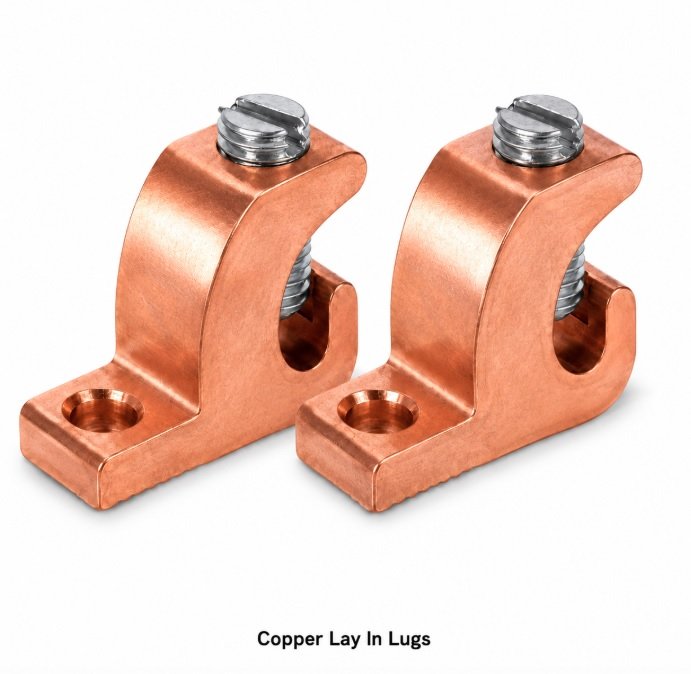
Copper Lay-In Lugs, Lay-In Grounding Connectors, Open-Face Ground Lugs, Setscrew Lugs
Price: US$ 17.90 per kilogram | Custom pricing available for bulk, OEM and utility framework orders.
Copper lay-in lugs are open-faced mechanical connectors machined or forged from high-strength pure electrolytic copper and used to terminate, tap and run grounding and bonding conductors. Unlike a closed compression lug, the conductor is simply laid into the open copper channel and locked in place with a captive setscrew, while a drilled tongue bolts the lug to an enclosure, busbar, ground rod, transformer pad or conduit grounding bushing. Because the conductor is not cut, a single continuous earth wire can be run through several lay-in lugs as an unbroken jumper – the defining advantage that makes the copper lay-in lug (also called a lay-in grounding connector, open-face ground lug or setscrew lug) the connector of choice for equipment grounding, bonding jumpers and buried ground grids. Cable Glands India manufactures copper lay-in lugs across the full 14 AWG to 250 kcmil conductor range with 0.22 in to 0.33 in stud holes, rated for 90°C service and UL 486B direct-burial grounding, supplied to electrical OEMs, EPC contractors, power utilities and distributors worldwide.
Product Overview
Function of a Lay-In Lug in the Grounding Path
A lay-in lug performs one job with total reliability: it forms a permanent, low-resistance mechanical bond between a grounding conductor and a fixed metal surface. The conductor is placed into the open barrel, the setscrew is torqued down onto it, and the drilled tongue is bolted to the equipment. This creates a gas-tight metal-to-metal interface that carries fault current, lightning discharge and static leakage to earth. The open-face geometry means the installer never has to feed a wire end through a closed sleeve, so the same continuous grounding electrode conductor can be looped through multiple lugs – across conduit runs, cable trays, motor frames and switchgear – without a single splice. In grounding and bonding, connected terms such as equipment grounding conductor, bonding jumper, grounding electrode conductor, ground bus, earth pit and lightning down-conductor all describe circuits where a copper lay-in lug provides the termination.
Electrolytic Copper Body Construction
The performance of any grounding connector begins with the metallurgy of its body. Cable Glands India machines and forges copper lay-in lugs from electrolytic tough-pitch copper (C11000) with a minimum 99.9% copper content and roughly 100% IACS conductivity, ensuring the lug never becomes the weak link in the earth path. High-conductivity copper resists ohmic heating under fault current, holds clamping force without creep, and forms a corrosion-stable interface with copper conductors. Where higher purity or brazeability is needed, oxygen-free copper (C10200) and phosphorus-deoxidised copper (C12200) are offered. Related material terms buyers commonly specify include ETP copper, oxygen-free copper, DHP copper, half-hard temper, IACS conductivity, annealed copper bar and copper rod stock – each of which affects strength, conductivity and setscrew retention in the finished lug.
Open-Face, Setscrew and Bolt-Down Interface
Three mechanical features define the lay-in lug: the open barrel, the setscrew, and the drilled tongue. The open barrel accepts stranded or solid conductors laid in from above; the hardened setscrew – typically a hex-socket (Allen) or slotted-head design in stainless steel or silicon bronze – applies concentrated clamping pressure to bite through surface oxide; and the tongue carries a bolt hole (0.22 in to 0.33 in / M5 to M8) for mounting to a pad, angle or busbar. Together these give a field-serviceable, re-enterable joint that can be inspected, re-torqued and reused. Associated hardware terms include setscrew, cup-point grub screw, hex key, mounting bolt, flat washer, spring washer, lock nut and grounding pad, all of which form part of a complete lay-in termination assembly.
Conduit Grounding Bushing and Enclosure Bonding
A major use for copper lay-in lugs is bonding metallic conduit systems. The lug mounts on a grounding bushing at a conduit entry, and a continuous bonding jumper is laid through a line of bushings to tie every raceway to the ground bus. This satisfies code requirements for a continuous, low-impedance equipment grounding path around concentric knockouts, reducing conduits, and eccentric fittings. Connected components in this application include grounding bushing, insulated throat bushing, locknut, sealing washer, bonding jumper, ground bus bar and enclosure ground pad. The open-face lug makes this a fast, inspectable installation – an electrician can drop the jumper into each lug and torque a single setscrew rather than cutting and crimping at every box.
Utility, Substation and Transformer Grounding
In substations and on utility transformers, copper lay-in lugs terminate the heavy grounding conductors that connect tanks, fences, structures and surge arresters to the buried ground grid. Solid copper construction and a 90°C, direct-burial rating allow the lug to survive years of soil moisture, thermal cycling and fault-current stress. Here the lay-in lug interfaces with a wider family of grounding hardware: ground rods, exothermic weld connections, ground grid conductors, tank grounding pads, fence bonding straps and pad-mount transformer lugs. Because the connector is mechanical rather than welded, it can be removed for maintenance testing of ground resistance – an advantage over permanent bonds in test-well and inspection-pit designs.
Renewable Energy and Data-Centre Bonding
Solar farms, wind installations and data centres depend on dense, inspectable bonding networks, and the copper lay-in lug is specified throughout them. On PV racking it bonds module frames and rails to the equipment grounding conductor; in data centres it ties signal reference grids, cable ladders and cabinet frames to the common bonding network. Related terms in these sectors include PV frame bonding lug, WEEB, signal reference grid, common bonding network (CBN), mesh-BN, cabinet earth bar and structured-ground busbar. The re-enterable lay-in design supports the frequent moves, adds and changes typical of these facilities without destroying the connector.
Range, Sizing and Interchangeability
Cable Glands India supplies copper lay-in lugs in the industry-standard CL size family – CL-50, CL-112, CL-200 and CL-252 – spanning 14 AWG to 250 kcmil conductors and 0.22 in to 0.33 in bolt holes, dimensionally interchangeable with common North American grounding connectors. Each size is offered bare or tin-plated, with optional two-hole tongues, private-label marking and metric bolt patterns. This lets OEMs and distributors standardise on a single source while matching existing panel and switchgear drilling. Connected selection terms include conductor size range, stud hole diameter, tongue thickness, barrel depth, dual-rated AL9CU, two-hole NEMA pad and centre-to-centre spacing.
Key Features
- Pure electrolytic copper body (C11000, ≥99.9% Cu, ~100% IACS) for maximum conductivity and strength.
- Open-face lay-in design – run a continuous grounding conductor through multiple lugs with no cut or splice.
- Captive setscrew clamping (stainless / silicon-bronze) that bites through oxide for a gas-tight joint.
- Wide range: 14 AWG – 250 kcmil conductors; 0.22 in – 0.33 in (M5–M8) bolt holes.
- 90°C rated and direct-burial suitable, evaluated to UL 486B / UL 467 grounding practice.
- Bare or tin-plated finishes for copper-only or dual-rated aluminium/copper interfaces.
- Re-enterable and serviceable – inspect, re-torque and reuse without destroying the connector.
- RoHS-compliant, ISO 9001 manufacture with private-label and custom sizing for OEMs.
High-Conductivity Copper for Fault-Current Survival
Grounding connectors must carry prospective fault currents that can reach tens of kiloamperes for several cycles. The electrolytic copper barrel of a Cable Glands India lay-in lug provides the cross-section and conductivity to absorb this energy without annealing, softening or losing clamp force. Because copper’s resistivity is far below that of steel or brass, the lug contributes negligible voltage drop and negligible heating to the ground path, keeping touch and step potentials within safe limits. Connected performance terms include short-circuit withstand, I²t rating, temperature rise, contact resistance and IACS conductivity – every one of which improves when the connector body is high-purity copper rather than a copper alloy.
Setscrew Clamping and Gas-Tight Contact
The clamping system is what turns two pieces of metal into a single conductor. A cup-point or knurled setscrew concentrates force onto the laid-in conductor, displacing the thin oxide film and cold-welding copper to copper at the asperity level. This produces a gas-tight interface that resists oxygen ingress and therefore resists the slow rise in contact resistance that plagues loose joints. Correct torque is essential: too little leaves a high-resistance connection, too much shears strands. Related terms include cup-point setscrew, oxide penetration, cold-weld contact, clamp force, torque specification and re-torque interval, all central to a durable lay-in termination.
Corrosion Behaviour and Plating Options
Buried and outdoor grounding connectors live in an aggressive environment of moisture, salts and dissimilar metals. Bare copper is galvanically noble and performs well against copper conductors and in most soils, which is why it is the default for buried grids. Where the lug must contact aluminium hardware or serve coastal and chemical plants, an electro-tin plating provides a compatible, corrosion-resistant surface and enables a dual-rated aluminium/copper joint. Connected corrosion terms include galvanic series, dissimilar-metal corrosion, tin plating, anti-oxidant compound, marine-grade finish and passivation – each addressed by correct finish selection.
Mechanical Robustness and Vibration Resistance
Transformers, motors, generators and rail vehicles subject grounding connections to continuous vibration and thermal cycling. The forged or bar-machined copper body of a lay-in lug resists fatigue cracking, and the setscrew plus a lock washer or thread-locking feature maintains clamp force under vibration. The bolt-down tongue distributes load to the mounting surface rather than the conductor. Associated terms include vibration resistance, thermal cycling, creep relaxation, lock washer, Belleville washer and pull-out strength, all of which describe how the lug keeps its integrity in service.
Code Compliance and Inspectability
Electrical inspectors require grounding terminations to be listed, correctly sized and accessible. The lay-in lug’s open, bolt-down form is inherently inspectable – the conductor and setscrew are visible, the size marking is legible, and the joint can be re-torqued during audits. Cable Glands India lugs support installation to UL 467, UL 486A/486B, the NEC, IS 3043 and IEC 62561-1. Connected compliance terms include listed grounding connector, conductor size marking, accessible connection, torque marking and equipment grounding conductor sizing per NEC 250.
Technical Specifications
| Parameter | Specification |
|---|---|
| Product type | Open-face mechanical lay-in lug (grounding / bonding connector) |
| Body material | Pure electrolytic copper – C11000 (ETP); C10200 (OF) / C12200 (DHP) optional |
| Copper purity / conductivity | ≥ 99.9% Cu; ~100% IACS (101% IACS for oxygen-free) |
| Setscrew / hardware | Stainless steel (A2/A4) or silicon bronze; hex-socket or slotted |
| Conductor range | 14 AWG – 250 kcmil (custom to 500 kcmil) |
| Stud / bolt hole | 0.22 in – 0.33 in (≈ M5 – M8); two-hole tongues optional |
| Finish | Bare (plain) copper or electro-tin plated (dual-rated AL/CU) |
| Temperature rating | 90°C continuous |
| Environmental rating | Indoor, outdoor and direct burial |
| Listing / evaluation | UL 486B / UL 467; ISO 9001 manufacture; RoHS compliant |
| Marking | Catalogue size + conductor range (private-label available) |
Standard Size Chart (CL Series)
| Type / Ref. | Conductor Range | Stud / Bolt Hole | Dimensions L × W × H (in) | Approx. Weight |
|---|---|---|---|---|
| CL-50 | 4 – 14 AWG | 0.22 in (≈ M5) | 1.07 × 0.38 × 0.78 | 0.05 lb (23 g) |
| CL-112 | 1/0 – 14 AWG | 0.27 in (≈ M6) | 1.50 × 0.60 × 1.17 | 0.18 lb (80 g) |
| CL-200 | 3/0 – 6 AWG | 0.33 in (≈ M8) | 2.00 × 0.80 × 1.56 | 0.45 lb (204 g) |
| CL-252 | 250 kcmil – 6 AWG | 0.33 in (≈ M8) | 2.20 × 0.80 × 1.79 | 0.56 lb (253 g) |
Dimensions are nominal; larger conductor ranges, two-hole tongues and metric bolt patterns are produced to order. Verify torque against the value marked on each lug.
Raw Material Grades
| Grade (UNS) | Copper Type | Key Properties | Typical Use in Lay-In Lugs |
|---|---|---|---|
| C11000 | Electrolytic Tough Pitch (ETP) | ≥99.9% Cu, ~100% IACS, excellent conductivity & strength | Standard body material for all grounding lay-in lugs |
| C10100 / C10200 | Oxygen-Free (OFE / OFHC) | ≥99.95–99.99% Cu, ~101% IACS, high ductility, brazeable | High-purity / brazed assemblies, sensitive grounding |
| C12200 | Phosphorus-Deoxidised (DHP) | Good weld/braze behaviour, resists hydrogen embrittlement | Fabricated and welded lug variants |
International Equivalent Copper Grades
| USA (UNS) | ISO / EN | Germany (DIN) | UK (BS) | India (IS) |
|---|---|---|---|---|
| C11000 (ETP) | Cu-ETP / CW004A | E-Cu58 / 2.0060 | C101 | IS 191 – Grade ETP |
| C10200 (OF) | Cu-OF / CW008A | OF-Cu / 2.0040 | C103 | IS 191 – Grade OF |
| C12200 (DHP) | Cu-DHP / CW024A | SF-Cu / 2.0090 | C106 | IS 191 – Grade DHP |
International Equivalent Standards
| Region | Standard | Scope |
|---|---|---|
| USA | UL 467 | Grounding & bonding equipment |
| USA | UL 486A / 486B | Wire connectors (copper & aluminium) |
| USA | NEC / NFPA 70 – Art. 250 | Grounding & bonding installation rules |
| India | IS 3043 | Code of practice for earthing |
| Germany | DIN 46234 / DIN 48083 | Cable lugs & earthing clamps |
| Europe / IEC | IEC 62561-1 / EN 62561-1 | Lightning-protection connection components |
Product Types and Variants
| Variant | Description | Typical Application |
|---|---|---|
| Single-hole lay-in lug | One bolt hole in the tongue, open barrel with one setscrew | General equipment grounding, enclosure bonding |
| Two-hole lay-in lug | NEMA two-hole tongue for anti-rotation, high-vibration bonds | Busbar, switchgear, transformer pad terminations |
| Tin-plated (dual-rated) lay-in lug | Electro-tin finish, AL9CU rated | Aluminium conductors, coastal / corrosive sites |
| Conduit grounding-bushing lug | Sized to mount on grounding bushings, lay-in jumper | Bonding metallic conduit & raceway systems |
| Heavy-duty / transformer lay-in lug | Large barrel, multiple setscrews for big conductors | Substation, pad-mount & utility grounding |
| Twin / multi-conductor lay-in lug | Parallel channels for two conductors in one body | Ground-grid taps, parallel bonding runs |
Applications in Industry
Power distribution & switchgear: terminating equipment grounding conductors and bonding jumpers to ground bus bars in LV/MV panels, MCCs and switchboards, where an inspectable, re-torquable joint is required.
Transformers & substations: connecting tank, neutral, structure and fence grounding conductors to the buried ground grid on distribution and pad-mount transformers, with 90°C and direct-burial performance.
Conduit & raceway bonding: mounting on grounding bushings to run a continuous bonding jumper across metallic conduits, cable trays and wireways without breaking the ground conductor.
Renewable energy: bonding PV module frames, racking, inverters and combiner boxes, and grounding wind-turbine structures, where dense inspectable bonding networks are mandated.
Industrial earthing & lightning protection: terminating down-conductors, earth-pit conductors and structural bonding straps to grounding electrodes in plants and process facilities.
OEM panel building & data centres: standardised grounding of enclosures, cabinet frames, signal reference grids and common bonding networks in manufactured assemblies.
Manufacturing Process
Copper lay-in lugs are produced from certified electrolytic copper bar and rod. Depending on size, bodies are cold-formed / hot-forged or CNC bar-machined to develop the open barrel and mounting tongue, then the bolt hole and setscrew thread are drilled and tapped. Forging aligns the grain flow for maximum strength; machining delivers tight tolerances on stud holes and barrel depth. After forming, each lug is deburred and cleaned, the setscrew thread is gauged, and stainless-steel or silicon-bronze setscrews are fitted. Lugs specified for aluminium or corrosive service pass through an electro-tin plating line. Finished lugs are marked with the catalogue size and conductor range (or the customer’s private-label mark), then inspected for dimensions, plating thickness, thread integrity and clamp function before packing. Connected process terms include copper forging, CNC machining, cold heading, tapping, deburring, electro-tin plating, laser/stamp marking and in-process gauging – the full route that turns copper stock into a listed grounding connector.
Quality Standards and Certifications
| Standard | Scope |
|---|---|
| ISO 9001:2015 | Quality management system governing manufacture & inspection |
| UL 467 | Grounding & bonding equipment reference |
| UL 486A / 486B | Copper & aluminium wire-connector performance |
| IS 3043 / IS 191 | Earthing practice & copper material grade (India) |
| DIN 46234 / IEC 62561-1 | Cable-lug & earthing-connection component requirements |
| RoHS / REACH | Restriction of hazardous substances in materials & plating |
Why Choose Cable Glands India
Cable Glands India is a specialist metal-part manufacturer supplying copper lay-in lugs and grounding hardware to electrical OEMs, EPC contractors, power utilities and distributors. Every lug is machined or forged in-house from certified electrolytic copper, backed by an ISO 9001 quality system, material test certificates and full dimensional and plating inspection. We hold the standard CL-50 to CL-252 range for fast dispatch and produce custom sizes, two-hole tongues, tin-plated dual-rated versions and private-label marking to drawing. With export experience across North America, Europe, the Middle East, Africa and Asia-Pacific, competitive per-kilogram pricing and responsive engineering support, we help buyers consolidate their grounding-connector supply with a single reliable source. Indicative price: US$ 17.90 per kilogram, with volume and OEM pricing on request.
Frequently Asked Questions
What is a copper lay-in lug?
An open-faced mechanical connector of electrolytic copper in which the conductor lays into an open channel and is clamped by a setscrew, while a drilled tongue bolts to equipment. It terminates ground and bonding conductors without cutting the wire.
What conductor range do copper lay-in lugs cover?
Standard sizes span 14 AWG to 250 kcmil with 0.22 in to 0.33 in (M5–M8) bolt holes. Custom ranges to 500 kcmil and larger bolt patterns are made to order.
Are copper lay-in lugs suitable for direct burial?
Yes. Solid copper lay-in lugs are rated for 90°C and direct burial and typically carry UL 486B recognition, making them suitable for buried ground grids, ground rods and concrete-encased electrodes.
Why use an open-face lay-in design for grounding?
The open face lets a continuous grounding conductor pass through several lugs as an unbroken jumper, keeping a low-impedance ground path with no cut or splice across multiple conduits or bushings.
Bare copper or tin-plated – which should I specify?
Bare copper for copper conductors and buried grounding; tin-plated where the lug contacts aluminium hardware or serves corrosive, coastal or dual-rated AL/CU applications.
What setscrew torque is required?
Follow the torque marked on the lug or the datasheet. Typical hex-socket setscrews range from about 45 lb-in on small sizes to 275–375 lb-in on larger sizes; always use a calibrated torque wrench.
Can copper lay-in lugs be used with aluminium conductors?
Bare copper is for copper conductors. For aluminium or dual-rated (AL9CU) use, choose the tin-plated version with an anti-oxidant compound.
What copper grade is used?
Bodies are C11000 electrolytic tough-pitch copper (≥99.9% Cu, ~100% IACS). Oxygen-free C10200 and DHP C12200 are available on request.
Which standards apply?
UL 467 and UL 486A/486B for grounding and wire connectors, with installation to NEC, IS 3043, IEC 62561-1 and DIN earthing practice; manufactured under ISO 9001 with RoHS-compliant materials.
What is the price and lead time?
Indicative price is US$ 17.90 per kilogram, with volume and OEM pricing on request. Standard sizes ship from stock; custom sizes and plating typically ship in 2–4 weeks.
International Equivalent Terms
| Language | Equivalent Terms for “Copper Lay-In Lugs” & Related Parts |
|---|---|
| Spanish | Terminales de conexión directa de cobre; conector de puesta a tierra; borne de tierra de cobre |
| Russian | Медные зажимные наконечники; заземляющий зажим; наконечник для укладки провода |
| French | Cosses à poser en cuivre; connecteur de mise à la terre; borne de terre en cuivre |
| Portuguese | Terminais de encaixe de cobre; conector de aterramento; borne de terra de cobre |
| Italian | Capicorda a posa in rame; connettore di messa a terra; morsetto di terra in rame |
Linked Parts and Related Terms
Copper lay-in lug, lay-in grounding connector, open-face ground lug, setscrew lug, conduit grounding bushing lug, mechanical grounding connector, two-hole lay-in lug, tin-plated lay-in lug, dual-rated AL9CU lug, ground bus bar, grounding bushing, bonding jumper, ground rod clamp, transformer grounding lug, cable tray bonding jumper, PV frame bonding lug, earth pit connector, grounding electrode conductor terminal, copper cable lug, copper battery terminal.
Related Products in this Category
- Copper Cable Lugs
- Copper Ring Type Terminals
- Copper Battery Terminals
- Copper Forgings – Forged Components
- Copper CNC Machined Components
- Copper Stamped Parts
- Copper Screw Machine Parts
- All Copper Parts & Terminals
Get a Quote – Copper Lay-In Lugs
Price: US$ 17.90 per kilogram | Custom pricing for bulk, OEM and utility framework orders.
Share your conductor range, stud/bolt hole size, finish (bare or tin-plated), required quantity and delivery timeline for a same-day quotation from our engineering team. Email sales@cableglandsindia.com or call / WhatsApp +91-22-43449300.