C95600 Bronze Casting, CDA 956 Bronze Casting
Rate: US$ 17.90/Kg
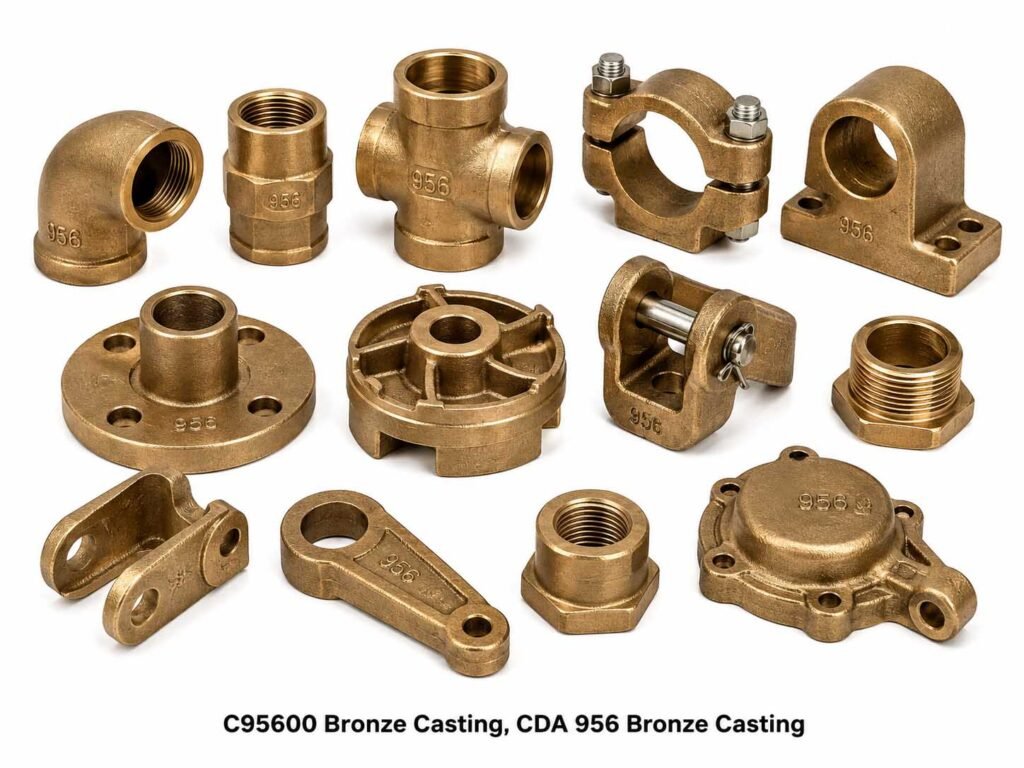
Cable Glands India is a specialist C95600 bronze casting manufacturer, foundry and exporter based in Jamnagar, Gujarat, India, supplying CDA 956 bronze castings to buyers in the United Kingdom, United States, Europe, Australia and Canada. C95600 — also known as CDA 956, aluminium‑silicon bronze, silicon aluminium bronze, or historically ASTM alloy 9E — is the highly machinable, connector‑grade member of the aluminium bronze family, and we cast it to ASTM B148, ASTM B763 and ASTM B30 in the as‑cast (M01) condition.
We supply C95600 castings as sand cast, shell moulded, gravity die cast, centrifugally cast and investment cast components, rough machined or fully finished to customer drawing, with EN 10204 3.1 material test certificates as standard.
C95600 / CDA 956 Bronze Casting Price
Price: US$ 17.90 per Kg (FOB Mundra / Nhava Sheva, India)
- Alloy: C95600 | CDA 956 | Aluminium Silicon Bronze (Cu‑7Al‑2Si)
- Unit price: US$ 17.90/Kg
- Minimum order quantity: 50 Kg (lower quantities quoted on request)
- Payment terms: T/T, L/C at sight
- Lead time: 3–5 weeks depending on tooling and machining scope
- Supplied as: as‑cast, shot blasted, rough machined or fully machined
Pricing is indicative for plain as‑cast components of moderate size and is subject to LME copper and aluminium movement, casting weight, pattern cost, machining content and order volume. Send us your drawing or sample for a firm, dimension‑specific quotation.
What Is C95600 Aluminium Silicon Bronze?
C95600 is an aluminium‑silicon bronze containing nominally 7% aluminium and 2.5% silicon in a copper matrix, with nickel limited to 0.25% maximum and no deliberate iron addition. The combination is unusual and deliberate: the aluminium supplies the tough, self‑healing alumina passive film that gives every aluminium bronze its corrosion resistance, while the silicon dramatically improves melt fluidity, feeding behaviour and — critically — machinability.
The absence of iron means C95600 does not develop the hard kappa precipitates found in C95400 and C95500. The microstructure is a cleaner alpha‑plus‑silicide structure, which is why C95600 machines far more freely than the iron‑bearing aluminium bronzes and produces excellent surface finishes and clean threads. It is also readily hot worked and forged, so cast and forged components can be specified in matching chemistry.
Because copper content is high (88% minimum) and both aluminium and silicon are modest, C95600 retains better electrical conductivity behaviour and better cold formability than the high‑aluminium grades. This makes it the natural specification for cable connectors, terminals, lugs, valve stems, gears and worms where a component must be corrosion resistant, reasonably strong and heavily machined.
Key Properties of C95600 / CDA 956 Castings
- Tensile strength 415 N/mm² minimum, 515 N/mm² typical as sand cast
- Outstanding machinability compared with iron‑bearing aluminium bronzes — clean threads and fine finishes
- Excellent corrosion resistance in seawater, brackish water, industrial atmospheres and many chemical media
- Excellent castability and fluidity from the silicon addition — thin sections and intricate detail reproduce well
- Good hot forgeability, so cast and forged parts can share one chemistry
- High ductility — 10% minimum elongation, 18% typical
- Non‑sparking — suitable for ATEX and hazardous‑area hardware
- Non‑magnetic, with good resistance to stress corrosion cracking
- Readily weldable by TIG and MIG with silicon bronze or aluminium bronze filler
C95600 Chemical Composition (ASTM B148 / ASTM B30)
| Element | Symbol | Composition (% by weight) |
|---|---|---|
| Copper | Cu | 88.0 min. |
| Aluminium | Al | 6.0 – 8.0 |
| Silicon | Si | 1.8 – 3.2 |
| Nickel (incl. Cobalt) | Ni + Co | 0.25 max. |
Copper plus the sum of the named elements shall be 99.0% minimum. Every heat is verified on a calibrated optical emission spectrometer before pouring, and the ladle analysis is reported on the material test certificate. Silicon is closely controlled within the 1.8–3.2% band because it governs both fluidity and the machinability that buyers specify this alloy for.
C95600 Mechanical Properties
| Property | Minimum (ASTM B148) | Typical (as sand cast) |
|---|---|---|
| Tensile strength | 415 N/mm² (60 ksi) | 515 N/mm² (75 ksi) |
| Yield strength, 0.5% extension | 195 N/mm² (28 ksi) | 235 N/mm² (34 ksi) |
| Elongation in 50 mm | 10% | 18% |
| Brinell hardness (3000 kg) | — | 140 HB |
| Modulus of elasticity | 103 GPa (15,000 ksi) | |
| Shear modulus | approx. 42 GPa | |
| Poisson’s ratio | 0.34 | |
| Machinability | Very good — markedly better than C95400 / C95500 | |
Values are for separately cast test bars to ASTM B148. Properties in the body of a heavy section casting are typically 5–15% lower because of slower solidification and coarser grain; we quote section‑specific expectations at enquiry stage for wall thicknesses above 50 mm.
C95600 Physical & Thermal Properties
| Property | Value (Metric) | Value (Imperial) |
|---|---|---|
| Density | 7.70 g/cm³ | 0.278 lb/in³ |
| Melting range (solidus – liquidus) | 982 – 1004 °C | 1800 – 1840 °F |
| Thermal conductivity at 20 °C | 38.6 W/m·K | 22.3 Btu/ft·h·°F |
| Electrical conductivity at 20 °C | 8% IACS | 8% IACS |
| Coefficient of thermal expansion (20–300 °C) | 16.6 × 10⁻⁶ /°C | 9.2 × 10⁻⁶ /°F |
| Specific heat capacity | 419 J/kg·K | 0.10 Btu/lb·°F |
| Magnetic permeability | < 1.05 (essentially non‑magnetic) | |
| Maximum continuous service temperature | 210 °C | 410 °F |
C95600 International Equivalent Grades
| Standard / Country | Designation | Notes |
|---|---|---|
| UNS / CDA (USA) | C95600 / CDA 956 | Historically ASTM alloy 9E; industry name Aluminum Bronze E |
| ASTM (USA) | B148, B763, B30 | Sand castings, valve castings, ingot |
| EN 1982 / DIN (Europe) | Nearest: CuAl7Si2 family | No exact European casting equivalent |
| BS 1400 (UK) | No direct equivalent | Nearest in service terms: AB1 (different chemistry) |
| JIS (Japan) | No direct equivalent | CAC702 is the nearest aluminium bronze casting grade |
| GB/T (China) | Nearest: ZCuAl8Si (silicon aluminium bronze family) | Composition differs |
C95600 is a distinctly North American specification and there is no exact one‑for‑one European, British or Japanese casting equivalent. Where a project drawing calls for CDA 956 we pour to the ASTM B148 C95600 chemistry and certify to that standard; if you need a European‑certified alternative we will advise the closest available EN 1982 grade against your duty and provide a comparison of properties.
C95600 vs C95400 vs C95500 vs C95800 — Which Bronze Should You Specify?
| Alloy | Nominal composition | Tensile (min.) | Machinability | Best suited to |
|---|---|---|---|---|
| C95600 | Cu‑7Al‑2.5Si | 415 N/mm² | Very good | Cable connectors, terminals, valve stems, gears, worms — heavily machined corrosion‑resistant parts |
| C95200 | Cu‑9Al‑3Fe | 450 N/mm² | Fair | Ductile, weldable general service |
| C95400 | Cu‑11Al‑4Fe | 515 N/mm² | Moderate (rating 60) | Gears, bushings, wear parts, non‑sparking tools |
| C95500 | Cu‑11Al‑4Fe‑4Ni | 620 N/mm² | Difficult | Highest strength — heavily loaded gears, dies, valve trim |
| C95800 | Cu‑9Al‑4Fe‑4.5Ni‑1Mn | 585 N/mm² | Difficult | Marine grade NAB — propellers, seawater pumps, offshore |
Rule of thumb: specify C95600 when the part carries a lot of machining, needs clean threads or a fine bore finish, and must resist corrosion at moderate load. Step up to C95400 when wear and load dominate, and to C95500 or C95800 when peak strength or permanent seawater immersion governs.
Casting & Foundry Practice for C95600
Sand Casting
Our green sand and chemically bonded no‑bake lines produce C95600 castings from a few hundred grams to several hundred kilograms. The silicon addition gives C95600 noticeably better fluidity than iron‑bearing aluminium bronzes, so thin walls, fine detail and long, slender sections reproduce reliably. Bottom‑gated, filtered running systems are used to prevent oxide film entrainment.
Shell Moulding & Investment Casting
C95600’s castability makes it an excellent shell moulding and lost wax investment casting alloy. Surface finishes of Ra 3.2–6.3 µm and close dimensional tolerances substantially reduce machining on connectors, terminals, valve stems and intricate hardware.
Gravity Die Casting (Permanent Mould)
For repeat production the faster cooling of a permanent mould refines grain, lifts mechanical properties above the equivalent sand casting and reduces machining allowance. Ideal for connector bodies, lugs, brackets and small fittings.
Centrifugal Casting
Horizontal and vertical centrifugal casting produces dense, porosity‑free C95600 sleeves, bushings, wear rings and gear blanks with a clean bore, in sizes from 40 mm to 900 mm outside diameter.
Forging & Hot Working
Unlike the high‑aluminium grades, C95600 is readily hot forged in the 700–850 °C range. Where a design mixes cast and forged components, both can be supplied in matching C95600 chemistry with a single material certificate family.
Machining, Welding & Fabrication Guidance
- Machining: the standout property of this alloy. Silicon breaks the chip and eliminates the hard kappa phase, so C95600 turns, drills, taps and threads far more freely than C95400 or C95500. Use sharp positive‑rake carbide, surface speed 90–150 m/min and a steady feed; avoid dwelling, which work hardens the surface.
- Threading and knurling: excellent — a principal reason C95600 is chosen for connector bodies, terminals, lugs and valve stems.
- Welding: readily welded by GTAW (TIG) and GMAW (MIG) using silicon bronze (ERCuSi‑A) or aluminium bronze (ERCuAl‑A2) filler. Clean the oxide film mechanically before each pass and keep interpass temperature moderate. Preheat is generally unnecessary except in very heavy sections.
- Brazing and soldering: not recommended because of the tenacious alumina film; use welding or mechanical joints.
- Heat treatment: C95600 is supplied in the as‑cast (M01) condition. It is not a quench‑and‑temper alloy like C95400 or C95500. A stress‑relief anneal at 400–450 °C followed by air cooling can be applied before final machining to improve dimensional stability.
- Corrosion behaviour: good resistance to seawater, brackish water, industrial atmospheres, non‑oxidising acids and many process chemicals. Good resistance to stress corrosion cracking. Avoid strongly oxidising acids, ammonia and amine environments.
- Galvanic compatibility: C95600 pairs well with copper alloys, copper‑nickel and austenitic stainless steel. Isolate from aluminium, zinc and plain carbon steel in an electrolyte.
Applications of C95600 / CDA 956 Bronze Castings
Electrical & Cable Accessories
Cable connectors, hotline clamps, Liveline clamps, Bronze vise clamps, Transformer ground connectors, Transformer ground clamp, Transformer Spades, Transformer Spade Connectors, Transformer Spade Terminals, compression and bolted lugs, terminals, terminal clamps, busbar connectors, earthing and bonding hardware, substation fittings, transmission line hardware, transformer terminals and hazardous‑area cable gland components. This is the classic application family for C95600, where corrosion resistance, mechanical strength and heavy thread machining all have to coexist.
Valves & Fluid Handling
Valve stems, valve seats, seat rings, bonnet bushings, gland followers, packing glands and small valve bodies cast to ASTM B763.
Power Transmission
Worms, worm wheels, gears, gear blanks, splined couplings and lightly loaded bushings, particularly where a clean machined tooth form matters more than peak load capacity.
Marine & Offshore
Deck fittings, sheaves, hydraulic fittings, hose couplings, seawater‑service hardware and splash‑zone components.
Oil, Gas & Hazardous Areas
Non‑sparking fittings, ATEX enclosure hardware, instrument fittings, tooling inserts and flameproof enclosure components.
General Engineering
Pump components, fasteners, threaded inserts, bushings, wear pads, architectural hardware and decorative castings where corrosion resistance and finish quality are both required.
Manufacturing & Supply Capability
- Casting weight range: 50 g to 1,500 kg per piece
- Processes: green sand, no‑bake resin sand, shell moulding, gravity die casting, centrifugal casting and investment casting; hot forging on request
- Melting: medium‑frequency induction furnaces with degassing and controlled fluxing to minimise hydrogen and oxide entrapment
- Machining: in‑house CNC turning, sliding‑head turning, VMC machining, thread rolling, gear hobbing and grinding
- Tolerances: CT8–CT10 as‑cast, machined tolerances to ISO 2768‑m or tighter to drawing
- Batch sizes: prototype single pieces through to series production of hundreds of thousands of connector parts
- Tooling: in‑house wood, resin and aluminium pattern making; core boxes, shell dies and permanent moulds
- Reverse engineering: castings reproduced from samples, sketches, 3D scans or legacy drawings
Quality Assurance, Testing & Certification
- Optical emission spectrometry on every heat, with ladle analysis reported
- Tensile, proof stress and elongation testing on separately cast or attached test bars to ASTM B148
- Brinell hardness survey
- Microstructure examination for alpha phase and silicide distribution
- Dye penetrant, radiographic and ultrasonic NDT on request
- Electrical resistance and conductivity checks on connector and terminal castings
- Hydrostatic pressure testing of pressure‑retaining castings
- Dimensional inspection with CMM and layout marking against drawing
- EN 10204 3.1 material test certificates as standard; 3.2 third‑party certification through Lloyd’s, DNV, BV or TUV on request
Export Packing & Worldwide Delivery
C95600 castings are supplied in ISPM‑15 compliant fumigated wooden cases or heat‑treated pallets, VCI wrapped where corrosion in transit is a concern, with part numbers, heat numbers and purchase order references stencilled on each package. We export from Mundra and Nhava Sheva on FOB, CIF, CFR, DAP and DDP terms and routinely ship to the United Kingdom, United States, Canada, Germany, the Netherlands, France, Italy, Spain, Australia, New Zealand, the UAE, Saudi Arabia, South Africa, Singapore and Brazil.
Why Buy C95600 Bronze Castings from Cable Glands India
- Dedicated non‑ferrous foundry in Jamnagar, India’s brass and bronze manufacturing cluster
- Long‑standing specialisation in electrical connectors, cable glands and earthing hardware — exactly the components C95600 was designed for
- Deep experience across the full aluminium bronze range — C95200, C95300, C95400, C95500, C95600, C95800 and C95900
- Casting plus heavy machining under one roof, so you buy a finished, threaded, ready‑to‑fit part
- Full metallurgical traceability from ingot to shipped component
- Competitive Indian foundry economics with English‑language technical support in your time zone
- Established export documentation and freight handling for UK, EU, North American and Australian buyers
Frequently Asked Questions About C95600 Bronze Casting
What is the price of C95600 bronze casting?
Our indicative price for C95600 / CDA 956 bronze castings is US$ 17.90 per Kg, FOB India, for plain as‑cast components at a minimum order quantity of 50 Kg. The final price depends on casting weight, geometry, pattern cost, machining content, order volume and prevailing LME copper and aluminium prices.
Is C95600 the same as CDA 956?
Yes. C95600 is the UNS number and CDA 956 is the older Copper Development Association designation for the same aluminium‑silicon bronze casting alloy. Older drawings may also refer to it as ASTM alloy 9E or as Aluminum Bronze E; all four names describe the same nominally Cu‑7Al‑2.5Si composition.
What is the difference between C95600 and C95400?
C95400 is an iron‑bearing aluminium bronze with 10–11.5% aluminium and 3–5% iron, giving higher strength (515 N/mm² minimum) and better wear resistance but harder machining. C95600 contains 6–8% aluminium with 1.8–3.2% silicon and no deliberate iron, giving lower strength (415 N/mm² minimum) but far better machinability, castability and thread quality. Choose C95400 for wear duty and C95600 for heavily machined connector and valve components.
Why does C95600 machine better than other aluminium bronzes?
Two reasons. It contains no deliberate iron addition, so the hard kappa phase precipitates that make C95400 and C95500 abrasive are absent. And the 1.8–3.2% silicon forms fine silicides that break the chip cleanly rather than allowing it to smear. The result is longer tool life, cleaner threads and better bore finishes.
Is C95600 aluminium silicon bronze non‑sparking?
Yes. Like other aluminium bronzes, C95600 is a non‑sparking copper alloy and is used for hardware, fittings and tooling in ATEX and other hazardous‑area installations in oil, gas, petrochemical and mining environments.
Can C95600 castings be welded?
Yes. C95600 welds readily by TIG and MIG using silicon bronze (ERCuSi‑A) or aluminium bronze (ERCuAl‑A2) filler. Remove the alumina film mechanically before each pass. Preheat is generally unnecessary except for very heavy sections.
Can C95600 be heat treated?
C95600 is supplied in the as‑cast (M01) condition and is not a quench‑and‑temper alloy like C95400 or C95500. A stress‑relief anneal at 400–450 °C followed by air cooling can be applied before final machining where dimensional stability is critical.
Does C95600 resist seawater corrosion?
C95600 offers good resistance to seawater, brackish water and industrial atmospheres and is widely used for marine deck hardware, fittings and connectors. For permanently immersed, high‑velocity seawater service such as propellers and seawater pump internals, the nickel aluminium bronze grades C95500 and C95800 remain the correct specification.
What ASTM standards cover C95600 castings?
ASTM B148 for aluminium bronze sand castings, ASTM B763 for copper alloy sand castings used in valve applications, and ASTM B30 for copper‑base alloys in ingot form.
What is the minimum order quantity, and can you work to our drawing?
Our standard minimum order is 50 Kg per part number, with smaller trial quantities considered. We manufacture entirely to customer drawing, 3D model, sample or sketch, including pattern and core box manufacture in‑house, and can reverse engineer obsolete components.
Do you supply material test certificates?
Yes. EN 10204 3.1 certificates covering chemical analysis, mechanical properties and hardness are issued as standard with every shipment. Third‑party 3.2 certification and class society witnessing can be arranged on request.
Which countries do you export C95600 castings to?
We regularly export C95600 and CDA 956 bronze castings to the United Kingdom, United States, Canada, Germany, the Netherlands, France, Italy, Spain, Australia, New Zealand, the UAE, Saudi Arabia, Singapore, South Africa and Brazil.
Related Aluminium Bronze Casting Grades
- Aluminum Bronze Casting — Foundry Overview
- C95400 Aluminum Bronze Casting, AB1 Grade Bronze Casting
- C95500 Aluminum Bronze Casting, CDA 955 Bronze Casting
Request a Quotation for C95600 Bronze Castings
Send us your drawing, 3D model or sample together with the governing specification (ASTM B148 C95600 / CDA 956), casting weight, annual quantity and machining scope. Our metallurgical and estimating team will respond with a firm price, lead time and process route.
Cable Glands India — C95600 bronze casting manufacturer, CDA 956 aluminium silicon bronze foundry and exporter, Jamnagar, Gujarat, India.