Leaded Bronze Alloy Casting – High Leaded Tin Bronze Bearing Bronze
Rate: US$ 17.90/Kg
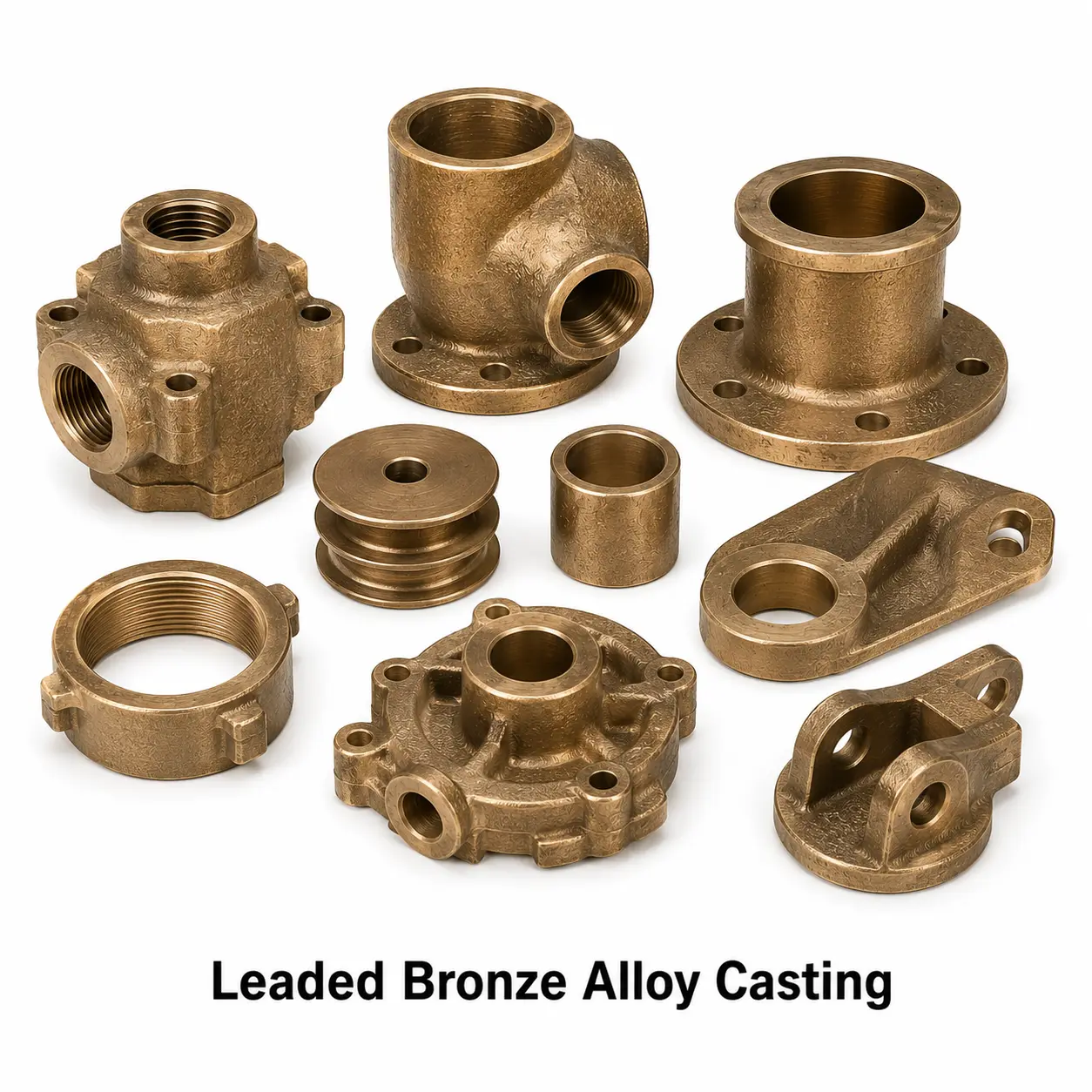
Cable Glands India manufactures leaded bronze alloy castings across the high-leaded tin bronze family, including grades such as C93200 (SAE 660), C84400, and C93700, supplied for bushings, bearings, thrust washers, and general wear-resistant components. Leaded bronze alloys contain a higher lead fraction than standard gunmetal or red brass, giving the cast structure a self-lubricating characteristic that reduces galling and seizure risk under boundary lubrication or intermittent lubrication conditions. Pump OEMs, gearbox manufacturers, heavy equipment builders, and industrial machinery fabricators source leaded bronze alloy castings from Cable Glands India because our foundry controls lead distribution, melt chemistry, and casting process to deliver bearing-grade castings with consistent performance.
Price: US$ 17.90 per kilogram | Custom pricing available for bulk and OEM orders
Product Overview
What Leaded Bronze Alloy Casting Is
Leaded bronze refers to a family of copper-tin casting alloys with lead content ranging from moderate, as in C83600, to high, as in C93200 (SAE 660) which contains around 7 percent lead. The free lead phase distributed through the bronze matrix does not dissolve fully into the copper-tin solid solution, instead forming discrete lead particles that provide embeddability and a degree of dry-running tolerance in bearing applications.
Leaded Bronze Sand Casting
Sand casting is used for larger leaded bronze bushings, bearing housings, and wear plates in low to medium production volumes, with mould design controlled to promote uniform lead distribution rather than segregation during solidification.
Leaded Bronze Investment Casting
Investment casting is offered for smaller, more intricate leaded bronze components such as small bushings and bearing inserts where close as-cast tolerance reduces machining allowance.
Leaded Bronze Green Sand Casting
Green sand casting supports medium volume leaded bronze components where reusable pattern equipment provides competitive per-piece pricing for recurring bushing and bearing production programs.
Leaded Bronze Centrifugal Casting
Centrifugal casting is widely used for leaded bronze bushings and bearing sleeves because the outward centrifugal force during solidification helps counteract lead segregation, producing a more uniform lead distribution through the wall section than static casting methods.
Leaded Bronze Permanent Mold Casting
Permanent mold casting is applied to higher volume leaded bronze bushings and thrust washer blanks where a reusable metal mould improves dimensional repeatability for recurring production runs.
Leaded Bronze Resin Sand Shell Molding / Casting
Resin sand shell moulding is used for leaded bronze components requiring improved surface finish and dimensional accuracy over conventional sand casting, reducing machining stock on bearing and bushing blanks.
Typical Products Cast in Leaded Bronze Alloy
Cable Glands India casts leaded bronze alloy into plain bearings and bushings, thrust washers, wear plates, sleeve bearings for pumps and gearboxes, guide bushings for heavy machinery, bearing cages, and general low-friction wear components machined to customer drawings from the as-cast blank.
Key Features
- High-leaded tin bronze compositions including C93200 (SAE 660), C84400, and C93700
- Sand casting, investment casting, green sand casting, centrifugal casting, permanent mold casting, and resin sand shell casting available
- Self-lubricating bearing performance from distributed free lead phase
- Good embeddability for foreign particles in bearing applications
- Suitable for boundary and intermittent lubrication conditions
- Custom pattern and tooling development in-house
- CNC machining available on the same castings for finished components
- Batch-wise chemical composition and mechanical test certificates
Lead Distribution Control
Because uneven lead distribution can create weak points and inconsistent bearing performance, melt handling and pouring practice are controlled to keep the lead phase finely and evenly dispersed through the casting, particularly for centrifugally cast bushings.
Bearing and Bushing Performance
Leaded bronze castings are specified for plain bearings and bushings where the self-lubricating lead phase reduces the risk of galling and seizure during startup, shutdown, or momentary loss of lubrication.
Machinability of High-Leaded Grades
The higher lead content in grades such as C93200 improves machinability further compared with lower-lead bronze, giving good surface finish and chip control during boring and turning operations used to finish bushing bores and outer diameters.
Load and Wear Considerations
Leaded bronze grades vary in strength and load capacity depending on tin and lead content, and Cable Glands India can recommend the appropriate grade based on load, speed, and lubrication conditions specific to the application.
Casting Process Selection by Component
Cable Glands India selects sand casting, investment casting, green sand casting, centrifugal casting, permanent mold casting, or resin sand shell casting for each leaded bronze order based on component geometry, wall thickness, production volume, and target unit cost.
Technical Specifications
| Parameter | Typical Range / Value |
|---|---|
| Alloy designation | C93200 (SAE 660), C84400, C93700 (reference grades) |
| Tensile strength | 170 to 240 MPa (grade dependent) |
| Elongation | 8 percent to 20 percent |
| Hardness | 55 to 70 HB |
| Density | Approximately 8.9 g/cm3 (grade dependent) |
| Casting methods | Sand, investment, green sand, centrifugal, permanent mold, resin sand shell |
| Typical casting weight range | 0.05 kg to 100 kg (larger on request) |
Raw Material Grades
| Grade | Alloy Type | Notes |
|---|---|---|
| C93200 (SAE 660) | High-leaded tin bronze | Standard bearing bronze, approximately 7 percent lead |
| C84400 | Leaded semi-red brass | Moderate lead, general purpose casting |
| C93700 | High-leaded tin bronze | Higher lead content for heavy bearing duty |
| C83600 | Leaded red brass | Lower lead reference grade |
International Equivalent Standards
| Country / Standard Body | Equivalent Reference |
|---|---|
| USA – ASTM / SAE | ASTM B584 C93200 / SAE 660 |
| UK – BS | BS 1400 LB1 / LB4 (leaded bronze reference) |
| Germany – DIN | DIN 1705 CuPb Sn bearing bronze reference |
| Europe – EN | EN 1982 CC495K (reference) |
| India – IS | IS 318 leaded bronze ingots and castings (reference) |
| Japan – JIS | JIS H5120 CAC603 (reference) |
Product Types and Variants
| Casting Type | Description | Typical Use |
|---|---|---|
| Sand cast blanks | Larger components, low to medium volume | Bearing housings, wear plates |
| Investment cast blanks | Close tolerance, intricate geometry | Small bushings, bearing inserts |
| Green sand cast blanks | Medium volume, reusable pattern | Bushings, thrust washers |
| Centrifugal cast bushings | Directionally solidified, uniform lead distribution | Sleeve bearings, bushings |
| Permanent mold cast blanks | Higher volume, repeatable dimensions | Bushings, thrust washers |
| Resin sand shell cast blanks | Improved surface finish and accuracy | Precision bearing components |
| Finished machined components | Fully machined from cast blank | Ready-to-install bearings and bushings |
Applications in Industry
Pump and Gearbox Bearings
Sleeve bearings and bushings for pumps, gearboxes, and rotating machinery are cast in leaded bronze for reliable low-friction performance under boundary lubrication conditions.
Heavy Machinery Bushings
Guide bushings and wear bushings in construction and heavy industrial machinery use leaded bronze for wear resistance and embeddability against contamination.
Thrust Washers and Wear Plates
Thrust washers and wear plates subject to sliding contact are cast in leaded bronze for consistent low-friction performance over extended service life.
General Industrial Bearing Applications
General plain bearing applications across industrial equipment specify leaded bronze where a self-lubricating bearing material is preferred over rolling element bearings.
Manufacturing Process
Production begins with melt preparation in induction furnaces, where copper, tin, and lead are charged and alloyed to the specified leaded bronze grade, verified by spectrometer analysis before pouring. Depending on component size, tolerance, and volume, castings are produced by sand casting, investment casting, green sand casting, centrifugal casting, permanent mold casting, or resin sand shell casting, with centrifugal casting favoured for bushings where uniform lead distribution is critical. Castings are fettled to remove gates, risers, and flash, then proceed to CNC machining, where bore diameters, outer diameters, and flange features are finished to drawing tolerance. Finished components are cleaned, dimensionally inspected, and packed for dispatch with accompanying material and test certification.
Quality Standards and Certifications
| Standard / Certification | Scope |
|---|---|
| ISO 9001 | Quality management system certification |
| ASTM B584 | Reference specification for copper alloy sand castings |
| SAE 660 | Reference specification for high-leaded tin bronze bearing bronze |
| EN 1982 | Reference specification for copper alloy ingots and castings |
| RoHS | Restriction of hazardous substances compliance on request |
Why Choose Cable Glands India
- In-house melting, casting, and CNC machining for full process control
- Controlled lead distribution for consistent bearing performance
- Sand, investment, green sand, centrifugal, permanent mold, and resin sand shell casting under one roof
- In-house pattern and tooling development for new component designs
- Material and mechanical property certification on request
- Competitive per-kilogram pricing with volume and OEM discounts
Frequently Asked Questions
Q1: What is leaded bronze alloy casting?
Leaded bronze alloy casting refers to copper-tin casting alloys with added lead content, such as C93200 (SAE 660), C84400, and C93700, used for bushings, bearings, and wear components due to the self-lubricating properties of the free lead phase.
Q2: Why is lead added to bronze bearing alloys?
Lead forms discrete particles within the bronze matrix that provide a degree of self-lubrication and embeddability for foreign particles, reducing the risk of galling and seizure in plain bearing applications.
Q3: What casting methods do you offer for leaded bronze?
We offer sand casting, investment casting, green sand casting, centrifugal casting, permanent mold casting, and resin sand shell casting, with centrifugal casting commonly preferred for bushings requiring uniform lead distribution.
Q4: What is SAE 660 bronze?
SAE 660, also designated C93200, is a widely used high-leaded tin bronze bearing bronze containing approximately 7 percent lead, valued for general purpose plain bearing applications.
Q5: Can leaded bronze be used without additional lubrication?
Leaded bronze provides a degree of self-lubrication and dry-running tolerance, but the appropriate operating conditions depend on load and speed, and our team can advise on suitable grades for specific applications.
Q6: What casting weight range can you produce?
Standard capability covers castings from approximately 0.05 kg up to 100 kg, with larger components available on request.
Q7: Can you supply finished machined components, not just raw castings?
Yes, our foundry and CNC machining operations work together to supply fully finished, ready-to-install bushings and bearing components from the same leaded bronze casting.
Q8: What is the price of leaded bronze alloy casting?
Indicative pricing is US$ 17.90 per kilogram, with final pricing depending on component geometry, casting process, machining requirements, and order quantity.
Q9: Do you export leaded bronze alloy castings internationally?
Yes, Cable Glands India exports leaded bronze alloy castings and machined components worldwide, with documentation support for customs and OEM approval processes.
International Equivalent Terms
| Language | Equivalent Terms |
|---|---|
| Spanish | Fundicion de bronce al plomo, Bronce plomado fundido |
| Russian | Lite iz svintsovoy bronzy, Svintsovistaya bronza litaya |
| French | Fonte de bronze au plomb, Bronze plombe coule |
| Portuguese | Fundicao de bronze chumbado, Bronze ao chumbo fundido |
| Italian | Fusione di bronzo al piombo, Bronzo piombato fuso |
Linked Parts and Related Terms
Leaded Bronze Alloy Casting, SAE 660 Bearing Bronze, C93200 Bronze Casting, Bushing Casting, Bearing Bronze Casting, Sand Casting, Investment Casting, Centrifugal Casting, Permanent Mold Casting, C83600 Bronze Casting.
Related Products in this Category
Browse the Leaded Bronze Casting and Machined Casting Parts range for grade-specific casting and machining information:
- C83300 Bronze Casting and Machined Cast Parts
- C83600 Bronze Casting and Machined Cast Parts
- C84400 Bronze Casting and Machined Cast Components
- C83800 Bronze Casting and Machined Cast Components
- C84800 Bronze Casting and Machined Cast Components
- C93200 – SAE 660 Bronze Casting and Machined Cast Fittings
- C93700 (80-10-10 / SAE 64) Bronze Casting
- C93800 Leaded Bronze Casting
- C83600 Bronze Casting
- UNS C95500 Bronze Casting
- DZR Brass Casting, Dezincification Resistant Brass Casting
- High Conductive Copper Casting
- Silicon Brass / Silicon Bronze Casting ASTM C87300, C87500, C87600
- Gunmetal Casting – LG2 Bronze Casting
- Phosphor Bronze Casting
Get a Quote – Leaded Bronze Alloy Casting
Ready to source leaded bronze alloy castings for bushings, bearings, thrust washers, or custom wear components? Our foundry team can recommend the correct grade and casting process for your application.
Price: US$ 17.90 per kilogram | Custom pricing available for bulk and OEM orders
Email: sales@cableglandsindia.com
Phone / WhatsApp: +91-22-43449300
Website: www.cableglandsindia.com
Share your drawing, required quantities, and preferred delivery timeline, and we will respond with a detailed quotation within one business day.