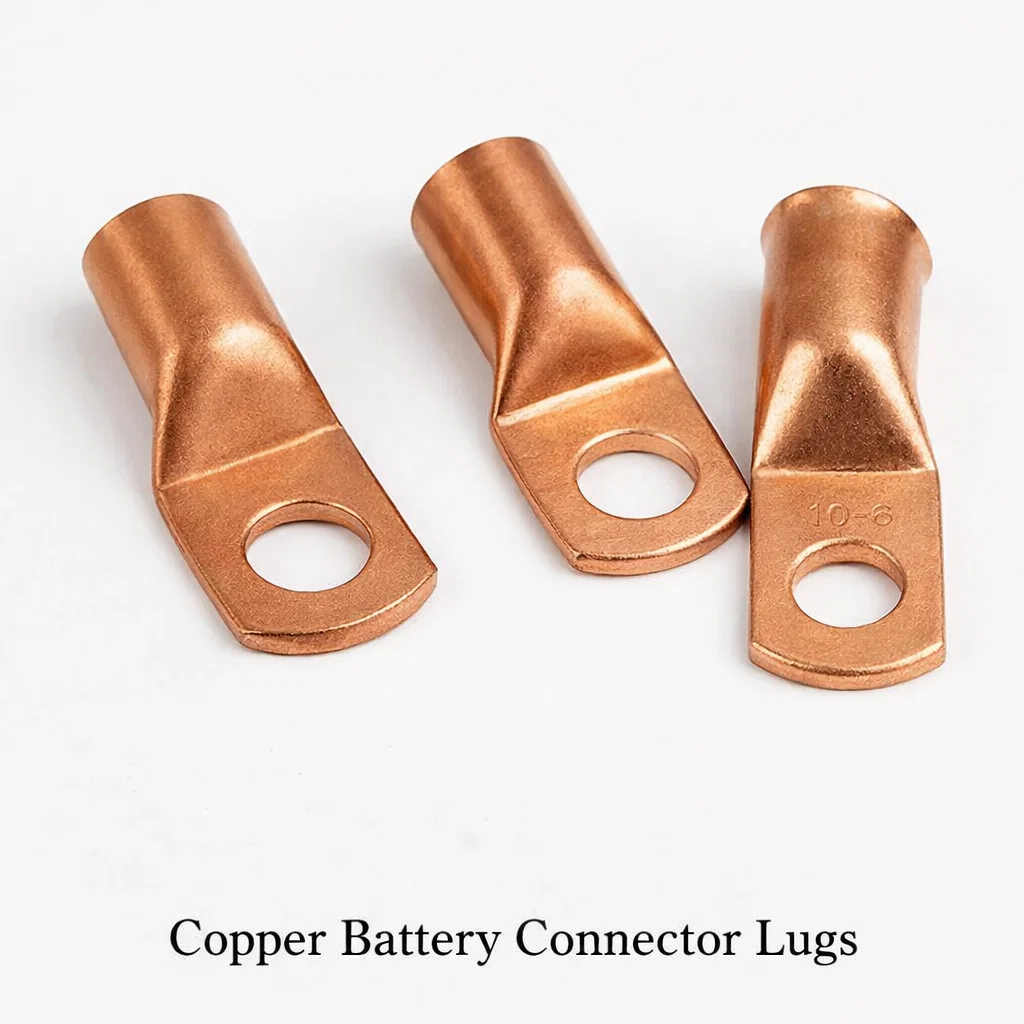
Cable Glands India manufactures a comprehensive range of Copper Battery Connector Lugs — precision-machined crimp and bolt-type lugs for battery terminals, busbar connections, and energy storage systems. Produced from electrolytic tough pitch (ETP) copper at our ISO 9001:2015 certified Jamnagar, India facility, our battery connector lugs are exported to the USA, UK, Germany, Australia, Canada, and the Middle East, serving automotive, marine, industrial UPS, solar energy storage, and electric vehicle (EV) sectors.
What Are Copper Battery Connector Lugs?
Copper battery connector lugs (also known as battery cable lugs, terminal lugs, or battery terminal connectors) are electrical connectors that join battery cables to battery terminals, busbars, starter motors, alternators, inverters, and other high-current equipment. They consist of a barrel (which crimps or bolts onto the cable conductor) and a palm or tongue (which bolts to the battery post, busbar, or equipment terminal stud). Available in straight-barrel, offset, and 90°-angled configurations, with ring, fork, pin, and spade tongue profiles to suit different terminal types.
Types of Copper Battery Connector Lugs We Manufacture
1. Standard Crimp Copper Battery Lugs (Ring Tongue, DIN 46235)
Open-barrel or closed-barrel ring tongue lugs machined and pressed from ETP copper tube. Barrel crimped onto stranded copper cable conductors using hydraulic, pneumatic, or ratchet crimping tools. Ring tongue with single bolt hole for stud mounting on battery posts. Available for cable cross-sections from 16 mm² to 630 mm² (2 AWG to 1200 kcmil equivalent). Tin-plated as standard. Conforms to DIN 46235, BS 4579, and IEC 62291.
2. Bolted (Mechanical) Copper Battery Connector Lugs
Two-bolt or four-bolt mechanical lugs where the conductor is clamped by one or more screws into the barrel rather than being crimped. Allows re-termination and adjustment in the field without crimping tools. Suitable for solid or stranded conductors. Used in industrial battery banks, telecom UPS systems, and data centre battery strings. Available in 35–240 mm² cable range.
3. Long-Barrel Copper Battery Lugs (Heavy-Duty, Forged)
Extended barrel length for large-conductor (240 mm² to 630 mm²) battery cable applications — typical in standby generator sets, large UPS systems, and electric bus battery packs. Long barrel provides two-point crimp support, reducing strain on the conductor at the lug entry. Forged or machined from solid copper billet for maximum current density.
4. 90° Angle (Offset) Copper Battery Lugs
The 90° offset lug has the connector tongue bent at a right angle to the barrel, reducing the cable bend radius required at the terminal and allowing flat cable routing along enclosure walls or battery trays. Available in left and right-hand offset variants. Popular in marine battery installations and EV battery pack engineering where space is constrained.
5. Tinned Copper Battery Lugs (Tin-Plated, Corrosion Resistant)
Electrolytic tin plating (8–15 µm) on the full lug body protects against battery acid vapours, humidity, and salt-air corrosion in marine and automotive battery compartments. Tin plating also prevents oxidation of the copper-to-copper contact interface at the battery post, maintaining low contact resistance over the product life. Standard offering for all marine-grade battery lugs.
6. Dual-Hole Copper Battery Connector Lugs (Two-Bolt Tongue)
Tongue with two bolt holes for double-bolt mounting on busbars or battery terminal blocks — distributes the bolt load, prevents rotation, and provides a lower-resistance contact interface due to larger contact area. Standard in battery room busbars, switchgear battery feeds, and industrial backup power systems.
7. EV Battery Pack Copper Lugs (High-Current, 400V–800V Systems)
Heavy-duty lugs for electric vehicle (EV) and hybrid vehicle battery packs operating at 400V or 800V bus voltage with peak currents of 500–2000 A. Features include: ultra-low-resistance machined contact face, anti-rotation wing or keying feature, over-moulded or heat-shrink insulation collar, and M8 or M10 hex bolt hole for high-torque terminal connection. Available in 95 mm² to 300 mm² for EV main battery cables.
8. Copper Battery Lug with Insulating Boot (Pre-Insulated)
Factory-fitted PVC or heat-shrink insulating boots covering the lug barrel and palm, leaving only the bolt-hole tongue exposed. Colour-coded: red for positive, black for negative. The boot provides 600V insulation equivalent, protects against accidental short-circuits during installation and maintenance, and prevents moisture ingress into the crimp zone. Popular in automotive after-market and marine battery installations.
Related Products and Accessories
- Copper battery terminals (post clamps, side-mount, and top-post)
- Copper split bolt connectors and line taps
- Copper compression cable lugs (for power distribution)
- Busbar connectors and copper busbars
- Battery cables (welding-type flexible copper, PVC or rubber insulated)
- Copper earth/grounding lugs and clamps
- Terminal blocks for battery management systems (BMS)
- Cable ferrules (bootlace ferrules) for stranded conductors
Material Grades & International Equivalents
| Standard | Grade | Country/Region | Purity / Conductivity |
|---|---|---|---|
| ASTM | B187 (ETP Copper) | USA | 99.9% Cu, 100% IACS |
| EN | CW004A (Cu-ETP) | Europe | 99.9% Cu, 100% IACS |
| BS | C101 | UK | ETP Copper, 100% IACS |
| DIN | E-Cu57 (2.0060) | Germany | 57 MS/m minimum |
| JIS | C1100 | Japan | 99.9% Cu |
| IS | 191 Grade 1 | India | 99.9% Cu, 100% IACS |
| Plating | Sn (ASTM B545) | International | 8–15 µm tin, electrolytic |
Technical Specifications
| Parameter | Specification |
|---|---|
| Body Material | ETP Copper (99.9% Cu min), ASTM B187 / EN CW004A |
| Plating | Tin-plated (8–15 µm) or natural copper |
| Cable Cross-Section | 16 mm² to 630 mm² / 2 AWG to 1200 kcmil |
| Bolt Hole Diameter | M6, M8, M10, M12, M16 (or 1/4″, 5/16″, 3/8″, 1/2″) |
| Current Rating | Per conductor ampacity (lug adds <1 µΩ resistance) |
| Voltage Rating | Up to 1000V AC / 1500V DC (standard) |
| Standards | DIN 46235, IEC 62291, UL 486A-486B, BS 4579 |
| Temperature Rating | -50°C to +150°C (without insulation boot) |
Applications
- Automotive starter motor and alternator cable terminations
- Marine battery banks and shore power connections
- Industrial UPS and standby battery systems
- Solar energy storage (lithium-ion and lead-acid battery banks)
- Electric vehicle (EV) and e-bike battery packs
- Forklift truck and golf cart battery connections
- Telecoms battery backup systems (VRLA battery strings)
- Generator set battery and starter cable lugs
- Railway rolling stock battery systems
Why Choose Cable Glands India for Copper Battery Connector Lugs?
- 100% ETP Copper: All lugs machined or pressed from verified electrolytic copper — conductivity tested at incoming inspection. No brass or copper alloy substitution.
- In-House Tin Plating: Electrolytic tin plating in our own plating facility — controlled 8–15 µm thickness, uniform coverage, RoHS compliant.
- DIN 46235 and IEC 62291 Compliance: Standard lug dimensions conform to international crimp lug standards — compatible with all major crimping tools.
- Full Size Range: 16 mm² to 630 mm² covers automotive through heavy industrial battery cable sizes from one supplier.
- Custom Engineering: Non-standard barrel ID, special bolt hole sizes, dual-hole tongues, EV-specific features — all accommodated with drawing approval.
- ISO 9001:2015 Certified: Material certificate, crimp pull-out test results, and plating thickness report provided per batch.
- 30–60% Cost Advantage: Significant cost savings for US, European, and Australian buyers importing from India.
Frequently Asked Questions (FAQ)
Q1. What is the difference between a battery lug and a cable lug?
The terms are often used interchangeably. Technically, “battery lug” refers to a cable lug specifically designed for battery cable connections — typically featuring tin plating for corrosion resistance, thicker copper walls for high-current density, and bolt holes matching standard battery post stud diameters (M8, M10, 3/8″). General “cable lugs” encompass a broader range including power distribution lugs that may have different dimensional standards (e.g., IEC 60228 crimp lugs). Our battery connector lugs are optimised for the battery cable application but can also be used as general-purpose high-current cable terminations.
Q2. Why is ETP copper used for battery lugs rather than brass?
Electrolytic tough pitch (ETP) copper has an electrical conductivity of 100% IACS (International Annealed Copper Standard) — the benchmark for conductor materials. Brass (a copper-zinc alloy) has only 25–40% IACS conductivity depending on alloy. For battery connections carrying hundreds of amperes, even a small increase in lug resistance causes significant voltage drop and heat generation. Copper lugs maintain negligible additional resistance at the termination joint, while brass lugs would introduce measurable voltage drop and potential overheating. For high-current battery applications, copper is the only appropriate material.
Q3. Should battery lugs be tin-plated or bare copper?
Tin-plated battery lugs are preferred in most applications. Tin plating prevents oxidation of the copper surface — copper oxide is a poor electrical conductor and increases contact resistance at the battery post interface. Tin also provides protection against battery acid vapours (sulphuric acid in lead-acid batteries, which attacks bare copper). For indoor, dry, and short-duration applications, bare copper lugs are acceptable. For automotive, marine, and outdoor battery installations, tin-plated lugs should always be specified.
Q4. What crimp tool is required for your copper battery lugs?
Our copper battery lugs are compatible with standard hexagonal crimp dies conforming to DIN 48083 or NEMA-standard crimping tools. For cable cross-sections 16–240 mm², ratchet hand crimping tools (e.g., Klauke, Cembre, or Burndy equivalents) with the appropriate die set are suitable. For 300–630 mm² lugs, hydraulic or electric pump-operated crimping tools are required to achieve the specified crimp indent depth and contact resistance. Always use the die size matching the lug barrel dimensions specified in our product data sheet.
Q5. What bolt hole size is standard for battery terminal connections?
Common battery terminal bolt hole sizes: automotive batteries typically use M8 (8 mm) or M10 (10 mm) stud bolts; marine and industrial battery terminals use M10 or M12; EV battery packs commonly use M8, M10, or M12 depending on the OEM specification; telecom and UPS battery terminals use M6 or M8 for smaller cells and M10 or M12 for larger VRLA batteries. We manufacture lugs in all standard metric bolt hole sizes (M6, M8, M10, M12, M16) and imperial equivalents (5/16″, 3/8″, 1/2″).
Q6. Can copper battery lugs be used on lithium-ion battery packs?
Yes. Copper battery lugs are fully compatible with lithium-ion (Li-ion, LiFePO4, NMC, etc.) battery packs. The lug material requirements are the same as for any battery system — high-conductivity copper, corrosion-resistant surface (tin plating recommended), and appropriately sized for the peak discharge current. For pouch cell or prismatic cell connections, custom-designed copper lugs with specific tongue dimensions and bolt patterns to match the battery cell terminals are often required — we can manufacture these from customer-supplied drawings.
Q7. What is the pull-out strength of crimped copper battery lugs?
A correctly crimped copper battery lug (using the specified die and crimp depth) achieves a pull-out strength exceeding the tensile strength of the cable conductor itself — the cable will break before the crimp releases. For example, a 70 mm² copper cable has a breaking force of approximately 10–12 kN; a correctly crimped lug on 70 mm² should withstand at least 10 kN pull-out force. We test crimp integrity per IEC 61238-1 (compression and mechanical crimp fittings standard). Test reports available on request.
Q8. Do you supply pre-insulated copper battery lugs?
Yes. Pre-insulated battery lugs are available with factory-fitted PVC or heat-shrink sleeves over the barrel and lower palm section, colour-coded red (positive) or black (negative). The insulation sleeve extends 10–15 mm beyond the barrel end to protect the cable-to-lug interface from moisture ingress and mechanical abrasion. Heat-shrink variants with internal sealant provide waterproof sealing when heated — important for marine and outdoor installations.
Q9. Are your copper battery lugs RoHS compliant?
Yes. Our ETP copper battery lugs and tin-plated variants are fully RoHS Directive 2011/65/EU compliant. The tin plating uses a pure tin or tin-bismuth electrolytic bath free from lead, cadmium, hexavalent chromium, and other restricted substances. RoHS compliance declaration and material data sheet (MSDS/SDS) are available on request for inclusion in your EU CE documentation.
Q10. What is the maximum cable size available for your battery connector lugs?
Our standard range extends to 630 mm² (equivalent to approximately 1200 kcmil AWG). For cable sizes above 630 mm², we can manufacture custom lugs to drawing — these are typically used in large standby generator sets, high-power UPS systems, and submarine or offshore power systems. Please enquire with your cable cross-section, strand count, outer diameter, and bolt hole requirement for a custom quotation.
Q11. How do you ensure copper purity in battery lugs?
Copper purity is verified at two stages: (1) incoming raw material inspection using an XRF (X-Ray Fluorescence) spectrometer or OES (Optical Emission Spectrometry) analysis, confirming Cu content ≥99.9% and IACS conductivity meets specification; (2) each batch is linked to the raw material supplier’s EN 10204 3.1 material test certificate recording the chemical analysis. This traceability chain allows us to produce batch-level material certificates for buyers who require documented material compliance.
Q12. What is your lead time for copper battery connector lug orders?
Standard catalogue sizes (16–240 mm², M8/M10 bolt hole, tin-plated) typically have 7–14 working day lead time from purchase order to despatch. Non-standard sizes (oversized barrel, special bolt hole, 90° offset, dual-hole tongue) require 21–35 working days. Sample orders (25–100 pieces) of standard sizes can be dispatched within 5–7 working days. FCL container orders require additional lead time for production scheduling — advise required quantity and delivery date when enquiring.
Q13. Can you supply copper battery lugs for solar energy storage systems?
Yes. Solar battery storage systems (both off-grid and grid-tied) use copper battery lugs at battery bank terminal connections, inverter DC input terminals, and string combiner DC bus connections. For solar applications, we recommend tin-plated lugs for outdoor and shed-mounted battery banks, and dual-hole tongue lugs for busbar connections in larger multi-battery systems. We can supply lugs rated for the 48V, 120V, 240V, or 480V DC voltage levels common in solar storage applications.
Contact Cable Glands India at sales@cableglandsindia.com to request a quote on Copper Battery Connector Lugs. Please specify cable cross-section (mm² or AWG), bolt hole size, quantity, and required plating finish.
📦 Request a Free Quote from Cable Glands India
We are a leading manufacturer and exporter of precision-machined components based in Jamnagar, India — the brass capital of the world. Trusted by buyers across the USA, UK, Europe, Australia, Canada, and the Middle East.
- ✅ ISO 9001:2015 Certified manufacturing facility
- ✅ CNC machined to tight tolerances — drawings welcome
- ✅ MOQ flexible — samples to bulk orders
- ✅ 30–60% cost savings vs. European or US domestic suppliers
- ✅ Fast lead times — dispatched within 7–14 working days
- ✅ Third-party inspection available (SGS, Bureau Veritas)
- ✅ Custom alloys, threading, plating & packaging on request
📧 Get in Touch
Email: sales@cableglandsindia.com
Website: www.cableglandsindia.com
Response time: Within 24 hours (Mon–Sat)
Send us your technical drawings, specifications, or a sample part. Our engineering team will revert with pricing and lead time within one business day.