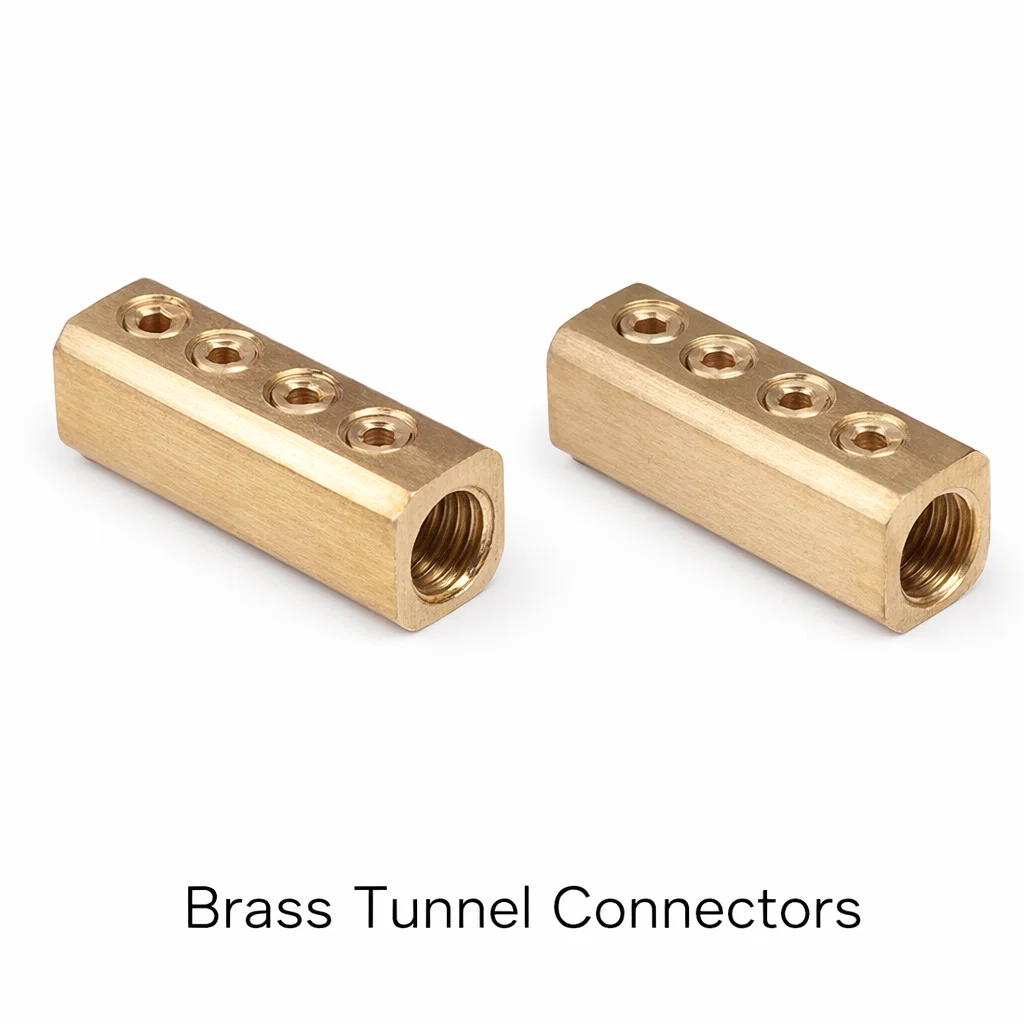
Cable Glands India manufactures precision Brass Tunnel Connectors — also known as through-wall conduit connectors or pass-through fittings — for flexible conduit systems used in electrical enclosures, control panels, cable ducts, and partition walls. Machined from CW614N free-cutting brass at our Jamnagar, India facility, our tunnel connectors are exported to the USA, UK, Germany, Australia, UAE, and Canada, serving electrical panel builders, EPC contractors, and OEM machinery manufacturers worldwide.
What Is a Brass Tunnel Connector?
A brass tunnel connector is a through-wall fitting that allows a flexible conduit to pass through a panel wall, gland plate, or partition and be secured mechanically on both sides. Unlike a standard conduit connector that terminates the conduit at a panel entry, a tunnel connector creates a protected conduit passage through a wall — the conduit enters one side, passes through the fitting body, and exits the other side. This is essential for routing flexible conduit through enclosure walls, cable trays with dividing barriers, or between two separate sections of a switchgear cabinet while maintaining IP protection at the wall penetration point.
Types of Brass Tunnel Connectors We Manufacture
1. Standard Straight Brass Tunnel Connector (Both-Side Grip)
The standard tunnel connector has conduit clamping mechanisms on both sides of the panel wall. A threaded outer body passes through the panel hole and is secured with a locknut; conduit is inserted and locked from both entry sides using integrated or separate clamping rings. Suitable for metallic and non-metallic flexible conduit. Available in M16 to M63.
2. Bulkhead Tunnel Connector with Central Flange
Features a central hexagonal or circular flange that sits flush against the enclosure wall outer surface. The flange provides a larger seating area, distributing the installation torque over a wider panel surface and preventing deformation of thin-gauge panel material. Popular in stainless steel enclosures and GRP (fibreglass) distribution boards.
3. Tunnel Connector with IP65 Seal (Liquid-Tight Through-Wall)
Incorporates elastomeric sealing rings on both entry faces to maintain the IP65 or IP67 rating of the enclosure at the cable pass-through point. The seals compress against both the conduit jacket and the panel wall surface on installation. Essential for outdoor enclosures, washdown environments, and food processing facilities.
4. Nickel-Plated Tunnel Connectors
Nickel-plated variants of all tunnel connector types for use in corrosive, marine, or chemical environments. The electrolytic nickel coating (5–10 µm) provides 500+ hour ASTM B117 salt-spray resistance and a consistent silvery appearance matching nickel-plated cable glands and conduit connectors in the same installation.
5. Metric to NPT Tunnel Connector (International Pass-Through)
Designed for installations where flexible conduit on one side uses metric thread connections and the panel or conduit system on the other side requires NPT thread. Widely used when European-designed machines are installed in US plants, or when conduit runs from metric European control equipment into American-standard junction boxes.
6. EMI Shielded Tunnel Connector (Brass with Nickel Plating)
For EMI-sensitive environments, our shielded tunnel connector ensures 360° electrical contact with the conduit braid or metallic jacket throughout the pass-through — maintaining the Faraday cage integrity of the enclosure. Used in defence electronics, medical imaging rooms, and high-frequency inverter drive enclosures.
7. Tunnel Connector with Strain Relief Clamp
An extended body version with a multi-grip strain relief section that distributes pull-out forces along a longer section of the conduit jacket. For applications where the conduit may be subjected to tension — such as between moving and fixed sections of a machine, or where conduit drops vertically between floors of a building.
8. PG Thread Tunnel Connectors (European Standard)
PG-threaded (Panzergewinde) tunnel connectors in PG7 through PG48 for European electrical panel standards. These are direct replacements for PG-threaded gland plates in distribution boards and control cabinets. Body dimensions conform to DIN 40430 PG thread profiles.
Related Products and Accessories
- Brass conduit connectors (fixed and swivel)
- Brass one-piece conduit adapters
- Brass cable glands (A1, A2, B, BW, CW types)
- Brass locknuts and clamping rings
- Gland plates (brass, aluminium, stainless steel)
- IP sealing inserts and bushing grommets
- Conduit couplings and extension pieces
- Metric to NPT and PG adaptors
Material Grades & International Equivalents
| Standard | Grade | Country/Region | Notes |
|---|---|---|---|
| EN / BS EN | CW614N | Europe / UK | Free-machining brass, primary grade |
| BS | CZ121 | UK (legacy) | Equivalent to CW614N |
| ASTM | C36000 | USA | Free-cutting brass, 61.5% Cu |
| DIN | 2.0401 (Ms58) | Germany | Free-machining brass |
| JIS | C3604 | Japan | Free-cutting brass rod |
| IS | 319 Type II | India | Indian standard |
Technical Specifications
| Parameter | Specification |
|---|---|
| Body Material | CW614N / C36000 Free-Machining Brass |
| Finish | Natural brass or Nickel-plated (5–10 µm) |
| Panel Entry Thread | Metric M16–M63, PG7–PG48, NPT ½”–2″, BSP G½”–G2″ |
| Panel Wall Thickness | 1.0–3.5 mm (standard); up to 6 mm (extended shank versions) |
| Conduit OD Range | 10 mm to 54 mm |
| IP Rating | IP65 with sealing ring; IP67 with dual O-ring seal |
| Temperature Range | -40°C to +120°C |
| Standards | IEC 60423, UL 514B, DIN 40430 |
Applications
- Through-wall conduit routing in switchgear and MCC panels
- Cable pass-through in partition walls of electrical rooms
- Flexible conduit entry into EEx/ATEX enclosures (zone separation)
- Machine tool conduit routing through guarding panels
- Automotive body shop robot conduit management
- Data centre cable management barriers
- Marine bulkhead conduit pass-through (IMO compliant)
- Pharmaceutical and food processing clean room conduit systems
Why Choose Cable Glands India for Brass Tunnel Connectors?
- Complete Conduit System Supply: We manufacture tunnel connectors, straight connectors, swivel connectors, one-piece adapters, and cable glands — one source for your entire conduit fitting programme.
- CNC Precision Machining: All tunnel connector bodies are CNC-turned to ±0.01 mm — critical for the through-wall fit tolerance that determines IP performance.
- Custom Wall Thickness: We produce non-standard shank lengths to suit thicker GRP enclosure walls, stainless steel panels, or architectural partition boards on request.
- ISO 9001:2015: Each batch includes dimensional inspection record, material certificate, and IP test sample report.
- 30–60% Cost Savings: Significant advantage over European-sourced equivalents — our regular customers report 35–55% landed cost reductions including freight and duties.
- Fast Export Despatch: Standard sizes stocked and despatched within 5–7 working days; FCL container orders despatched within 3–4 weeks.
Frequently Asked Questions (FAQ)
Q1. What is the difference between a tunnel connector and a standard conduit connector?
A standard conduit connector terminates the end of a flexible conduit at a panel entry — the conduit ends at the fitting. A tunnel connector is a through-wall fitting: the conduit enters one side, passes through the fitting body (which is mounted in the panel wall), and exits the other side. The tunnel connector secures the conduit on both sides of the wall and maintains IP protection at the wall penetration point.
Q2. What panel wall thicknesses can brass tunnel connectors accommodate?
Our standard tunnel connectors accommodate panel wall thicknesses from 1.0 mm to 3.5 mm — covering the full range of standard steel and aluminium enclosure panel gauges. For GRP fibreglass enclosures (which have thicker walls, typically 4–6 mm) or stainless steel panels with reinforcing ribs, we offer extended-shank tunnel connectors with up to 8 mm wall accommodation. Custom shank lengths are available on request.
Q3. Do brass tunnel connectors maintain enclosure IP rating?
Yes, when correctly installed. Our IP65-rated tunnel connectors include elastomeric sealing rings that compress against the panel wall surface and the conduit jacket simultaneously, sealing the through-wall penetration to the same IP level as the enclosure. Correct installation requires the locknut to be torqued to the specified value and the sealing rings to be in good condition and correctly seated.
Q4. What hole diameter is required in the panel for installation?
The panel hole diameter corresponds to the connector’s panel entry thread size: M20 requires a 20 mm hole, M25 requires a 25 mm hole, and so on for metric threads. NPT ½” requires a 21.3 mm hole, NPT ¾” requires a 26.7 mm hole. PG thread hole diameters follow DIN 40430 specifications. Standard punch sizes for Greenlee, Roper Whitney, and similar panel punches match these dimensions.
Q5. Can tunnel connectors be used in ATEX hazardous area installations?
Brass tunnel connectors can be used for zone separation barriers in ATEX installations where the fitting separates a hazardous zone from a safe area. In such applications, the tunnel connector must be specified with certified sealing — typically requiring an IP rated connector combined with an internal conduit sealing fitting (CSF) that blocks gas transmission through the conduit bore. Consult your hazardous area electrical engineer for specific zone 1 or zone 2 barrier requirements.
Q6. Are nickel-plated tunnel connectors available?
Yes. All standard tunnel connector sizes are available with electrolytic nickel plating (5–10 µm). Nickel-plated versions are recommended for marine, coastal, chemical, and food processing environments where natural brass may dezincify or tarnish. Nickel-plated tunnel connectors match the appearance of nickel-plated cable glands and conduit connectors for a consistent finish across the installation.
Q7. What is the difference between a tunnel connector and a cable gland?
A cable gland terminates an electrical cable (with or without armour) at an enclosure, providing mechanical grip on the cable outer sheath, armour clamping, and IP sealing around the cable. A tunnel connector is for flexible conduit — it doesn’t contact the cable directly but rather secures the conduit pipe itself as it passes through the wall. Inside the conduit, cables run freely without being gripped. Tunnel connectors are part of the conduit system; cable glands are part of the cable termination system.
Q8. Can I route multiple conduits through a single gland plate using tunnel connectors?
Yes. Gland plates with multiple punched holes are used in exactly this way — a tunnel connector is installed in each hole, and separate flexible conduits pass through each connector. This provides individual conduit support and IP sealing for each conduit run rather than a single multi-cable entry seal. We supply brass gland plates alongside our tunnel connector range for a complete solution.
Q9. What is the pull-out resistance of a brass tunnel connector?
Standard tunnel connectors for 20 mm OD conduit achieve a minimum pull-out resistance of 100 N axial force when installed per specification. Our heavy-duty extended-grip variants achieve 150–200 N. These values are measured with the conduit jacket in good condition and the clamping ring torqued correctly. Pull-out resistance increases proportionally with conduit OD as the grip contact area increases.
Q10. Do you supply tunnel connectors with fire-rated sealing?
Standard brass tunnel connectors do not incorporate intumescent fire sealing. For fire-rated wall penetrations (ASNZS 1530, UL 1479, EN 13501), a separate intumescent sealant or fire collar must be applied around the conduit at the wall penetration after the tunnel connector is installed. We can advise on compatible intumescent products and installation methods for your specific fire rating requirement.
Q11. What certifications do your brass tunnel connectors carry?
Our brass tunnel connectors are manufactured to IEC 60423, UL 514B (dimensional compliance), and DIN 40430 thread standards. We provide EN 10204 3.1 material certificates, dimensional inspection reports, and IP test records. CE marking under the Machinery Directive or LVD is the responsibility of the equipment manufacturer who incorporates our components. Third-party product certification (CB scheme, UL listing) can be pursued for specific projects — contact us to discuss requirements.
Q12. Can tunnel connectors be used in food-grade or pharmaceutical applications?
Natural brass contains trace lead (Pb 1.6–2.5% in CW614N) which may be a concern in food contact applications under FDA 21 CFR or EU Regulation 10/2011. However, brass tunnel connectors in food processing facilities are typically used in conduit systems that never contact food product — they are installed in panels, junction boxes, and machine guarding, not in food zones. For surfaces that may contact food or cleaning solutions directly, we offer stainless steel alternatives. Nickel-plated versions in non-food-contact areas are also acceptable in most EHEDG and 3-A sanitary standard interpretations.
Q13. What is the best way to install a brass tunnel connector in a GRP enclosure?
For GRP (fibreglass) enclosures: (1) drill the correct panel hole size using a carbide-tipped hole saw; (2) deburr and clean the hole edges; (3) insert the tunnel connector body through the hole; (4) fit the sealing washer and locknut from the inside face; (5) hand-tighten then torque the locknut to the specified value (typically 5–8 Nm for M20 size); (6) insert the conduit through both entry sides and lock the clamping rings. Do not over-torque on GRP as the material can crack around the hole — use a torque-controlled spanner and our extended-flange variants which distribute the clamping load.
Contact Cable Glands India at sales@cableglandsindia.com with your panel wall thickness, conduit OD, thread requirement, and quantity to receive a competitive quote on Brass Tunnel Connectors for flexible conduit systems.
📦 Request a Free Quote from Cable Glands India
We are a leading manufacturer and exporter of precision-machined components based in Jamnagar, India — the brass capital of the world. Trusted by buyers across the USA, UK, Europe, Australia, Canada, and the Middle East.
- ✅ ISO 9001:2015 Certified manufacturing facility
- ✅ CNC machined to tight tolerances — drawings welcome
- ✅ MOQ flexible — samples to bulk orders
- ✅ 30–60% cost savings vs. European or US domestic suppliers
- ✅ Fast lead times — dispatched within 7–14 working days
- ✅ Third-party inspection available (SGS, Bureau Veritas)
- ✅ Custom alloys, threading, plating & packaging on request
📧 Get in Touch
Email: sales@cableglandsindia.com
Website: www.cableglandsindia.com
Response time: Within 24 hours (Mon–Sat)
Send us your technical drawings, specifications, or a sample part. Our engineering team will revert with pricing and lead time within one business day.