Brass Lock Nuts – Manufacturer & Exporter from India
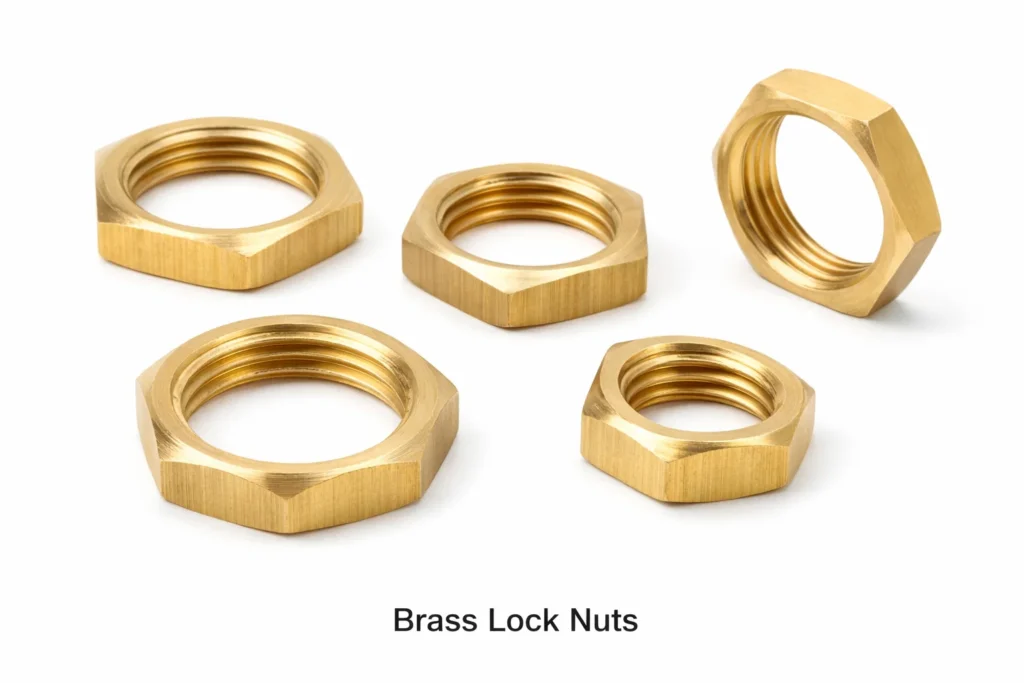
We are one of the leading manufacturers, suppliers and exporters of Brass Lock Nuts from India. We have been supplying Brass Lock Nuts and Brass prevailing torque fasteners to the world market for 3 decades. Brass Lock Nuts — sometimes called Brass nylon insert lock nuts, Brass prevailing torque nuts, Brass stover nuts, or Brass locking hex nuts — are designed to resist loosening caused by vibration, shock, or dynamic loading. Unlike standard Brass hex nuts that rely solely on clamping force, lock nuts incorporate a secondary locking mechanism to maintain joint integrity under operational stress. Our Brass Lock Nuts are manufactured from premium free-cutting Brass alloys and are available in metric DIN 985, DIN 982, ISO 7042, ANSI/ASME B18.16, and JIS B 1196 standards. With our ISO 9001:2015, ISO 14001:2015, and ISO 45001:2018 certifications and three decades of global exporting experience, we are a trusted source for OEMs, panel builders, and MRO distributors worldwide.
Overview
Vibration-induced loosening is one of the most common causes of fastener failure in machinery, automotive assemblies, electrical enclosures, and structural connections. Brass Lock Nuts address this problem through one of several locking mechanisms: a non-metallic (nylon) insert that deforms elastically over the bolt thread and creates a prevailing torque, a distorted (out-of-round) top section that grips the thread mechanically, or a serrated bearing face that bites into the mating surface to prevent rotation. Each type is suited to different application requirements in terms of temperature range, reusability, and locking torque magnitude.
In electrical and electronic applications, Brass Lock Nuts are extensively used to secure cable glands, conduit fittings, and panel cutout bushings. The non-magnetic and non-sparking properties of Brass make these lock nuts mandatory in intrinsically safe and ATEX-rated environments. In plumbing and HVAC systems, Brass lock nuts secure pipe unions, valves, and meter fittings against vibration from flowing fluids and pump pulsations. In automotive and marine assemblies, they prevent critical fastener loosening under engine vibration and wave-induced dynamic loads.
We manufacture Brass Lock Nuts in four principal types: Nylon Insert Lock Nuts (DIN 985 / DIN 982) — with a polyamide ring insert that resists temperatures up to 120°C and provides reliable re-usable locking for up to five cycles; All-Metal Prevailing Torque Nuts (DIN 980 / ISO 7042) — with a distorted top section for higher-temperature applications; Stover/Elliptical Lock Nuts — lightweight all-metal type with elliptical deformation; and Panel Lock Nuts / Conduit Lock Nuts — thin-body nuts with serrated or smooth bearing faces for securing conduit and cable gland fittings in panel cutouts.
| Standard / Region | Grade / Designation | Composition | Remarks |
|---|---|---|---|
| India IS 319 | Free-Cutting Brass Gr. 1 | Cu 57–59%, Pb 2.5–3.5%, Zn Bal. | Most common, excellent machinability |
| Europe EN | CW614N (CuZn39Pb3) | Cu 59%, Pb 3%, Zn Bal. | EN 12164 – standard European CNC grade |
| Europe (Low Lead) | CW608N (CuZn36Pb2As) | Cu 63%, Pb 1.5–2%, As trace, Zn Bal. | Dezincification-resistant for water fittings |
| USA ASTM | C36000 | Cu 60–63%, Pb 2.5–3.7%, Zn Bal. | ASTM B16 – standard USA free-cutting Brass |
| UK BS | CZ121 / CZ122 | Cu 57–59%, Pb 2.5–3.5%, Zn Bal. | BS 2874 – British equivalent |
| Germany DIN | Ms 58 / CuZn39Pb3 | Cu 57–60%, Pb 2.5–3.5%, Zn Bal. | DIN 17660 – widely used in Europe |
| Japan JIS | C3604 | Cu 59–63%, Pb 1.8–3.7%, Zn Bal. | JIS H 3250 – Japanese OEM preferred |
| China GB | HPb59-1 | Cu 57–61%, Pb 0.8–1.9%, Zn Bal. | GB/T 4423 |
Manufacturing Process
Brass Lock Nuts begin as either cold-forged blanks (for smaller sizes M3–M16) or CNC-machined from hexagonal Brass bar (for M16–M48). After the basic nut body is formed and tapped to the specified thread profile and tolerance class, the locking feature is applied: for nylon insert types, a polyamide PA66 ring is compression-fitted into a pre-machined recess in the nut top; for all-metal prevailing torque types, the top cylindrical section is mechanically deformed (swaged) off-round using a controlled hydraulic press operation; for panel lock nuts, a knurled or serrated bearing face is machined or rolled onto the base. The nylon insert is sourced from high-quality PA66 stock (rated to 120°C continuous, 130°C peak) or PA46 for higher-temperature variants (rated to 150°C). After assembly, all lock nuts are inspected for prevailing torque per DIN 985 / ISO 2320 using calibrated torque testing equipment.
Machinery used includes CNC multi-spindle automatic lathes, nut formers, tap holders with CNC thread cycle, vibratory deburring systems, hydraulic swaging presses for all-metal types, insert-press machines for nylon insert types, and torque verification stations.
| Thread (d) | Pitch (mm) | Width Across Flats s (mm) | Nut Height m (mm) | Min. Prevailing Torque (Nm) | Max. Prevailing Torque (Nm) |
|---|---|---|---|---|---|
| M4 | 0.7 | 7.0 | 5.0 | 0.15 | 0.55 |
| M5 | 0.8 | 8.0 | 5.0 | 0.30 | 0.90 |
| M6 | 1.0 | 10.0 | 6.0 | 0.55 | 1.60 |
| M8 | 1.25 | 13.0 | 8.0 | 1.20 | 3.40 |
| M10 | 1.5 | 17.0 | 10.0 | 2.40 | 6.80 |
| M12 | 1.75 | 19.0 | 12.0 | 4.20 | 11.80 |
| M16 | 2.0 | 24.0 | 16.0 | 9.00 | 25.00 |
| M20 | 2.5 | 30.0 | 20.0 | 17.00 | 47.00 |
| M24 | 3.0 | 36.0 | 22.0 | 28.00 | 78.00 |
International Standards
Our Brass Lock Nuts are manufactured per DIN 985 (Nylon Insert Hex Lock Nuts, metric coarse and fine), DIN 982 (Nylon Insert Hex Lock Nuts, high type), DIN 980 (All-Metal Prevailing Torque Hex Nuts), ISO 7042 (All-Metal Prevailing Torque Hex Nuts), ISO 7044 (All-Metal Prevailing Torque Hex Nuts, fine pitch), ANSI/ASME B18.16 (Prevailing Torque Hex Nuts, inch series), BS 4929 (Prevailing Torque Hex Nuts), and JIS B 1196 (Insert Hex Lock Nuts). Temperature ratings for nylon insert types are certified per ISO 2320.
Plating and Finish
Brass Lock Nuts are supplied in natural Brass finish as standard. Nickel plating (electrolytic or electroless), tin plating, and passivated finishes are available. Nylon insert colour coding (natural white PA66, blue PA66, or black PA46 for high-temperature) is also offered for easy visual identification in assembly environments. For marine and outdoor applications, we recommend nickel-plated Brass lock nuts, which provide salt spray resistance exceeding 500 hours per ASTM B117.
Tolerances and Performance
Thread tolerance class 6H (metric) or 2B (unified) as standard. Prevailing torque is verified per ISO 2320 / DIN 985 on every production batch using calibrated digital torque meters. Minimum prevailing torque is guaranteed as specified in the standard. Nylon insert lock nuts are rated for up to 5 reuse cycles with consistent locking performance. Maximum operating temperature for PA66 insert: 120°C continuous. All-metal prevailing torque types operate up to 300°C.
Industries Served
Brass Lock Nuts are used extensively in electrical panel board and enclosure assembly, cable gland and conduit fittings, ATEX and explosion-proof equipment, plumbing and pipe unions, HVAC vibration-sensitive connections, marine and offshore hardware, automotive and two-wheeler assemblies, railway equipment, industrial machinery, medical devices, instrumentation, and solar energy mounting structures.
Turnaround Time
Standard DIN 985 metric sizes M4–M24 are available from stock with dispatch within 2–3 working days for repeat orders. For custom sizes, all-metal types, or large volume requirements, our lead time is 4–6 weeks from order confirmation. We offer expedited production for urgent requirements on mutual agreement.
Why Choose Us Over Other Manufacturers
Our three decades of exporting Brass fasteners to demanding markets in the UK, Germany, USA, Australia, and the Middle East have shaped a manufacturing culture focused on zero-defect delivery. We test every batch of Brass Lock Nuts for prevailing torque compliance — not just dimensionally. Our customisation capabilities include non-standard thread pitches, special nylon insert materials (PTFE-coated, high-temperature PA46, or glass-filled PA66), and custom plating stacks. We can produce private-label packaging with your company branding at minimal additional cost, making us an ideal manufacturing partner for global distributors. Our ISO 9001:2015, ISO 14001:2015, and ISO 45001:2018 certified quality system ensures traceability and consistency from raw material to finished product. We maintain open communication channels and provide proactive production updates, sample inspection reports, and material test certificates without needing to be asked.
Packaging and Shipping
Brass Lock Nuts are packed in inner polythene bags and outer corrugated cartons (max 25 kg per carton). Custom retail packaging, blister packs, and customer-branded labels are available. We export via sea freight (FCL/LCL) and air freight to all major global destinations. Shipping documentation including invoice, packing list, Certificate of Origin, and material test certificate is provided as standard.
Customer Testimonials
“We use Brass lock nuts from Cable Glands India in our cable gland assemblies. The prevailing torque values have been consistently within specification across multiple orders, and the delivery has always been on time. Their team is proactive — they flag any potential delay well in advance, which helps our production planning greatly.”
— Thomas Gruber, Production Manager, Germany
“Finding a supplier who can do nylon insert Brass lock nuts in custom sizes with private label packaging was not easy — until we found Cable Glands India. Three years on, they remain our preferred manufacturing partner for Brass fasteners.”
— David Walsh, Technical Director, Canada
Frequently Asked Questions (Q&A)
Q1: What is the difference between DIN 985 and DIN 982 Brass Lock Nuts?
DIN 985 specifies a low-profile (thin-type) nylon insert lock nut with a total height approximately 0.8 times the thread diameter. DIN 982 specifies a high-type nut with full height equal to approximately 1.0 times the thread diameter, offering greater thread engagement and higher clamping capability. For most applications DIN 985 is standard; DIN 982 is used where maximum joint strength is required.
Q2: Can Brass nylon insert lock nuts be reused?
Yes, up to five cycles as per ISO 2320. After five reuses the nylon insert may lose sufficient locking force and the nut should be replaced. For critical applications we recommend replacing lock nuts after three cycles for an added safety margin.
Q3: What is prevailing torque?
Prevailing torque is the rotational resistance created by the locking mechanism itself, measured before any axial (clamping) load is applied. It indicates how well the nut will resist loosening under vibration. Standards specify minimum and maximum prevailing torque values to ensure consistent locking performance.
Q4: What temperature can Brass nylon insert lock nuts withstand?
Standard PA66 nylon inserts are rated to 120°C continuous service. For higher temperatures up to 150°C, we supply PA46 insert variants. For temperatures above 150°C, all-metal prevailing torque lock nuts (DIN 980 / ISO 7042) are recommended.
Q5: Are Brass lock nuts suitable for use in ATEX zones?
Yes. Brass is non-sparking and non-magnetic, making Brass lock nuts suitable for use in ATEX Zone 1 and Zone 2 classified areas. They are commonly used in ATEX cable gland assemblies and explosion-proof junction boxes.
Q6: Do you supply panel lock nuts (conduit lock nuts)?
Yes, we manufacture Brass panel lock nuts — thin-body nuts with smooth or serrated bearing faces — used to secure cable glands and conduit fittings in panel cutouts. These are available in metric and BSP thread profiles to suit most cable gland sizes.
Q7: What is the difference between a lock nut and a jam nut?
A jam nut is a thin standard hex nut (DIN 439) used in a double-nut arrangement to lock a standard nut in place through friction. A lock nut has a built-in locking mechanism (nylon insert or metal deformation). Lock nuts generally provide more reliable and consistent locking torque than jam nuts.
Q8: Can you supply UNC/UNF thread Brass lock nuts?
Yes, we manufacture Brass nylon insert and all-metal lock nuts in UNC (1/4″ to 1-1/2″) and UNF thread profiles to ANSI/ASME B18.16.
Q9: Do you offer custom height Brass lock nuts?
Yes. We can manufacture Brass lock nuts with non-standard heights (taller or shorter than DIN 985/982 standards) to suit specific application requirements. Please share your drawing for quotation.
Q10: What is your maximum production capacity for Brass lock nuts?
We can produce up to 2 million Brass lock nuts per month across all standard sizes. For larger volumes, please discuss your requirements with our sales team for a dedicated capacity allocation.
Q11: What certifications do you hold?
We are ISO 9001:2015 (Quality Management), ISO 14001:2015 (Environmental Management), and ISO 45001:2018 (Occupational Health and Safety) certified. Material test certificates per EN 10204 Type 3.1 are available on request.
Q12: What is the lead content in your Brass lock nuts?
Standard grades contain 2.5–3.5% lead (IS 319 / CW614N / C36000). Low-lead grades (<0.25% Pb) in CW724R or C69300 are available for RoHS/REACH compliance and potable water applications.
Q13: Can you supply Brass lock nuts with Stainless Steel nylon insert?
Brass lock nuts always use a non-metallic (nylon/polyamide) insert. For all-metal locking, we supply DIN 980 / ISO 7042 all-metal prevailing torque Brass nuts. There is no “stainless steel insert” variant for this product.
Q14: Do you provide DFARS/ITAR compliant Brass fasteners?
We do not manufacture defence-specific ITAR-controlled items. However, for DFARS material compliance (melted and manufactured in approved countries for US defence procurement), please contact our sales team with your specific requirement for evaluation.
Q15: What is the best way to request a quotation?
Send us your technical specification (thread size, pitch, standard, finish, quantity, and any special requirements) by email to sales@cableglandsindia.com. We will revert with a quotation, material data sheet, and available delivery schedule within one business day.
Glossary of Terms
Prevailing torque – The torque required to run a lock nut down a mating bolt thread before axial load is applied, generated by the locking mechanism rather than friction from clamping. Nylon insert (PA66) – A polyamide 66 ring fitted into the top of a lock nut; it deforms elastically over the bolt thread to create locking resistance. All-metal lock nut – A lock nut that achieves its locking action entirely through metallic deformation (distorted top section) without any non-metallic insert; suitable for high temperatures. DIN 985 – German/European standard for hexagon thin lock nuts with non-metallic insert. ISO 2320 – International standard for mechanical performance requirements for prevailing torque steel fasteners; used as a reference for testing Brass lock nuts. Swaging – A cold-forming process used to permanently deform the top of an all-metal lock nut off-round, creating a prevailing torque feature. ATEX – ATmosphères EXplosibles; European classification system for equipment used in explosive atmospheres; Brass fasteners are widely specified in ATEX-rated assemblies.
Related Parts
Brass hex nuts, Brass DIN 934 nuts, Brass jam nuts, Brass thin nuts, Brass flange nuts, Brass wing nuts, Brass coupling nuts, Brass panel nuts, Brass conduit lock nuts, Brass cable gland lock nuts, Brass plain washers, Brass spring washers, Brass star washers, Brass hex bolts, Brass threaded studs, Brass nylon insert nuts, Brass all-metal prevailing torque nuts
Request a Quote Today
For Brass Lock Nuts in standard or custom specifications, contact our technical sales team. We are happy to discuss your application, recommend the correct locking mechanism for your operating conditions, and provide a competitive quotation with fast turnaround. Email: sales@cableglandsindia.com | Phone: +91-22-43449300. ISO 9001:2015 | ISO 14001:2015 | ISO 45001:2018 certified manufacturer and exporter from India.